
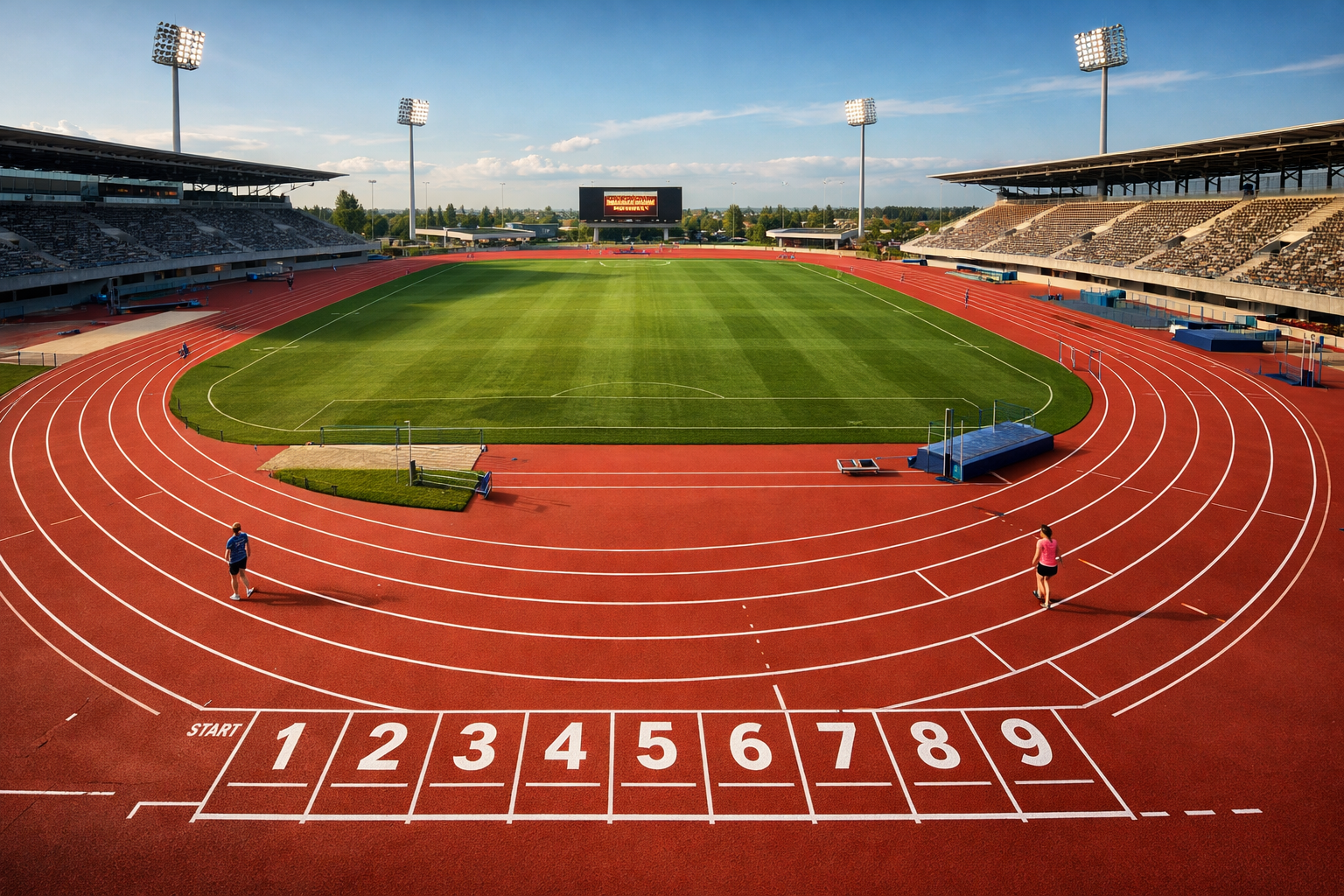
What Is a 400 Meter Running Track?
A 400 meter running track is an outdoor athletics track designed so that one complete lap measures 400 meters along the prescribed measurement line of the inside lane. Standard outdoor facilities generally include two straight sections connected by curved ends, with multiple running lanes arranged around a central field area.
The overall dimensions of an athletics facility depend on its track geometry, number of lanes, lane widths, safety clearances, field-event facilities, spectator provisions, access routes, and site limitations. Accurate surveying and technical planning are therefore important before construction begins.
A complete 400 meter athletics facility may include the running surface, track edging, drainage infrastructure, engineered foundation, synthetic surfacing, lane markings, field-event areas, and associated sports infrastructure.
Facilities intended for formal competition should be designed and evaluated against the current requirements of the relevant athletics governing body. Training and recreational tracks may follow different project specifications depending on their purpose.
Importance of Professional 400 Meter Running Track Construction
The quality of an athletics track depends on more than its visible synthetic surface. Soil stability, formation levels, foundation construction, drainage performance, surface thickness, installation conditions, and marking accuracy all influence the finished facility.
Professional 400 meter running track builders begin by evaluating the site and determining the most suitable construction approach. Soil conditions, existing levels, rainfall patterns, available space, surrounding infrastructure, and expected usage are considered when preparing the project plan.
A carefully managed construction process helps reduce the risk of uneven surfaces, drainage problems, premature material deterioration, and costly corrective work.
- Detailed site inspection and feasibility assessment
- Accurate track layout and dimensional planning
- Suitable ground preparation and compaction
- Engineered drainage and water management
- Stable foundation and base construction
- Selection of an appropriate synthetic surface system
- Professional installation and curing procedures
- Accurate lane marking and final inspection
Benefits of a Professionally Built 400 Meter Running Track
A properly planned synthetic athletics track provides a consistent environment for training, fitness activities, and athletic development. The right combination of foundation engineering and surface technology can support regular use while maintaining the intended characteristics of the running surface.
Consistent Running Surface
Accurate base preparation and professional surfacing help create a uniform running area across the designated lanes.
Suitable Traction and Resilience
Synthetic track systems can be selected to provide appropriate grip, resilience, and running comfort for the intended level of athletic activity.
Weather-Resistant Performance
Outdoor athletics surfaces are selected according to climatic conditions and expected environmental exposure. Proper drainage and installation are essential for managing rainfall and reducing water accumulation.
Durability for Regular Training
Suitable materials, correct installation, and routine maintenance can help an athletics track withstand frequent use and preserve its intended performance characteristics.
Professional Appearance
Clean finishing, clearly defined lane markings, and a well-planned layout create a professional appearance for educational institutions, sports academies, and stadium facilities.
Multiple Usage Opportunities
A 400 meter running track can support athletics coaching, school competitions, university sports programs, fitness training, and community sporting events.
Types of 400 Meter Running Track Surface Systems
Selecting the right synthetic running track surface is an important part of project planning. The decision should consider the intended level of competition, available budget, climatic conditions, expected traffic, maintenance requirements, and technical specifications.
1. Polyurethane (PU) Running Track
Polyurethane running track systems are widely used in modern synthetic athletics facilities. Depending on the selected system, PU surfacing can provide a resilient, durable, and professionally finished running surface.
PU track systems are available in different constructions, including spray-coated, sandwich, and full polyurethane systems. The appropriate specification should be selected according to the intended performance and project requirements.
2. EPDM Running Track Surface
Ethylene propylene diene monomer, commonly known as EPDM, is a synthetic rubber material used in many sports surfacing applications. EPDM granules may form part of the wearing layer in a running track system, depending on the specified binder and installation method.
EPDM is available in different colours and grades. Its performance depends on the complete surface formulation, layer design, material quality, and installation process rather than on the granules alone.
3. Sandwich System Running Track
A sandwich running track combines multiple layers to create a synthetic athletics surface. Depending on the selected design, the system may include a resilient base layer, polyurethane binder, rubber granules, and a durable top layer.
This construction can be considered for facilities that require a balance of surface performance, durability, and project cost. The final specification should be based on the required technical characteristics.
4. Spray-Coated Running Track
Spray-coated running track systems generally use a suitable polyurethane binder and rubber granules to create a textured synthetic surface. The system can be suitable for training facilities and projects where the selected specification meets the intended usage requirements.
Proper base preparation, application thickness, material selection, and installation conditions are important for achieving a consistent finish.
5. Full PU Running Track
Full polyurethane running tracks use a polyurethane-based construction designed for demanding athletics applications. Depending on the specific system, they may offer carefully controlled surface characteristics and a premium finish.
Before choosing a full PU system, project owners should review the technical specification, installation requirements, testing provisions, maintenance plan, and overall lifecycle cost.
How to Select the Right Running Track Surface
- Determine whether the facility is intended for training or competition.
- Evaluate the existing site and foundation requirements.
- Consider local rainfall, temperature, and environmental exposure.
- Compare the specifications of available synthetic track systems.
- Review maintenance requirements and expected usage intensity.
- Confirm compliance requirements for the intended competition level.
400 Meter Running Track Construction Process
Professional 400 meter running track installation requires coordinated civil engineering and sports surfacing work. The precise sequence and construction details depend on the site conditions, foundation design, drainage requirements, and selected synthetic surface.
Step 1: Site Survey and Feasibility Study
The process begins with an inspection of the proposed location. Available land, existing ground levels, soil conditions, access, drainage patterns, surrounding structures, and project objectives are evaluated before finalizing the construction plan.
Step 2: Track Layout and Design
Track geometry is developed according to the intended number of lanes, available space, safety clearances, field-event requirements, and applicable athletics specifications. The design should establish accurate dimensions and identify the required infrastructure.
Step 3: Excavation and Ground Preparation
Excavation and formation preparation are carried out according to the approved design. Unsuitable material may be removed, and soil improvement or stabilization may be required depending on ground conditions.
Step 4: Drainage System Installation
Drainage is designed to manage surface water and protect the underlying foundation. Depending on the project, the system may include drainage channels, underground pipes, collection points, and suitable discharge arrangements.
Step 5: Sub-Base and Foundation Construction
Suitable foundation and sub-base materials are placed and compacted in accordance with the engineering specification. Correct material grading, compaction, levels, and construction quality are important for supporting the finished running track.
Step 6: Base Preparation and Level Checks
The completed base is inspected for surface regularity, levels, gradients, stability, and readiness for synthetic surfacing. Any defects identified at this stage should be corrected before the next construction phase.
Step 7: Synthetic Track Surface Installation
The selected PU, EPDM-based, sandwich, spray-coated, full PU, or other specified system is installed according to the approved technical details and manufacturer's instructions. Material handling, weather conditions, application thickness, and curing requirements are managed during installation.
Step 8: Lane Marking and Athletics Markings
Once the surface has reached the required condition, lane lines and other specified markings are applied. Measurements and marking positions should be checked against the approved layout and the requirements of the intended use.
Step 9: Final Inspection and Handover
The completed facility is inspected for surface quality, drainage, line marking, finishing, and compliance with the project specification. Any required testing or certification should be completed before the track is approved for its intended use.
Applications of 400 Meter Running Tracks
A 400 meter athletics track can support a broad range of sports and fitness activities. The design and surface system can be adapted to suit educational institutions, public sports facilities, training centres, and competitive athletics venues.
- School athletics tracks and sports grounds
- College and university athletic facilities
- Professional athletics stadiums
- Sports academies and coaching centres
- Government sports complexes
- Private athlete training facilities
- Community sports and fitness centres
- Corporate sports campuses
- Multipurpose sports infrastructure projects
- Regional and national athletics venues
Each facility should be planned according to its available land, intended number of users, required sports activities, accessibility, and applicable technical standards.
Complete 400 Meter Athletics Track Infrastructure
A complete athletics project may include more than the running track itself. Additional facilities can be integrated into the overall development to support different track and field events, athlete movement, safety, and facility operations.
- Synthetic 400 meter running track
- Six-lane or eight-lane track configurations, where appropriate
- Long jump and triple jump facilities
- High jump areas
- Pole vault facilities, where required
- Shot put and other throwing-event areas
- Steeplechase facilities, where applicable
- Safety zones and athlete access routes
- Track edging and kerbing
- Surface and underground drainage infrastructure
- Lane marking and event markings
- Associated spectator and support facilities, where included
The final scope should be documented before construction so that the layout, infrastructure, budget, and construction schedule reflect the actual requirements of the facility.
All-Weather Running Track Construction and Drainage
Outdoor athletics tracks are exposed to rainfall, sunlight, humidity, heat, dust, and seasonal temperature changes. These conditions can affect the running surface and foundation over time, making proper drainage and suitable material selection essential parts of track construction.
An all-weather running track should incorporate an appropriate foundation, engineered gradients, suitable drainage, and a synthetic surface selected for the local climate and intended usage. The construction design should also consider how water will be collected and discharged from the facility.
Effective water management helps reduce standing water and protects the underlying layers from avoidable deterioration. However, weather resistance and drainage performance depend on the complete track design, material system, installation quality, and maintenance.
Before construction, the project team should evaluate local rainfall, soil permeability, site levels, drainage outfall arrangements, and the manufacturer's installation requirements.
Running Track Safety and Performance Requirements
Safety and surface consistency are important considerations in every athletics track project. A suitable track system should be selected to match the intended athletic activities and the performance requirements established for the facility.
Professional construction focuses on accurate track geometry, stable foundations, appropriate traction, consistent surface characteristics, proper drainage, and correctly positioned lane markings. These measures help provide a suitable environment for training and athletic activities.
- Stable and uniform running surface
- Suitable traction and surface resilience
- Accurate track dimensions and lane widths
- Proper gradients and drainage arrangements
- Correct surface application and curing
- Clearly defined lane and event markings
- Safe access and transition areas
- Routine inspection and preventive maintenance
Where a track is intended for recognized competition, the completed facility should be assessed against the relevant technical and certification requirements before being used for that purpose.
400 Meter Running Track Maintenance
Regular maintenance helps preserve the condition, appearance, and usability of a synthetic athletics track. A suitable maintenance plan should reflect the surface system, frequency of use, local weather conditions, and manufacturer's guidance.
- Remove leaves, dust, and debris regularly.
- Inspect drainage channels and collection points.
- Check for worn, loose, or damaged surface areas.
- Clean heavily used sections using approved methods.
- Monitor lane markings for fading or damage.
- Repair localized defects promptly.
- Arrange periodic professional surface inspections.
- Plan resurfacing or renovation when technically required.
Preventive maintenance can help identify minor defects before they require extensive repairs. The service life of a running track depends on material quality, installation, usage intensity, environmental exposure, drainage performance, and maintenance.
400 Meter Running Track Construction Cost
The 400 meter running track construction cost varies according to the site, track configuration, foundation requirements, surface system, drainage design, and total project scope. An accurate estimate should be prepared using the actual project specifications rather than a generic price.
Factors That Affect Running Track Cost
- Site clearing, excavation, and ground improvement
- Soil conditions and foundation requirements
- Number of lanes and track configuration
- Drainage channels, pipes, and discharge arrangements
- Sub-base and base construction materials
- Selected PU, EPDM-based, sandwich, or other surface system
- Surface thickness and material specifications
- Lane marking and athletics event markings
- Field-event facilities and ancillary infrastructure
- Transport, labour, testing, and site logistics
- Renovation requirements, if an existing track is present
Different synthetic track systems have different material, installation, and maintenance costs. A site inspection and clearly defined scope help determine the appropriate technical solution and project budget.
Contact Sports-Facility to discuss your proposed track layout, location, surface preference, available site, and construction requirements for a project-specific quotation.
Turnkey 400 Meter Running Track Construction Services
Turnkey athletics track development brings the major stages of a project together under a coordinated construction plan. This approach can simplify project management and help maintain consistency between civil works, drainage, foundation construction, synthetic surfacing, and final finishing.
Sports-Facility offers sports infrastructure solutions tailored to project requirements, including the planning and development of running tracks and related sports surfaces.
- Site inspection and project consultation
- Track layout and design coordination
- Earthwork and ground preparation
- Drainage system development
- Foundation and sub-base construction
- PU and EPDM-based synthetic surfacing
- Sandwich and spray-coated track systems
- Lane marking and finishing
- Track repair, renovation, and resurfacing
- Final inspection and project handover
The specific services included in each project should be confirmed in the quotation and technical scope of work.
400 Meter Running Track Standards and Specifications
Track geometry, lane dimensions, markings, surface characteristics, and associated field-event facilities should be established according to the intended purpose of the facility. Tracks built for general training may have different requirements from venues intended for recognized athletics competitions.
Where formal competition use is planned, the design should be reviewed against the current World Athletics technical rules, facility requirements, and applicable certification procedures. Requirements can vary according to the competition category and the intended certification level.
Project owners should confirm the applicable standards before finalizing the design, material specification, installation method, testing plan, and handover requirements.
Why Choose Sports-Facility for Running Track Construction?
Developing a quality athletics facility requires coordination between site engineering, drainage, foundation construction, synthetic surfacing, track geometry, and finishing work. A structured project approach helps ensure that these elements are considered together rather than treated as separate tasks.
Sports-Facility provides sports infrastructure solutions for running tracks and other athletic facilities. Project planning can be tailored to the requirements of schools, universities, sports academies, stadiums, training centres, and commercial sports developments.
When selecting a contractor, review relevant project experience, technical proposals, material specifications, installation methodology, quality-control procedures, warranty terms, and after-installation support.
The objective is to develop a running track that meets the project's technical requirements, intended usage, and long-term maintenance expectations.
Frequently Asked Questions About 400 Meter Running Tracks
1. What is the standard length of a 400 meter running track?
A standard outdoor athletics track is designed so that one lap measures 400 meters along the prescribed measurement line of the inside lane. The total facility footprint depends on the track geometry, lane configuration, safety areas, and associated sports facilities.
2. How many lanes are there on a 400 meter running track?
Six-lane and eight-lane configurations are common for outdoor athletics tracks. The appropriate number depends on the available space, intended usage, competition requirements, and project specifications.
3. Which surface is best for a 400 meter running track?
PU-based systems, including sandwich and spray-coated constructions, are used for synthetic athletics tracks. EPDM granules may be incorporated into suitable systems. The best option depends on performance requirements, budget, climate, usage, and applicable technical specifications.
4. How much does a 400 meter running track cost?
The construction cost depends on site preparation, soil conditions, drainage, lane configuration, foundation design, synthetic surfacing, field-event facilities, and installation requirements. A project-specific quotation should be prepared after reviewing the site and scope of work.
5. How long does it take to construct a 400 meter running track?
The construction period depends on site conditions, weather, earthwork, drainage, foundation work, surface installation, curing requirements, and project size. A reliable schedule can be established after the site assessment and construction methodology have been finalized.
6. Can a 400 meter running track be constructed in a school?
Yes. Schools can develop athletics tracks for physical education, running practice, sports competitions, and fitness programs. The layout and construction scope should be adapted to the available land, intended usage, and applicable requirements.
7. Does a synthetic running track require drainage?
Yes. Effective drainage is an important part of outdoor track construction. The drainage system should be designed to manage rainfall, control water accumulation, and protect the underlying foundation and surfacing system.
8. Can an existing running track be resurfaced?
Yes. Depending on the condition of the existing surface and foundation, a track may be repaired, renovated, or resurfaced. A technical inspection helps determine whether localized repairs or more extensive reconstruction is required.
9. Is a 400 meter running track suitable for professional competitions?
It can be suitable if the facility meets the applicable requirements for the intended competition level. Track geometry, markings, surface performance, testing, and any necessary certification should be reviewed against the relevant athletics rules.
10. What maintenance does a synthetic athletics track need?
Maintenance typically includes removing debris, inspecting drainage, monitoring surface wear, checking lane markings, and repairing damaged areas. The maintenance schedule should follow the surface manufacturer's recommendations and actual usage conditions.
Plan Your 400 Meter Running Track Project with Sports-Facility
Planning a new athletics track for a school, college, university, sports academy, stadium, or training facility? The right combination of track design, foundation engineering, drainage, and synthetic surfacing can help create a dependable sports environment.
Sports-Facility provides solutions for 400 meter running track construction, synthetic athletics surfaces, PU and EPDM-based track systems, lane marking, drainage development, track renovation, and related sports infrastructure requirements.
Contact our team to discuss your project location, available land, number of lanes, preferred surface system, construction scope, and budget. We can help identify the requirements that need to be considered before preparing a project-specific proposal.
Start planning your athletics track project with Sports-Facility.