
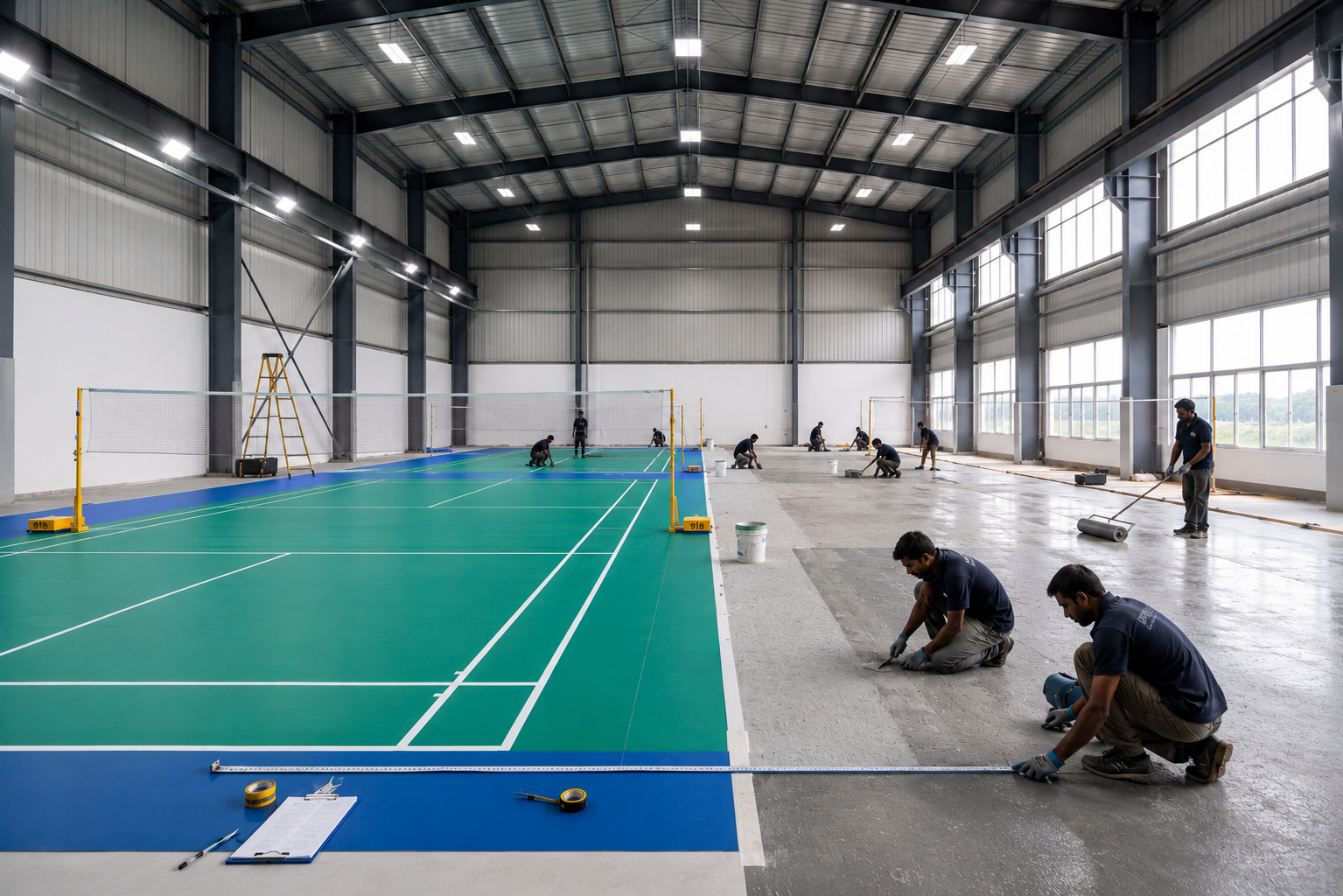
Quick Answer: What Does Badminton Court Construction Include?
Badminton court construction includes site assessment, layout planning, ground or base preparation, leveling and compaction, construction of the sub-base, sports flooring installation, court line marking, net and pole installation, lighting, ventilation, finishing, and final quality inspection.
The objective is to create a court with accurate dimensions, suitable traction, controlled surface response, adequate shock absorption, and sufficient durability for regular badminton play.
Complete Badminton Court Construction Details
A badminton court is more than a marked playing area. Professional construction requires precision engineering and proper coordination between the foundation, flooring system, court dimensions, lighting, and sports equipment. Each component contributes to player comfort, safety, performance, and the overall service life of the facility.
The construction process normally begins with a detailed site survey. The available area, existing ground conditions, levels, drainage requirements, access, ventilation, lighting requirements, and intended use of the facility are evaluated before construction begins.
Once the design and layout are finalized, the construction team prepares a stable base and installs the selected sports flooring system. Court dimensions and playing lines are then marked accurately, followed by installation of professional net posts, nets, lighting systems, and other required accessories.
Standard Badminton Court Dimensions
Accurate court dimensions are one of the most important parts of badminton court construction. The playing area must be measured carefully to ensure that singles and doubles courts are properly marked.
| Specification | Standard Measurement |
|---|---|
| Court Length | 13.40 m (44 ft) |
| Doubles Court Width | 6.10 m (20 ft) |
| Singles Court Width | 5.18 m (17 ft) |
| Net Height at Posts | 1.55 m |
| Net Height at Centre | 1.524 m |
| Recommended Indoor Clear Height | Approximately 9–12 m |
In addition to the marked playing area, the overall facility should provide adequate clearance around the court so that players can move safely during rallies, lunges, jumps, and rapid changes of direction.
1. Site Survey and Project Planning
The first stage of badminton court construction is a detailed site assessment. Construction professionals evaluate the available space and determine whether the proposed area is suitable for the intended court and supporting facilities.
Important planning considerations include:
- Available site area and court orientation
- Existing ground and surface conditions
- Level differences and drainage requirements
- Indoor or outdoor application
- Ceiling and clear-height requirements
- Lighting and ventilation requirements
- Player movement and safety clearance
- Selection of suitable sports flooring
- Location of net posts and court markings
- Future maintenance and facility requirements
Proper planning at this stage helps prevent dimensional errors, drainage problems, uneven surfaces, and unnecessary modifications during later construction stages.
2. Ground Preparation and Leveling
A stable and properly prepared base is essential for long-lasting badminton court construction. For new outdoor facilities, the ground may require excavation, leveling, filling, grading, and compaction before the sports base is constructed.
The surface should be prepared to achieve the required levels and stability. Proper compaction helps reduce settlement and provides a reliable foundation for the subsequent flooring system.
For indoor courts, the existing concrete floor should also be checked for levelness, surface condition, moisture, cracks, and other defects before sports flooring installation begins.
3. Sub-Base and Foundation Construction
The sub-base supports the complete sports flooring system and plays an important role in distributing loads across the court area. Depending on the project, the foundation may incorporate a suitable concrete or engineered sports base.
The base should be stable, sufficiently level, and prepared according to the requirements of the selected flooring system. Any significant unevenness or surface defects should be addressed before the final sports floor is installed.
Badminton Court Flooring Options
Choosing the right badminton court flooring is one of the most important decisions in the construction process. Flooring affects player comfort, traction, movement, shock absorption, maintenance requirements, durability, and overall playing characteristics.
Wooden Badminton Court Flooring
Wooden sports flooring is a premium choice for indoor badminton facilities. A properly engineered wooden sports floor can provide a comfortable playing surface along with controlled shock absorption and suitable traction.
Wooden flooring is commonly considered for professional sports facilities, indoor stadiums, badminton academies, clubs, and high-quality training centres. Depending on the project, different hardwood species and engineered sports-floor systems may be considered.
PVC Vinyl Badminton Court Flooring
PVC vinyl sports flooring is a practical option for many indoor badminton facilities. It provides a uniform playing surface and can be designed with suitable cushioning and sports-performance characteristics.
PVC flooring is commonly used in schools, training centres, indoor halls, clubs, academies, and recreational sports facilities where durability and ease of maintenance are important considerations.
PU Sports Flooring
PU or polyurethane sports flooring can provide a seamless cushioned surface for indoor sports applications. Its layered construction can be designed to provide suitable resilience, traction, and player comfort.
PU sports flooring may be suitable for professional training courts, sports complexes, multipurpose halls, and other facilities requiring a performance-oriented seamless surface.
Acrylic Badminton Court Flooring
Acrylic sports surfaces are commonly considered for outdoor applications because they can provide a durable playing surface when the system is correctly designed and installed for the environmental conditions.
Acrylic systems may be used for community courts, recreational areas, outdoor sports facilities, and multipurpose sports spaces.
How to Choose the Right Badminton Court Flooring?
The ideal flooring system depends on the intended use, location, performance requirements, available budget, maintenance expectations, and whether the court is indoor or outdoor.
| Flooring Type | Common Application | Key Consideration |
|---|---|---|
| Wooden Flooring | Professional indoor courts, academies, stadiums | Premium performance and engineered cushioning |
| PVC Vinyl Flooring | Schools, clubs, training centres, indoor halls | Durability and practical maintenance |
| PU Flooring | Sports complexes and professional training facilities | Seamless cushioned sports surface |
| Acrylic Flooring | Outdoor and recreational courts | Weather-resistant sports surface |
Badminton Court Construction Process
A professional badminton court construction project normally follows a systematic sequence. The exact construction method may vary according to the site, flooring specification, building structure, and project requirements.
- Site Survey and Measurement: The proposed area is inspected and measured to determine the appropriate court layout and construction requirements.
- Design and Planning: Court orientation, dimensions, flooring type, lighting, ventilation, equipment locations, and supporting areas are planned.
- Ground Preparation: The site is cleared, leveled, graded, and compacted where required.
- Base Construction: A suitable concrete or sports foundation is prepared to provide stability and support for the flooring system.
- Surface Preparation: The base is checked for levelness, moisture, cracks, and surface defects before flooring installation.
- Sports Flooring Installation: The selected wooden, PVC, PU, or acrylic sports flooring system is installed according to its technical requirements.
- Court Line Marking: Singles and doubles court lines are measured and marked accurately using suitable sports-floor marking materials.
- Net and Pole Installation: Professional net posts and the badminton net system are installed at the appropriate positions.
- Lighting Installation: Sports lighting is installed to provide suitable visibility while minimizing glare and distracting shadows.
- Final Inspection: The finished court is checked for dimensions, surface quality, markings, equipment installation, and overall finish before handover.
Importance of Shock-Absorbing Badminton Flooring
Badminton involves repeated jumping, lunging, sudden stopping, rapid acceleration, and frequent changes in direction. For this reason, flooring should be selected with player movement and impact considerations in mind.
A suitable sports flooring system can provide controlled cushioning and help create a more comfortable playing environment. Properly engineered flooring can also contribute to traction and surface consistency while reducing excessive impact during repeated movement.
Badminton Court Line Marking
Accurate line marking is essential for distinguishing singles and doubles playing areas. Court lines should be measured carefully and applied cleanly so that they remain clearly visible during regular play.
Professional installation uses appropriate sports-floor marking materials compatible with the selected flooring system. The finished markings should have clean edges, consistent widths, and accurate positioning.
Badminton Court Lighting Requirements
Lighting is a critical part of indoor badminton court construction. Players need clear visibility of the shuttle throughout fast rallies, especially when the shuttle travels at different heights and speeds.
A well-planned sports lighting system should provide uniform illumination while reducing glare, harsh shadows, and distracting reflections. LED sports lighting is commonly considered for modern indoor facilities because it can provide efficient and consistent illumination when properly designed.
Ventilation and Indoor Court Environment
Indoor badminton facilities should also consider ventilation and air movement during the design stage. Excessive air movement can affect shuttle flight, while poor ventilation can make the playing environment uncomfortable.
The ventilation strategy should therefore be planned according to the building design, number of courts, occupancy, climate, and intended use of the facility.
Badminton Court Equipment Installation
A complete badminton court construction project can include the installation of professional sports equipment in addition to flooring and markings.
- Badminton net posts
- Badminton nets
- Court line marking
- Sports lighting
- Protective wall systems where required
- Player seating and benches
- Scoreboards and accessories
- Safety and facility signage
Where Are Badminton Courts Constructed?
Professional badminton courts can be developed for a wide range of sports and recreational facilities.
- Schools and educational institutions
- Colleges and universities
- Badminton academies
- Sports clubs
- Indoor stadiums
- Professional training centres
- Sports complexes
- Fitness and recreation centres
- Residential communities
- Corporate sports facilities
- Commercial sports centres
Important Badminton Court Construction Details
Several technical and practical factors should be considered before starting a badminton court project.
- Accurate court dimensions and layout
- Stable and level foundation
- Suitable sports flooring system
- Appropriate shock absorption
- Controlled traction and surface response
- Accurate court line marking
- Suitable net and pole installation
- Uniform sports lighting
- Effective ventilation
- Proper drainage for outdoor facilities
- Quality installation workmanship
- Long-term maintenance planning
Badminton Court Construction Cost in India
The cost of badminton court construction in India varies according to flooring type, court size, base condition, site preparation, building requirements, lighting, equipment, number of courts, and overall project specifications.
The following figures provide approximate flooring-related cost ranges and should be treated as indicative rather than fixed project quotations.
| Flooring Type | Approximate Cost |
|---|---|
| Wooden Sports Flooring | ₹1,800 – ₹2,800 per sq. ft. |
| PVC Sports Flooring | ₹250 – ₹450 per sq. ft. |
| PU Sports Flooring | ₹350 – ₹650 per sq. ft. |
| Acrylic Flooring | ₹150 – ₹300 per sq. ft. |
The final project cost should be calculated after evaluating the actual site and confirming the required flooring system, foundation work, lighting, equipment, court quantity, and installation specifications.
Badminton Court Maintenance
Regular maintenance helps preserve the appearance, performance, and service life of a badminton court. Maintenance requirements depend on the flooring system installed.
- Regular removal of dust and dirt
- Cleaning with flooring-compatible products
- Periodic inspection of the sports surface
- Checking court line visibility
- Inspection of net posts and equipment
- Checking for surface damage or wear
- Prompt repair of damaged flooring
- Maintaining suitable indoor environmental conditions
Why Choose Professional Badminton Court Construction?
Professional badminton court construction requires more than installing a sports floor. Accurate measurements, appropriate foundation preparation, flooring selection, installation techniques, line marking, lighting, and equipment positioning all affect the finished facility.
Working with experienced sports flooring and court construction professionals can help ensure that the project is planned according to its intended use and completed with proper attention to surface quality, safety, durability, and finish.
Frequently Asked Questions About Badminton Court Construction
What are the main badminton court construction details?
The main badminton court construction details include site assessment, layout planning, ground or base preparation, flooring installation, court dimensions, line marking, lighting, ventilation, net and pole installation, and final inspection.
What is the standard badminton court size?
A standard badminton court is 13.40 metres long. The doubles court width is 6.10 metres, while the singles court width is 5.18 metres.
Which flooring is best for a badminton court?
Wooden, PVC, PU, and acrylic sports flooring can all be considered depending on the application. Wooden and PVC systems are commonly used for indoor courts, while acrylic surfaces are commonly considered for outdoor applications.
Is wooden flooring suitable for professional badminton courts?
Yes. Properly engineered wooden sports flooring can be a premium option for professional indoor badminton facilities, academies, stadiums, and high-performance training environments.
How much does badminton court construction cost in India?
Badminton court construction costs vary according to the flooring system, site preparation, foundation, lighting, equipment, court size, and project specifications. Flooring costs may range approximately from ₹150 to ₹2,800 per sq. ft. depending on the selected system.
How long does badminton court construction take?
A typical project may take around 2–4 weeks depending on the site condition, flooring system, project size, number of courts, construction requirements, and finishing work.
What type of lighting is suitable for an indoor badminton court?
Properly designed LED sports lighting can be used to provide uniform illumination while minimizing glare and distracting shadows. Lighting design should be planned according to the court layout and facility requirements.
Can badminton courts be constructed outdoors?
Yes. Outdoor badminton courts can be constructed using suitable weather-resistant sports surface systems, such as appropriately designed acrylic flooring, along with proper drainage and base preparation.
Professional Badminton Court Construction Services
Looking for professional badminton court construction services? We provide complete solutions for badminton court development, including site planning, base preparation, sports flooring installation, court line marking, lighting, equipment installation, and turnkey project execution.
Our badminton court construction solutions can be planned for schools, colleges, sports academies, clubs, indoor stadiums, residential communities, commercial sports complexes, and other sports facilities across India.
Request a Free ConsultationRelated Badminton Court Construction Services
- Badminton Court Construction
- Badminton Court Construction Details
- Indoor Badminton Court Construction
- Badminton Court Flooring Installation
- Wooden Badminton Court Flooring
- PVC Badminton Court Flooring
- PU Badminton Court Flooring
- Outdoor Badminton Court Construction
- Badminton Court Construction Cost
- Badminton Court Builders in India
- Professional Badminton Court Construction Company
- Sports Flooring Installation