
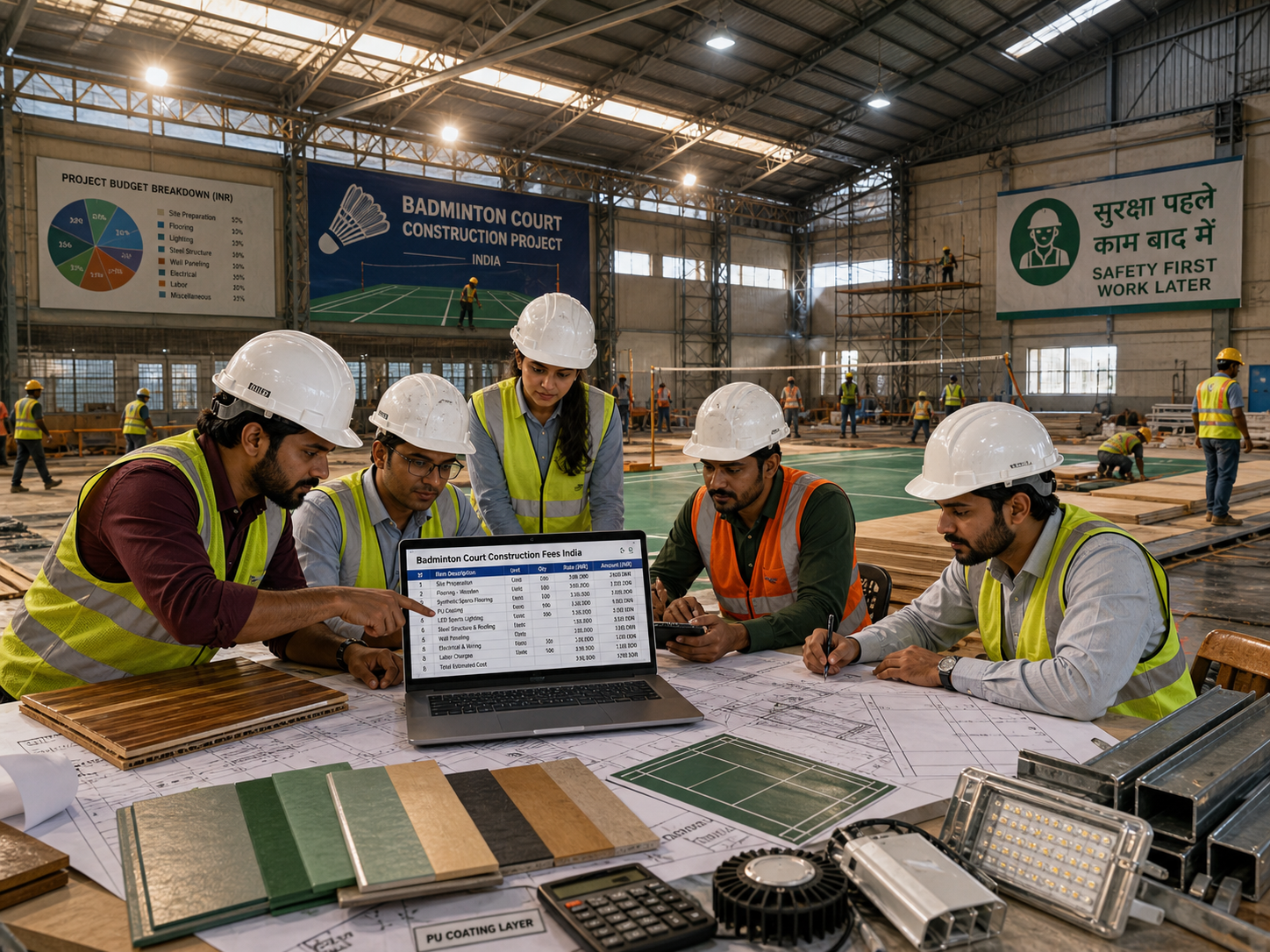
What Are the Badminton Court Construction Fees in India?
The badminton court construction fees in India can start from approximately ₹2.5 lakh and exceed ₹15 lakh per court, depending on the construction scope, flooring system, civil work, lighting, equipment and site conditions. Outdoor acrylic courts may require a lower initial investment, while fully equipped indoor courts with PVC, PU synthetic or sprung wooden flooring can involve additional infrastructure costs.
The actual badminton court construction cost depends on whether the project includes only the playing surface or a complete facility with a building structure, roofing, electrical installation, drainage, ventilation and sports accessories. A site-specific quotation is recommended before finalizing the project budget.
Badminton Court Construction Fees India: Complete Cost Guide
Badminton is increasingly popular in schools, colleges, universities, sports academies, residential communities, private clubs and commercial sports complexes across India. This growing demand has increased the need for professionally designed badminton courts that provide suitable playing conditions, durability and long-term value.
Understanding badminton court construction fees in India is an important first step when planning a new sports facility. The overall investment depends on several factors, including site preparation, foundation construction, sports flooring, court marking, lighting, electrical work, badminton nets, net posts, protective padding and installation.
Indoor badminton facilities may require additional expenditure for roofing, structural construction, ventilation, electrical infrastructure and specialized sports flooring. Outdoor courts generally have different construction requirements, including weather-resistant surfaces, appropriate slope and drainage.
A detailed badminton court construction estimate helps project owners compare materials, assess installation requirements, allocate their budget and identify potential additional expenses. Selecting suitable materials and maintaining construction quality can also help minimize avoidable repair costs over the service life of the facility.
Badminton Court Construction Cost in India by Flooring Type
The flooring system is one of the main factors affecting the cost of a badminton court. Different materials are suitable for different environments, usage levels and investment budgets.
| Flooring System | Typical Application | Relative Cost Level |
|---|---|---|
| Acrylic Sports Flooring | Outdoor recreational courts | Economical |
| PVC Vinyl Sports Flooring | Indoor schools, clubs and academies | Moderate |
| PU Synthetic Flooring | Selected indoor sports facilities | Moderate to premium |
| Sprung Wooden Sports Flooring | Premium indoor sports facilities | Premium |
These categories provide a general comparison rather than a fixed price list. The final construction cost depends on the flooring specification, installed area, base preparation, building infrastructure, labour, transportation and project inclusions.
When comparing quotations, confirm whether the price covers the complete court or only the flooring supply and installation. Civil construction, roofing, lighting, taxes and sports accessories may be charged separately.
Complete Badminton Court Construction Cost Breakdown
A reliable badminton court construction estimate should identify the major components of the project. Breaking down the costs makes it easier to understand the investment required for each stage and compare contractor quotations.
| Construction Component | Included Activities | Budget Consideration |
|---|---|---|
| Site Survey and Planning | Measurements, site inspection, layout and feasibility assessment | Depends on project scope |
| Ground Preparation | Clearing, excavation, levelling and compaction | Depends on existing conditions |
| Civil Foundation | PCC, RCC, concrete finishing, curing and base preparation | Can be a major expense |
| Drainage and Moisture Protection | Drainage arrangements and suitable moisture protection | Depends on site and flooring system |
| Sports Flooring | Acrylic, PVC, PU synthetic or sprung wooden systems | Depends on material and specifications |
| Court Marking | Measurement and application of badminton court lines | Depends on system and scope |
| Sports Lighting | LED fixtures, wiring, controls and installation | Depends on lighting design |
| Sports Equipment | Badminton nets, posts, padding and accessories | Depends on quantity and quality |
| Labour and Installation | Civil, flooring, electrical and finishing work | Depends on site and complexity |
| Building Infrastructure | Roofing, structural work, ventilation and related facilities | Required where included in the project |
| Testing and Handover | Final measurements, surface inspection and finishing | Depends on project requirements |
The total estimate should be calculated using measured quantities, specified materials and agreed rates. Applicable taxes, transportation charges, optional facilities and contingency allowances should be identified separately.
Factors Affecting Badminton Court Construction Fees in India
The total badminton court construction investment varies from one project to another. The following factors should be evaluated before approving a construction budget.
1. Site Location and Ground Conditions
The existing ground condition can influence excavation, compaction, levelling, foundation design and drainage requirements. Uneven terrain, weak soil, difficult site access or unsuitable existing surfaces may increase the amount of preparation required.
2. Indoor or Outdoor Construction
Indoor courts may require a building structure, roofing, ventilation, electrical systems and specialized sports flooring. Outdoor courts may require a properly prepared base, weather-resistant surfacing, suitable drainage and appropriate protection from environmental conditions.
3. Flooring Material and Specifications
Acrylic, PVC, PU synthetic and sprung wooden flooring systems have different installation methods, performance characteristics and maintenance requirements. The cost also depends on material quality, system thickness, underlayers and the condition of the supporting surface.
4. Foundation and Civil Work
A stable, level and properly prepared foundation is essential for the performance of the finished court. Concrete work, curing, moisture management and drainage should be planned according to site conditions and the selected flooring system.
5. Court Quantity and Total Area
A single-court project and a multi-court sports complex have different material quantities and infrastructure requirements. Multiple courts may allow coordinated procurement and shared facilities, although the final savings depend on the layout and scope of work.
6. Lighting and Electrical Installation
Lighting costs depend on the number of courts, ceiling height, fixture selection, mounting arrangements, electrical wiring and intended playing conditions. A suitable lighting layout should minimize glare and shadows.
7. Equipment and Additional Facilities
Net posts, nets, protective padding, seating, scoreboards, fencing, spectator facilities and changing rooms may add to the total investment. The estimate should distinguish essential requirements from optional upgrades.
8. Labour, Transportation and Taxes
Local labour rates, specialist installation requirements, transportation, material availability and applicable taxes can influence the final quotation. These items should be clearly identified before work begins.
Standard Badminton Court Dimensions for Construction
Correct court dimensions are essential for recreational badminton, professional training and competition facilities. Court layouts should follow the applicable Badminton World Federation (BWF) Laws of Badminton and the requirements of the intended venue.
| Specification | Standard Measurement |
|---|---|
| Full Court Length | 13.40 metres |
| Doubles Court Width | 6.10 metres |
| Singles Court Width | 5.18 metres |
| Net Height at Centre | 1.524 metres |
| Net Height at Posts | 1.55 metres |
| Short Service Line | 1.98 metres from the net |
The playing dimensions are only part of the space-planning process. Additional clearance is required around the court for player movement, safety and circulation. Ceiling height, lighting positions and surrounding obstacles should be assessed according to the level of play and applicable facility requirements.
A court layout should be finalized before construction begins to avoid marking errors, unsuitable clearances and costly modifications.
Badminton Court Flooring Types and Their Benefits
Choosing the correct flooring system affects playing comfort, traction, shock absorption, maintenance and the overall project budget. The most suitable option depends on the environment, frequency of play and performance requirements.
Acrylic Badminton Court Flooring
Acrylic sports flooring is commonly considered for outdoor recreational courts and selected multi-purpose sports surfaces. It can provide a durable playing surface when installed over a properly prepared base using a system designed for the intended application.
The construction estimate should include base preparation, surface coatings, court marking, drainage requirements and any additional installation work.
PVC Vinyl Badminton Court Flooring
PVC vinyl sports flooring is widely considered for indoor badminton courts in schools, clubs, coaching centres and sports academies. Depending on the selected product, the system can provide a consistent playing surface and suitable cushioning characteristics.
The quotation should specify the flooring system, thickness, underlayers, installation method, surface preparation and warranty. PVC sports flooring must be selected for badminton use rather than substituted with ordinary domestic vinyl flooring.
PU Synthetic Sports Flooring
PU synthetic flooring may be suitable for selected indoor sports facilities depending on the product formulation and installation system. Performance varies according to the system design, surface characteristics and intended application.
Before selecting PU flooring for badminton, confirm that the product is specifically suitable for the intended sport and meets the required traction, cushioning, durability and maintenance criteria.
Sprung Wooden Badminton Court Flooring
Sprung wooden sports flooring is a premium option for dedicated indoor sports facilities. Its engineered supporting structure is designed to provide a resilient playing surface and controlled shock absorption.
The total cost depends on the wooden surface, supporting structure, underfloor components, installation, finishing and ongoing maintenance. A complete system specification is important when comparing suppliers.
Indoor vs Outdoor Badminton Court Construction Cost
Indoor and outdoor badminton courts have different construction requirements. The most economical solution depends on the site, weather exposure, usage pattern and desired playing standard.
| Feature | Indoor Court | Outdoor Court |
|---|---|---|
| Building Structure | Required for a covered facility | May not be required |
| Common Flooring Options | PVC, suitable PU systems and sprung wood | Acrylic systems and other suitable outdoor surfaces |
| Weather Exposure | Generally protected | Exposed unless covered |
| Lighting | Indoor sports lighting may be required | Depends on operating hours and design |
| Drainage | Depends on building and site conditions | Important for rainwater management |
| Maintenance | Depends on flooring and facility usage | Depends on weather, surface and drainage |
| Construction Budget | Can increase substantially with building infrastructure | May be lower when major structures are not required |
A fair cost comparison should use the same scope of work. For example, a basic outdoor court should not be compared directly with a fully enclosed indoor sports facility that includes roofing, lighting, ventilation and premium flooring.
Materials Required for Badminton Court Construction
The materials required depend on the construction design, existing site conditions and selected flooring system. Common materials and equipment may include:
- Cement, concrete aggregates and reinforcement steel
- Sub-base and levelling materials
- Drainage components and moisture protection materials
- Acrylic, PVC, PU synthetic or wooden sports flooring
- Flooring adhesives and compatible underlayers
- Badminton court marking materials
- LED sports lighting fixtures and electrical components
- Badminton nets and net posts
- Protective padding and safety accessories
- Finishing materials and installation consumables
Material quantities should be calculated from actual measurements and approved specifications. Product suitability, manufacturer installation instructions and compatibility with the base should be confirmed before procurement.
Civil Construction Work for a Badminton Court
Civil work establishes the supporting structure for the playing surface. Depending on the project, it may include ground preparation, excavation, soil compaction, sub-base construction, PCC, RCC, concrete finishing, curing and drainage.
The foundation should be designed according to the site conditions and intended use. The required flatness, moisture condition and surface preparation depend on the flooring manufacturer's specifications.
Poor base preparation can lead to uneven flooring, cracks, moisture-related damage or premature deterioration. Including the necessary civil work in the initial estimate helps reduce the risk of expensive remedial work later.
Badminton Court LED Lighting and Electrical Costs
Lighting is an important consideration for indoor badminton facilities because players must track the shuttle during fast rallies. A well-planned lighting system should provide suitable illumination while minimizing glare and distracting shadows.
The electrical estimate may include:
- LED sports lighting fixtures
- Mounting arrangements and installation
- Electrical cables and wiring
- Switches and control equipment
- Distribution boards and protection devices
- Testing and electrical safety checks
The number, position and specification of fixtures should be determined according to the building layout and intended playing level. Energy efficiency and maintenance access should also be considered during planning.
Badminton Court Equipment and Accessories
Equipment completes the functionality of a badminton court and should be included in the estimate according to the facility's intended use.
| Equipment | Purpose |
|---|---|
| Badminton Net | Creates the playing division between the two sides |
| Net Posts | Supports the badminton net at the required height |
| Protective Padding | Helps reduce impact risks around selected structural elements |
| Player Seating | Provides seating for players and coaches |
| Scoreboard | Supports scorekeeping and match management |
| Safety Barriers | Helps define and protect the court area where required |
| Signage | Provides court identification and facility information |
The final equipment budget depends on quantity, material quality, portability, installation and the specifications required for recreational or competitive use.
Step-by-Step Badminton Court Construction Process
A systematic construction process helps coordinate civil work, flooring installation, lighting and finishing activities. The exact sequence may vary according to whether the project is indoor, outdoor, new construction or renovation.
Step 1: Site Inspection and Feasibility
Assess the available area, existing surface, ground condition, access, drainage and building requirements. Identify any structural or site-related work needed before construction.
Step 2: Court Layout and Design
Prepare the court layout using the required playing dimensions, surrounding clearance, circulation areas, lighting positions and supporting facilities.
Step 3: Ground Preparation and Foundation
Complete the required excavation, compaction, sub-base, concrete work, levelling, curing and drainage arrangements according to the approved design.
Step 4: Base Inspection
Check that the base meets the specified surface, moisture and installation requirements before applying or installing the selected sports flooring.
Step 5: Sports Flooring Installation
Install the selected acrylic, PVC, suitable PU or sprung wooden system according to the product specifications and manufacturer's instructions.
Step 6: Court Marking and Equipment
Apply the badminton court lines accurately and install the required nets, net posts, padding and other accessories.
Step 7: Lighting and Final Inspection
Complete the electrical work, test the lighting, inspect the playing surface and verify the court layout before handover.
Labour and Installation Charges for Badminton Courts
Labour and installation charges depend on the size of the project, flooring system, site access, construction complexity and finishing requirements.
The workforce may include civil construction workers, concrete finishing specialists, flooring technicians, electricians, court marking professionals, supervisors and quality inspectors.
Specialist flooring installation is particularly important because incorrect surface preparation, unsuitable adhesives, poor joint treatment or inaccurate markings can affect the final result. Quotations should identify the installation work included and any labour charged separately.
Badminton Court Maintenance and Long-Term Costs
The cost of owning a badminton court extends beyond the initial construction investment. Regular cleaning, preventive inspections and timely repairs help preserve the playing surface and reduce unexpected downtime.
- Clean the playing surface using approved methods.
- Inspect flooring for damage, lifting or uneven areas.
- Check court markings and repair them when necessary.
- Inspect nets, posts and other equipment regularly.
- Maintain lighting fixtures and electrical systems.
- Keep outdoor drainage clear and check for standing water.
- Follow the flooring manufacturer's maintenance instructions.
- Arrange repairs promptly when defects appear.
Maintenance frequency and cost vary by material, usage, environmental exposure and product requirements. Include expected cleaning, repair and eventual replacement costs when evaluating the long-term value of different flooring systems.
How to Reduce Badminton Court Construction Fees
Controlling construction expenditure requires a clear project scope, suitable material selection and efficient coordination. The objective should be to reduce unnecessary expenses without compromising essential safety and construction quality.
- Conduct a site survey before preparing the final budget.
- Compare itemized quotations with equivalent specifications.
- Select flooring according to the intended use and environment.
- Finalize the court layout before starting construction.
- Ensure the base is prepared correctly to reduce rework.
- Consider coordinated procurement for multiple courts.
- Choose suitable energy-efficient lighting equipment.
- Separate optional amenities from essential construction work.
- Confirm taxes, transportation and installation charges in writing.
- Follow a preventive maintenance plan after handover.
Choosing the lowest-priced materials without checking their suitability can increase long-term costs. A balanced estimate should consider initial expenditure, expected service life, maintenance and the quality requirements of the facility.
Why Choose Professional Badminton Court Construction Services?
Badminton court construction involves several specialized activities, including civil engineering, base preparation, sports flooring installation, court marking, lighting and equipment setup. Coordinating these activities through a clearly defined project scope can improve quality control and reduce avoidable delays.
Professional construction planning can help with:
- Site assessment and project feasibility
- Correct court dimensions and layout planning
- Selection of appropriate sports flooring
- Coordination of civil and installation work
- Lighting and electrical planning
- Equipment selection and installation
- Material and workmanship checks
- Final inspection and project handover
Before appointing a contractor, review the proposed specifications, installation methodology, project schedule, warranty terms and scope of work. Request clarification on any items excluded from the quotation.
Badminton Court Construction for Schools, Academies and Sports Complexes
Schools and Colleges
Educational institutions may require badminton courts for physical education, student recreation, coaching and sports competitions. The budget should reflect expected usage, maintenance arrangements, available space and the institution's infrastructure requirements.
Badminton Academies and Clubs
Training academies and sports clubs may prioritize consistent playing conditions, suitable flooring performance, lighting quality and durable equipment. The construction specification should match the level and frequency of training.
Residential Societies and Private Facilities
Residential communities and private owners may plan badminton courts for recreational use, fitness and community activities. Existing space, building restrictions, flooring selection and operating hours can influence the final cost.
Commercial Sports Complexes and Indoor Stadiums
Commercial facilities may require several courts, shared infrastructure, spectator areas, changing rooms and specialized lighting. A coordinated design and itemized estimate can help manage the larger project scope.
Badminton Court Construction Services Across India
Badminton court construction projects can be planned for schools, colleges, universities, sports academies, clubs, residential communities, government institutions and commercial sports complexes across India.
The construction budget varies according to local material availability, labour rates, transportation, site conditions, building infrastructure and selected sports flooring. A project in one city may therefore require a different investment from a similar project elsewhere.
A customized estimate should be based on the actual location, available dimensions, number of courts, flooring requirements, civil work and supporting facilities. Providing site photographs, drawings and measurements can help establish the initial scope of work.
Badminton Court Construction Fees India: Quick Summary
Badminton court construction fees in India depend on the court type, flooring system, civil work, building infrastructure, lighting and sports equipment. Outdoor acrylic courts may require a lower initial investment, whereas indoor facilities with PVC, PU synthetic or sprung wooden flooring can cost substantially more when structural and electrical work is included.
The most reliable way to determine the final price is to prepare an itemized estimate based on the actual site, flooring specification, number of courts and complete project requirements. Comparing equivalent quotations helps identify a suitable balance between cost, performance, durability and maintenance.
How Much Are Badminton Court Construction Fees in India?
Badminton court construction fees in India can start at approximately ₹2.5 lakh and exceed ₹15 lakh per court, depending on the flooring system, civil work, site conditions and overall project scope. Outdoor acrylic courts may cost less than fully equipped indoor facilities. The final price should be confirmed through a site inspection and detailed construction estimate.
Frequently Asked Questions About Badminton Court Construction Fees in India
1. What are the badminton court construction fees in India?
The construction budget can start at approximately ₹2.5 lakh and exceed ₹15 lakh per court, depending on the site, flooring system, civil work, lighting, equipment and infrastructure. These figures are indicative and should not be treated as fixed quotations.
2. Which badminton court flooring is the most economical?
Acrylic sports flooring is generally considered for economical outdoor court projects where the site and intended use are suitable. The complete cost also depends on foundation preparation, drainage and installation requirements.
3. Is indoor badminton court construction more expensive than outdoor construction?
Indoor construction can require additional expenditure for roofing, structural work, ventilation, electrical installation and specialized sports flooring. The actual difference depends on the scope of both projects.
4. What is included in a badminton court construction estimate?
A detailed estimate may include site preparation, civil foundation work, drainage, sports flooring, court markings, lighting, electrical installation, sports accessories, labour and finishing. Building infrastructure and applicable taxes should be listed separately when relevant.
5. What are the standard dimensions of a badminton court?
A standard badminton court is 13.40 metres long. The doubles court is 6.10 metres wide, while the singles court is 5.18 metres wide. Additional clearance is needed around the playing area.
6. Which flooring is suitable for an outdoor badminton court?
Acrylic sports flooring is commonly considered for outdoor badminton courts. The selected system should be suitable for exterior conditions, the prepared base and the site's drainage requirements.
7. Is PVC flooring suitable for indoor badminton courts?
Yes. PVC sports flooring can be suitable for indoor badminton facilities when the selected product is designed for sports use and installed over a properly prepared base.
8. What is sprung wooden badminton flooring?
Sprung wooden flooring is an engineered sports-flooring system with a resilient supporting structure beneath the wooden playing surface. It is generally considered for premium indoor facilities requiring controlled shock absorption and suitable playing characteristics.
9. Does civil work significantly affect badminton court construction costs?
Yes. Excavation, soil preparation, concrete construction, levelling, curing, drainage and moisture protection can significantly affect the total project budget, particularly when the existing site requires extensive preparation.
10. How long does badminton court construction take?
The project duration depends on the site, building requirements, flooring type, number of courts, material availability and finishing scope. A reliable timeline should be confirmed after reviewing the project requirements.
11. Can an existing concrete floor be used for badminton court installation?
An existing concrete floor may be suitable if it meets the structural, moisture, flatness and surface-preparation requirements of the selected flooring system. A site inspection is recommended before installation.
12. Does badminton court construction include lighting and equipment?
Lighting and equipment may be included, but this depends on the contractor's quotation. Confirm whether LED lights, electrical work, nets, net posts, padding and other accessories are part of the agreed scope.
13. Can multiple badminton courts be constructed together?
Yes. Multi-court facilities can be developed for academies, schools, clubs, universities and commercial sports complexes. The layout should account for playing clearances, circulation, lighting and supporting infrastructure.
14. Can badminton court construction costs be reduced?
Costs can be controlled by finalizing the layout early, comparing equivalent quotations, selecting suitable flooring, coordinating procurement and avoiding unnecessary modifications. Essential foundation quality and sports-flooring suitability should not be compromised.
15. How can I get a badminton court construction quotation?
Share the project location, available area, number of courts, preferred flooring, existing site condition and required facilities. These details help establish the scope for a customized construction estimate.
Request a Badminton Court Construction Cost Estimate
Planning a new badminton court or upgrading an existing sports facility? Get an estimate based on your project location, site conditions, flooring requirements, civil work, lighting, equipment and installation scope.
Whether the project is for a school, college, sports academy, residential community, private club or commercial sports complex, detailed cost planning can help you compare options and establish a realistic budget.
Contact the team to discuss your requirements and arrange the next steps for a project-specific quotation.
Request a Construction EstimateFor direct enquiries, call: +91 80094 83311
Plan Your Badminton Court Construction Project with Confidence
Understanding badminton court construction fees in India helps schools, academies, clubs, residential communities and commercial sports facilities plan their investment more effectively. The total cost depends on the flooring system, civil foundation, site preparation, lighting, accessories, labour and supporting infrastructure.
Outdoor acrylic courts may suit projects seeking a practical exterior sports surface, while indoor facilities may benefit from suitable PVC, PU synthetic or sprung wooden flooring systems. The right choice depends on the intended application, site conditions, maintenance requirements and available budget.
A detailed site assessment and itemized quotation help identify the actual construction requirements before work begins. Comparing specifications, installation scope and warranty terms also supports better procurement decisions.
For a customized badminton court construction estimate, provide the project location, number of courts, available dimensions and preferred flooring system. This information can help establish a clear project scope and support more effective construction planning.