
What Is a Basketball Court?
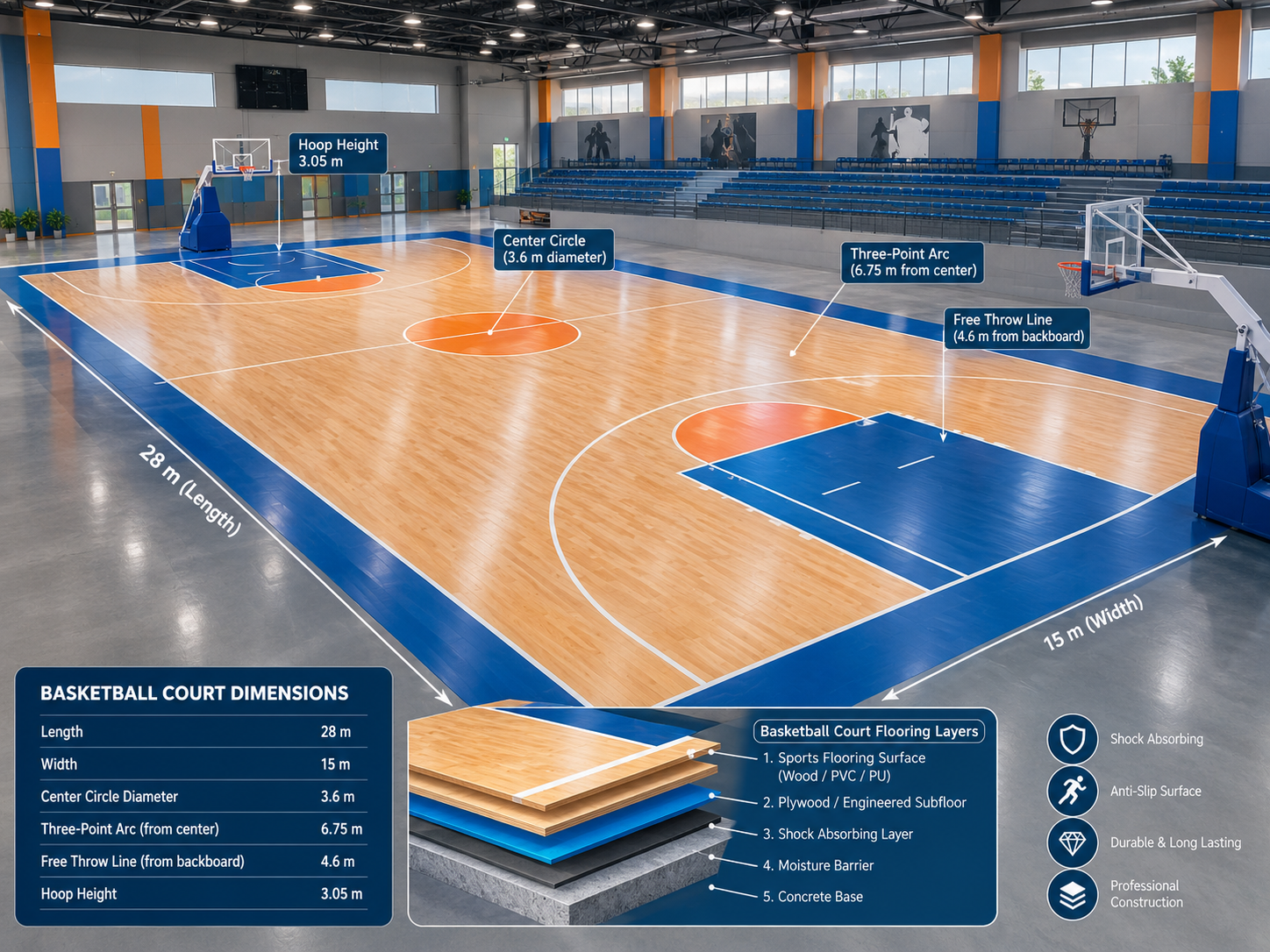
A basketball court is a rectangular playing surface specially designed for basketball. The court contains boundaries, lines, circles and designated playing areas that help organize the game and establish the position of players and equipment.
A complete basketball court consists of the playing surface, sidelines, baselines or endlines, centre line, centre circle, free-throw areas, three-point lines, key or paint areas, baskets and backboards. The exact dimensions and markings depend on the applicable basketball governing body and level of competition.
Basketball courts may be constructed indoors or outdoors. Schools, colleges, sports academies, clubs, residential communities, stadiums, commercial sports facilities and training centres may all require different court specifications based on their intended use.
Basic Structure of a Basketball Court
Understanding the basic structure is an important part of any basketball court explanation. The court is divided into clearly defined zones that support offensive and defensive gameplay.
| Component | Explanation |
|---|---|
| Playing Surface | The main floor or sports surface on which basketball is played. |
| Sidelines | Long boundary lines running along both sides of the court. |
| Baseline / Endline | Boundary line located at each end of the basketball court. |
| Centre Line | Divides the court into two main halves. |
| Centre Circle | Circular area located at the centre of the court and used for the opening jump ball. |
| Three-Point Line | Defines the area associated with three-point field-goal attempts. |
| Free-Throw Line | Line from which free throws are taken. |
| Key / Paint | Marked area surrounding the basket and free-throw lane. |
| Basket and Backboard | Scoring equipment positioned at both ends of the court. |
Basketball Court Layout Explained
The basketball court layout determines the position of the playing boundaries, scoring areas and equipment. Accurate layout is especially important during new court construction because errors in measurement can affect court usability and compliance with the intended playing specification.
Centre of the Court
The centre of the court contains the centre circle and centre line. These features establish the midpoint of the playing area and help divide the court into two halves.
Basket Areas
Each end of the court contains a basket, backboard and associated playing zones. The key or paint area extends from the basket toward the free-throw line and is an important area for offensive and defensive play.
Three-Point Area
The three-point line surrounds the basket area and separates long-distance three-point attempts from other field-goal attempts. The exact geometry varies between basketball organizations.
Basketball Court Dimensions
Basketball court dimensions are not identical across every organization. Different governing bodies and competition levels use their own court specifications. The following commonly referenced dimensions can help when understanding basketball court size.
| Basketball Court Type | Length | Width | Approximate Feet |
|---|---|---|---|
| FIBA | 28 metres | 15 metres | 91.86 ft × 49.21 ft |
| NBA | 28.65 metres | 15.24 metres | 94 ft × 50 ft |
| NCAA | 28.65 metres | 15.24 metres | 94 ft × 50 ft |
| High School | Approx. 25.60 metres | 15.24 metres | 84 ft × 50 ft |
The playing dimensions, line geometry and equipment requirements should always be checked against the current rules or specifications applicable to the intended level of competition.
Important Basketball Court Measurements
Overall court length and width are only part of basketball court design. Several additional measurements are required when preparing the layout.
- Basket Height: The standard basketball hoop height is 3.05 metres or 10 feet above the playing surface.
- Three-Point Line: The distance and shape vary according to the applicable governing body.
- Free-Throw Area: The free-throw line and lane configuration are defined by the applicable basketball court specification.
- Centre Circle: Located at the midpoint of the basketball court.
- Key Area: The dimensions and configuration can differ between basketball organizations.
- Safety Area: Additional space outside the playing lines may be required for player movement, officials, equipment and facility access.
Basketball Court Markings Explained
Court markings are essential for defining boundaries and playing zones. During construction, markings should be measured and positioned carefully according to the selected court specification.
Sideline Markings
Sidelines form the two long boundaries of the playing court.
Baseline Markings
Baselines or endlines define the short boundaries at both ends of the court.
Centre Line
The centre line divides the playing area into two halves.
Centre Circle
The centre circle is positioned around the midpoint of the court and is associated with the opening jump ball.
Free-Throw Line
The free-throw line identifies the position from which free throws are attempted.
Three-Point Line
The three-point line identifies the scoring area for three-point field goals under the applicable rules.
Key or Paint Area
The key, commonly called the paint, is the marked rectangular area around the basket and free-throw lane.
Basketball Court Flooring Types
Flooring is one of the most important components of a basketball court. The selected surface affects traction, player comfort, ball response, durability, maintenance and the overall playing experience.
| Flooring System | Common Application | Key Considerations |
|---|---|---|
| Wooden Sports Flooring | Indoor basketball courts | Suitable for indoor sports facilities when installed over an appropriately prepared subfloor and maintained correctly. |
| Acrylic Sports Surface | Outdoor basketball courts | Commonly used for outdoor courts with suitable base preparation and weather-resistant coating systems. |
| PU Sports Flooring | Indoor and selected outdoor applications | Can provide a resilient sports surface when specified and installed according to project requirements. |
| Synthetic Sports Flooring | Schools, clubs and multipurpose facilities | Available in different construction and performance specifications depending on the selected system. |
Indoor Basketball Court Explanation
Indoor basketball courts are constructed within enclosed buildings such as sports halls, stadiums, academies, schools and multipurpose sports facilities. Since the court is protected from direct outdoor weather, flooring and building design can focus heavily on playing performance, player comfort and facility usability.
Indoor Court Planning Includes
- Building and structural requirements
- Concrete or suitable subfloor preparation
- Sports flooring selection
- Ceiling clearance
- Sports lighting
- Ventilation and indoor environment
- Basketball equipment
- Player safety areas
- Team benches and access areas
- Spectator planning where required
Outdoor Basketball Court Explanation
Outdoor basketball courts must be planned to handle environmental conditions such as rain, sunlight, temperature changes and regular outdoor usage. Site preparation and drainage are particularly important because standing water can affect the playing surface and supporting construction.
Outdoor Basketball Court Requirements
- Suitable site selection
- Stable and level base
- Proper surface slope where applicable
- Effective drainage
- Durable outdoor sports coating
- Accurate court line marking
- Weather-appropriate equipment
- Perimeter fencing where required
- Outdoor sports lighting where required
Basketball Court Construction Process
Basketball court construction is a step-by-step process that combines site preparation, civil work, sports flooring, line marking and equipment installation.
- Site Inspection: Evaluate the available space, existing surface, access, drainage and environmental conditions.
- Planning and Design: Determine court dimensions, orientation, flooring system, equipment locations and required safety space.
- Ground and Base Preparation: Prepare the foundation or existing surface to provide a stable and appropriately level base.
- Civil Construction: Complete excavation, foundation, concrete and drainage work where required by the project.
- Surface Preparation: Clean, repair, level and prepare the substrate before installing the selected sports surface.
- Flooring Installation: Install the selected wooden, acrylic, PU or synthetic sports flooring system according to its technical requirements.
- Line Marking: Mark the boundaries, centre line, centre circle, free-throw areas, three-point lines and other required markings.
- Equipment Installation: Install basketball posts, backboards, rims, nets and other specified accessories.
- Final Inspection: Inspect the finished court for surface quality, dimensions, markings, equipment positioning and overall finishing.
Basketball Court Equipment
Basketball court equipment should be selected according to the intended use of the facility. A recreational court may require basic equipment, while a competition facility may require additional technical and operational equipment.
| Equipment | Purpose |
|---|---|
| Basketball Posts | Support the backboard and basketball rim. |
| Backboards | Provide the target area behind the basketball rim. |
| Basketball Rims | Provide the scoring ring for basketball shots. |
| Basketball Nets | Attached to the rim to indicate successful shots. |
| Scoreboard | Displays game score and other information where required. |
| Shot Clock | Used where required by the applicable competition format. |
| Protective Padding | Can be installed around selected structures to improve player safety. |
Important Basketball Court Design Considerations
Good basketball court design considers more than just the playing area. The surrounding facility should be planned so that players, coaches, officials and spectators can use the space safely and comfortably.
- Applicable court dimensions
- Available land or building area
- Court orientation
- Safety clearance
- Flooring requirements
- Drainage for outdoor courts
- Lighting requirements
- Ventilation for indoor courts
- Basketball equipment positioning
- Player and spectator circulation
- Maintenance access
- Future resurfacing requirements
Half Basketball Court Explanation
A half basketball court uses one basket and approximately half of a regulation playing area. Half courts are commonly used for recreational basketball, training, skill development, community spaces and smaller residential or institutional facilities.
The exact size of a half court depends on the selected design and whether the facility is intended for casual use, training or a particular competition format. Adequate movement and safety space should be considered around the playing area.
Where Are Basketball Courts Used?
Basketball courts can be developed for many types of sports facilities, with the construction specification adjusted to the intended usage.
- Schools: Courts for physical education, recreation and student activities.
- Colleges and Universities: Facilities for training, institutional competitions and recreational use.
- Sports Academies: Courts designed for structured basketball training.
- Sports Clubs: Facilities for recreational and organized basketball activities.
- Residential Communities: Outdoor or indoor courts for community recreation.
- Stadiums: Competition and event-oriented basketball facilities.
- Corporate Sports Facilities: Courts for employee recreation and sports programs.
- Multipurpose Sports Halls: Basketball courts integrated with other indoor sports activities.
Basketball Court Maintenance
Regular maintenance helps preserve the playing surface, markings and basketball equipment. Maintenance requirements vary according to the flooring system, environmental exposure and frequency of use.
- Remove dust and loose dirt regularly.
- Use cleaning products recommended for the selected flooring system.
- Avoid abrasive cleaning materials.
- Inspect court markings for fading or damage.
- Check basketball posts, backboards, rims and nets.
- Keep outdoor drainage paths clear.
- Repair cracks or surface defects promptly.
- Inspect flooring joints and surface finishes where applicable.
- Arrange professional maintenance or resurfacing when required.
Basketball Court Construction Cost Factors
The cost of constructing a basketball court depends on the project specification and site conditions. There is no single price applicable to every basketball court because construction requirements can vary significantly.
Major Factors Affecting Basketball Court Cost
- Site condition
- New construction or renovation
- Court dimensions
- Foundation requirements
- Concrete and civil work
- Drainage requirements
- Selected flooring system
- Line marking
- Basketball equipment
- Sports lighting
- Fencing
- Transportation and logistics
- Number of courts
- Indoor building requirements
A project-specific quotation is therefore best prepared after evaluating the site, required dimensions, flooring specification, civil work and equipment requirements.
Basketball Court Construction by Sports Facility India
Sports Facility India provides basketball court construction and sports flooring solutions for schools, colleges, sports academies, clubs, residential communities, commercial properties and other sports facilities.
Depending on the project, services can include site assessment, basketball court planning, civil work, base preparation, sports flooring installation, court line marking, basketball equipment installation and final finishing.
Indoor and outdoor basketball court solutions can be planned according to available space, expected usage, environmental conditions, selected flooring system and applicable playing requirements.
For competition-oriented projects, the court layout, markings and equipment should be designed against the current specifications of the relevant governing organization.
Frequently Asked Questions About Basketball Courts
What is a basketball court?
A basketball court is a rectangular playing surface designed for basketball. It contains boundaries, a centre circle, centre line, free-throw area, three-point line, key area, baskets and backboards.
What is the standard size of a basketball court?
A FIBA basketball court is 28 metres long and 15 metres wide. NBA and NCAA courts commonly measure 94 feet by 50 feet, approximately 28.65 metres by 15.24 metres. Exact requirements should be checked against the current rules applicable to the intended competition.
How high is a basketball hoop?
The standard basketball hoop height is 3.05 metres, or 10 feet, above the playing surface.
What are the main types of basketball court flooring?
Common basketball court flooring systems include wooden sports flooring, acrylic surfaces, PU flooring and synthetic sports flooring. Selection depends on whether the court is indoor or outdoor, expected usage and project requirements.
What is the three-point line on a basketball court?
The three-point line marks the area associated with three-point field goals. Its exact distance and geometry vary according to the applicable basketball governing body.
Can a basketball court be constructed outdoors?
Yes. Outdoor basketball courts can be constructed with suitable base preparation, drainage, outdoor sports surfacing, court markings and weather-appropriate equipment.
What flooring is suitable for an indoor basketball court?
Wooden sports flooring, PU systems and other suitable indoor sports flooring systems can be considered for indoor basketball courts. The final choice depends on the facility, usage and technical requirements.
What factors affect basketball court construction cost?
Cost can be affected by site condition, court size, civil and foundation work, drainage, flooring type, line marking, equipment, lighting, fencing, logistics and the number of courts.
What should be checked before constructing a basketball court?
Before construction, consider available space, court dimensions, applicable playing specifications, site condition, drainage, flooring, safety clearance, lighting, equipment and long-term maintenance.
Conclusion
A complete basketball court explanation covers much more than the basic court size. The layout includes specific boundaries, playing zones, markings and equipment, while the construction process requires suitable site preparation, foundation work, sports flooring and accurate finishing.
Whether the project is an indoor basketball court, outdoor community court, school facility, sports academy or competition-oriented venue, the design should be selected according to the intended use and applicable playing requirements.
Proper planning of dimensions, flooring, drainage, equipment, lighting and maintenance can help create a functional basketball facility that supports regular training, recreation and organized play.
Plan Your Basketball Court with Sports Facility India
Looking to construct or upgrade a basketball court? Sports Facility India provides basketball court construction, sports flooring, court marking and related facility solutions based on site conditions and project requirements.
🏀 Basketball Court Planning • 📐 Court Layout & Marking • 🏗️ Construction & Flooring Solutions
Get Consultation & QuoteContact Sports Facility India to discuss your basketball court requirements, available space, flooring preference and construction scope.