
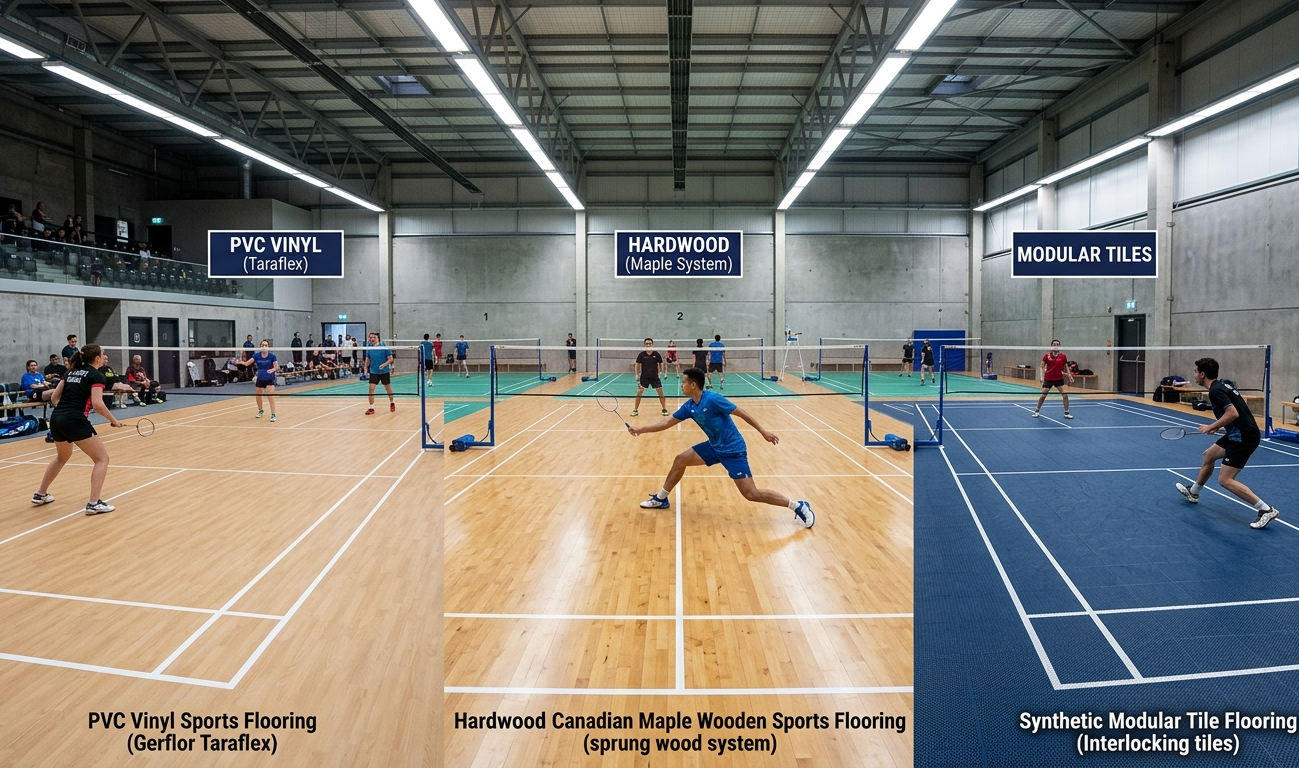
Choosing the Right Flooring for Your Badminton Court: A Complete Guide
Choosing the right flooring for your badminton court is one of the most important decisions when developing a safe, comfortable, and high-performance sports facility. Badminton involves rapid footwork, sudden changes in direction, lunges, jumps, and repeated movements that place considerable demands on the playing surface.
The right badminton court flooring should provide excellent traction, effective shock absorption, consistent playing characteristics, and long-term durability. Whether you are planning an indoor badminton court for a sports academy, school, fitness club, residential facility, or professional training centre, selecting a suitable flooring system can significantly influence player comfort and overall court performance.
At Sports Facility India, we provide comprehensive badminton court flooring solutions designed around the specific requirements of each project. From flooring consultation and surface preparation to professional installation and finishing, our team helps clients select practical flooring systems that balance performance, aesthetics, maintenance, and budget.
Why Choosing the Right Flooring for Your Badminton Court Matters
A badminton court is more than a marked playing area. Its flooring directly affects how players move, stop, turn, jump, and maintain balance during the game. An unsuitable surface may compromise comfort, traction, and long-term usability.
High-quality badminton court flooring creates a controlled playing environment that supports recreational players, coaches, and competitive athletes. The correct surface can also contribute to easier maintenance, improved facility appearance, and reduced long-term replacement requirements.
Key Benefits of Selecting Suitable Badminton Flooring
- Improved Player Safety: Suitable grip and cushioning help support stable movement and reduce unnecessary impact.
- Enhanced Playing Performance: Consistent surface characteristics support quick footwork and controlled movement.
- Shock Absorption: Cushioned systems help manage impact during lunges, jumps, and rapid direction changes.
- Long-Term Durability: Quality flooring withstands regular training sessions and repeated foot traffic.
- Easy Maintenance: Properly selected surfaces can simplify cleaning and routine upkeep.
- Professional Appearance: Attractive colours and precise court markings enhance the overall sports environment.
Important Factors to Consider Before Choosing Badminton Court Flooring
Every badminton court project has different requirements. Before selecting a flooring material, it is essential to evaluate the type of facility, expected usage, existing subfloor, player requirements, and available budget.
1. Type of Badminton Court
The flooring requirements for a professional indoor badminton academy may differ from those of a school, community centre, or multipurpose sports hall. Indoor courts generally require sports flooring systems designed for controlled traction, cushioning, and consistent movement.
2. Player Safety and Shock Absorption
Badminton involves repeated jumps, lunges, and sudden stops. Flooring with appropriate shock absorption and surface grip can improve comfort and support safer movement. The cushioning level should be selected according to the intended use and the flooring system's technical specifications.
3. Surface Grip and Traction
Players need dependable traction for quick changes in direction. A badminton court floor should provide a balanced grip that supports movement without feeling excessively slippery or obstructing natural footwork.
4. Durability and Usage Intensity
Courts used for several hours each day require flooring that can withstand regular training, repeated movement, and foot traffic. Material quality, wear resistance, installation standards, and maintenance all influence the useful life of the flooring.
5. Maintenance Requirements
Consider how easily the flooring can be cleaned, whether it requires periodic refinishing, and how well it handles dust, moisture, and regular usage. Low-maintenance flooring can be particularly practical for schools, clubs, and busy sports facilities.
6. Budget and Total Installation Cost
Flooring selection should account for more than the material purchase price. Surface preparation, subfloor correction, installation, court marking, transportation, and future maintenance may also influence the total project cost.
7. Professional Installation Quality
Even premium flooring may perform poorly if installed over an unsuitable or uneven base. Proper subfloor preparation, accurate installation, correct adhesive selection where applicable, and precise court marking are essential for achieving a reliable finished surface.
Best Flooring Options for Your Badminton Court
Different badminton court flooring systems offer different advantages. The best option depends on the facility's purpose, performance expectations, maintenance preferences, and budget.
1. Wooden Sports Flooring
Wooden sports flooring is a popular choice for premium indoor badminton facilities and performance-oriented sports environments. When properly engineered with an appropriate sports subfloor and surface finish, it can provide a comfortable and responsive playing experience.
Best suited for: Professional indoor courts, sports academies, and premium athletic facilities.
Advantages
- Suitable sports flooring systems can provide effective impact management.
- Premium appearance and professional indoor sports ambience.
- Can be designed for demanding athletic environments.
- Compatible with specialized sports surface finishes.
Considerations: May require higher initial investment, skilled installation, and regular maintenance depending on the wood system and usage.
2. PVC Vinyl Sports Flooring
PVC sports flooring is widely considered for indoor badminton courts because of its cushioned construction options, consistent surface finish, and relatively simple maintenance. It is available in different thicknesses, textures, and performance grades.
Best suited for: Badminton clubs, schools, indoor academies, gyms, and multipurpose sports halls.
Advantages
- Available in cushioned sports flooring configurations.
- Offers practical cleaning and maintenance requirements.
- Available in multiple colours and surface designs.
- Suitable options for regular training and recreational use.
- Can be installed efficiently on a properly prepared subfloor.
Considerations: Product quality, wear layer, cushioning construction, and installation technique should be evaluated before selection.
3. PU Synthetic Sports Flooring
Polyurethane-based sports flooring is another option for indoor athletic facilities. Depending on the system design, PU flooring can offer a seamless finish, durable surface performance, and suitable traction for multipurpose sports environments.
Best suited for: Indoor sports halls, recreational centres, and multipurpose athletic facilities.
Advantages
- Seamless finish in suitable installed systems.
- Can be designed for sports use and regular foot traffic.
- Available in different performance specifications.
- Suitable for facilities requiring a continuous synthetic surface.
Considerations: The system must be specified for badminton and installed according to the manufacturer's technical requirements.
4. Modular Interlocking Sports Mats
Modular interlocking mats are designed for facilities that need flexible installation, portability, or temporary sports setups. These systems can be practical where flooring needs to be assembled, removed, or relocated.
Best suited for: Temporary courts, recreational facilities, practice spaces, and flexible sports areas.
Advantages
- Convenient installation and removal.
- Practical for selected temporary or portable applications.
- Available in anti-slip and cushioned designs.
- Can be useful for facilities with changing space requirements.
Considerations: Joint design, surface stability, movement under load, and suitability for the intended level of play should be checked carefully.
Badminton Court Flooring Comparison: Which Surface Should You Choose?
The following table provides a general comparison of commonly considered badminton court flooring systems. Actual performance and service life depend on product specifications, installation quality, usage, and maintenance.
| Flooring Type | Ideal Application | Maintenance | Key Advantage | Investment Level |
|---|---|---|---|---|
| Wooden Sports Flooring | Premium indoor sports facilities | Moderate | Professional sports environment and engineered performance | Higher |
| PVC Vinyl Sports Flooring | Clubs, schools, academies, and indoor courts | Low to moderate | Cushioned options and practical maintenance | Moderate |
| PU Synthetic Flooring | Indoor multipurpose sports halls | Low to moderate | Seamless synthetic surface options | Moderate to higher |
| Modular Interlocking Mats | Temporary and flexible sports setups | Low to moderate | Portability and quick assembly | Varies by system |
Which Badminton Court Flooring Is Suitable for Different Facilities?
The ideal badminton flooring depends on the type of facility, playing frequency, and performance requirements. Here is a practical guide for initial planning.
| Facility Type | Flooring Options to Evaluate | Primary Considerations |
|---|---|---|
| Professional Badminton Academy | Engineered wooden or specialized cushioned sports flooring | Player comfort, performance, and long-term durability |
| School Badminton Court | PVC or suitable synthetic sports flooring | Safety, maintenance, and budget |
| Indoor Badminton Club | PVC, PU, or engineered wooden systems | Daily usage, durability, and operating costs |
| Multipurpose Sports Hall | PU or compatible synthetic sports flooring | Multi-sport suitability and surface resilience |
| Temporary Training Area | Suitable modular sports mats | Portability, stability, and installation flexibility |
Technical Requirements for High-Quality Badminton Court Flooring
Selecting badminton flooring based solely on appearance or price may lead to performance and maintenance challenges. A professional flooring system should be evaluated using technical and site-specific criteria.
- Subfloor Flatness: The base should be properly prepared and sufficiently level for the selected flooring system.
- Shock Absorption: Choose a system with cushioning characteristics appropriate for the intended use.
- Surface Traction: The floor should support controlled movement and dependable grip.
- Wear Resistance: The surface should be suitable for expected training intensity and foot traffic.
- Moisture Assessment: Indoor subfloors should be evaluated for moisture-related installation risks.
- Accurate Court Markings: Lines should be clearly marked according to the applicable badminton court dimensions.
- Lighting and Environment: Flooring should be considered alongside ventilation, lighting, and indoor facility conditions.
For competition-oriented projects, consult the applicable badminton regulations and flooring performance requirements before finalizing the design.
Professional Badminton Court Flooring Installation Process
Proper installation plays an important role in the safety, appearance, and performance of badminton court flooring. At Sports Facility India, our flooring installation approach is planned according to the selected material and site conditions.
- Site Inspection and Consultation: Evaluate the available space, intended usage, and existing floor condition.
- Subfloor Assessment: Check the base for levelness, cracks, surface defects, and relevant moisture conditions.
- Surface Preparation: Repair, clean, level, and prepare the base according to the selected flooring system.
- Flooring Material Selection: Finalize the appropriate product, thickness, finish, and performance specifications.
- Professional Installation: Install the flooring using suitable techniques and manufacturer-recommended procedures.
- Joint and Surface Finishing: Complete seams, transitions, edges, and finishing details where applicable.
- Court Marking: Apply accurate badminton court lines using suitable marking materials.
- Quality Inspection and Handover: Review the finished surface, markings, cleanliness, and project completion requirements.
Common Mistakes to Avoid When Choosing Badminton Court Flooring
Many flooring problems can be avoided by making informed decisions during the planning stage. Consider the following common mistakes before starting your project.
- Choosing flooring only because it has a low purchase price.
- Ignoring the condition and levelness of the existing subfloor.
- Selecting general-purpose flooring that is not designed for badminton.
- Overlooking shock absorption and traction requirements.
- Failing to consider daily usage and expected foot traffic.
- Using inexperienced installers without sports flooring knowledge.
- Neglecting maintenance instructions provided by the manufacturer.
- Not checking the compatibility of court markings with the flooring surface.
Badminton Court Flooring Maintenance Tips
Regular maintenance helps preserve the appearance and functional performance of badminton court flooring. Maintenance procedures should always follow the flooring manufacturer's recommendations.
- Remove dust and loose dirt using a soft broom or suitable vacuum.
- Use a clean, slightly damp microfiber mop where appropriate.
- Avoid harsh chemicals and abrasive cleaning equipment.
- Prevent outdoor dirt and moisture from being carried onto the court.
- Inspect flooring joints, surface wear, and court markings periodically.
- Address damage or surface defects promptly.
- Use suitable footwear designed for indoor court sports.
- Schedule professional maintenance when recommended for the flooring system.
Why Choose Sports Facility India for Badminton Court Flooring?
Selecting the right flooring partner is just as important as selecting the right material. Sports Facility India offers badminton court flooring solutions designed to support projects from initial planning through installation and completion.
Our Badminton Flooring Services Include
- Badminton court flooring consultation and planning.
- Indoor sports flooring recommendations.
- PVC, synthetic, and wooden flooring solutions.
- Subfloor preparation and surface correction.
- Professional badminton court flooring installation.
- Accurate court marking and finishing.
- Solutions for schools, clubs, academies, and sports facilities.
- Project support based on site conditions and client requirements.
Our objective is to help clients develop badminton courts that combine functional performance, attractive design, practical maintenance, and long-term usability.
Frequently Asked Questions About Choosing Badminton Court Flooring
Q1. What is the best flooring for a badminton court?
The best flooring depends on the facility's usage, budget, and performance requirements. Engineered wooden sports flooring, cushioned PVC flooring, and suitable synthetic sports flooring are commonly considered options for indoor badminton courts.
Q2. Is PVC flooring suitable for badminton courts?
Yes. PVC sports flooring can be suitable for badminton courts when it is specifically designed for indoor sports use and installed correctly. Its cushioning, traction, wear resistance, and surface specifications should be evaluated before selection.
Q3. Is wooden flooring better than synthetic flooring for badminton?
Wooden and synthetic sports flooring systems offer different advantages. Wooden systems may be preferred for certain premium indoor facilities, while synthetic options can provide practical maintenance and installation benefits. The best choice depends on the project's requirements.
Q4. Why is shock absorption important in badminton court flooring?
Shock absorption helps manage impact during jumps, lunges, and repeated movement. A suitable cushioned flooring system can improve player comfort and support safer movement during training and play.
Q5. How long does badminton court flooring last?
The service life varies according to flooring material, product quality, installation, usage intensity, and maintenance. Some systems may provide many years of service when properly selected and maintained. Consult the manufacturer for product-specific service-life expectations.
Q6. What factors affect badminton court flooring cost?
Flooring cost depends on material type, thickness, court size, subfloor condition, surface preparation, installation complexity, transportation, court markings, and project location.
Q7. Can badminton court flooring be installed on an existing concrete floor?
Yes, many flooring systems can be installed over a suitable existing concrete base. However, the floor must be assessed for levelness, cracks, moisture, cleanliness, and compatibility with the selected flooring system.
Q8. Do you provide complete badminton court flooring installation services?
Yes. Sports Facility India provides badminton court flooring consultation, surface preparation, professional flooring installation, court marking, and finishing services based on project requirements.
Choose the Right Flooring for Your Badminton Court!
Build a safer, more comfortable, and durable badminton playing environment with professional flooring solutions from Sports Facility India. Get expert guidance on material selection, installation, and complete badminton court flooring requirements.
Request Your Free Flooring Quote