
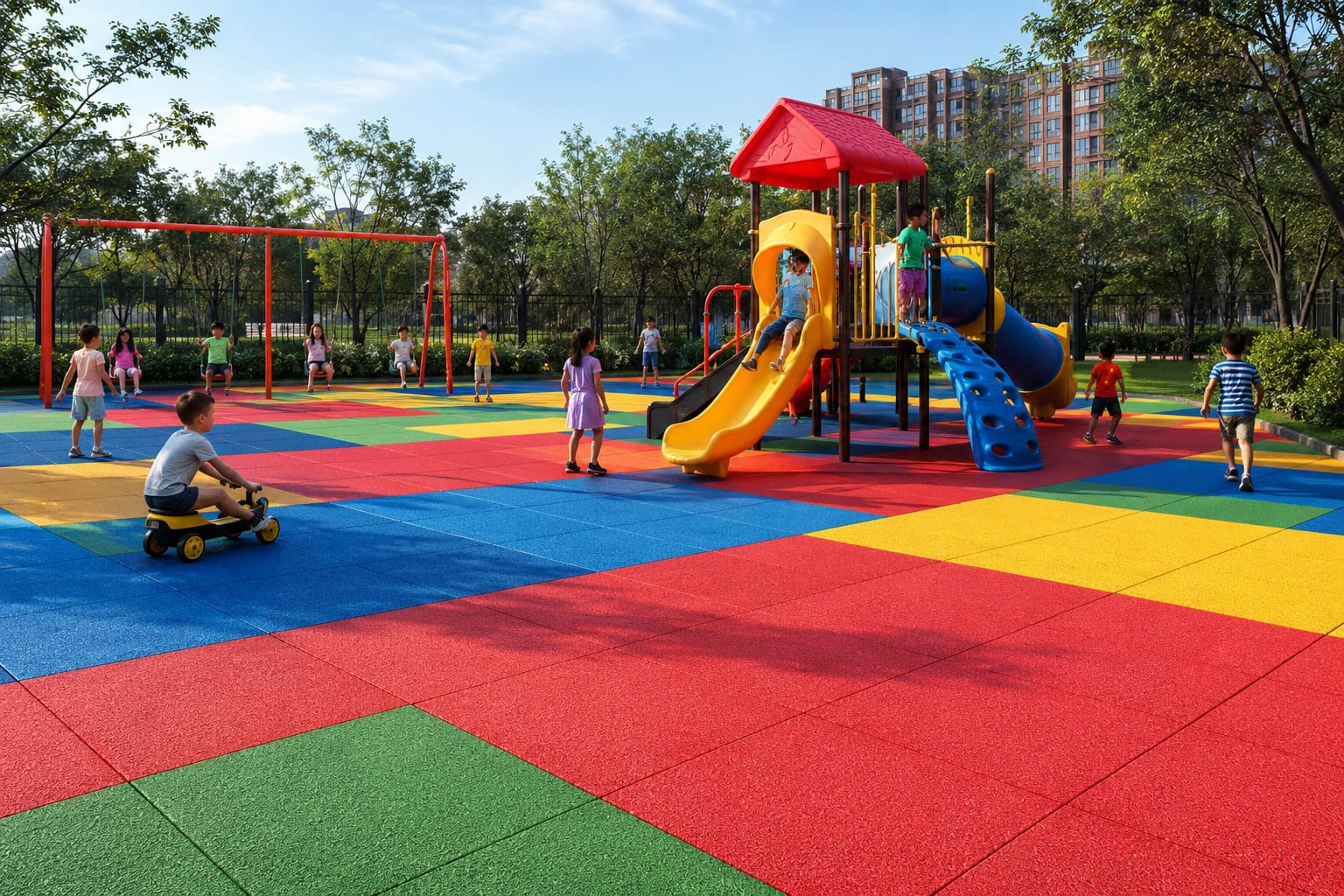
Why Choose Rubber Flooring for Children's Play Areas?
Playground flooring should be selected according to children's activities, playground equipment, site conditions and expected usage. Traditional hard surfaces may provide a rigid foundation, whereas appropriately specified rubber flooring offers a more resilient surface for recreational environments.
Rubber playground flooring is popular because it provides a combination of comfort, traction, surface flexibility, impact-absorbing characteristics and attractive design possibilities. Depending on the selected product and installation system, it can be used for both indoor and outdoor playground applications.
Another important advantage is design flexibility. Different rubber colours can be combined to create educational graphics, activity tracks, hopscotch patterns, colourful pathways and dedicated play zones.
- Resilient and comfortable playground surface.
- Slip-resistant textures available.
- Impact-absorbing characteristics depending on system specification.
- Suitable options for indoor and outdoor applications.
- Multiple colours and decorative patterns.
- Suitable for regular playground foot traffic.
- Convenient routine cleaning and maintenance.
- Customised flooring designs for different age groups.
- Available in modular and seamless flooring systems.
- Suitable for educational, residential and commercial projects.
Benefits of Rubber Playground Flooring for Kids
Installing suitable rubber flooring can improve the functionality and appearance of children's recreational areas. The main benefits depend on the rubber material, thickness, surface construction and installation quality.
1. Comfortable Playing Surface
Rubber flooring provides a resilient surface that is generally more comfortable underfoot than rigid concrete or ceramic flooring. It is suitable for areas where children regularly walk, run and participate in recreational activities.
2. Impact Absorption
Specially designed playground rubber flooring systems can absorb impact and help reduce the severity of certain falls. The required impact attenuation must be determined according to the playground equipment, critical fall height and applicable safety standards.
3. Slip-Resistant Surface
Suitable rubber flooring textures provide traction for everyday playground activities. Actual slip performance depends on the surface finish, moisture conditions, contamination and maintenance.
4. Attractive Colour Options
EPDM rubber flooring is available in a wide range of colours. Different shades can be combined to develop colourful playground layouts, learning areas and activity zones.
5. Indoor and Outdoor Applications
Depending on the product specification, rubber flooring can be installed in indoor play centres, schools, daycare facilities, residential societies, public parks and outdoor playgrounds.
6. Easy Routine Maintenance
Regular sweeping, suitable cleaning and periodic inspection help maintain the appearance and condition of rubber playground flooring.
7. Flexible Playground Designs
Rubber flooring can be installed in different patterns and layouts to create customised playground environments according to project requirements.
Applications of Rubber Flooring for Children's Play Areas
Rubber playground flooring is suitable for a wide range of educational, residential, recreational, hospitality and commercial environments. It can be specified for small indoor activity rooms as well as larger outdoor playground developments.
Educational Facilities
- School playgrounds
- Preschools
- Nursery schools
- Kindergartens
- Daycare centres
- Early learning centres
Residential Projects
- Residential societies
- Apartment complexes
- Gated communities
- Private villas
- Housing developments
- Community play areas
Commercial and Public Spaces
- Public parks
- Shopping malls
- Hotels and resorts
- Amusement parks
- Indoor play centres
- Recreational clubs
Types of Rubber Flooring for Children's Play Area
Different playground projects require different flooring systems. Factors such as location, equipment height, base condition, drainage, expected traffic, maintenance and design preferences influence the selection.
1. EPDM Rubber Flooring
EPDM rubber flooring is a popular choice for modern playgrounds because of its colour variety, weather-resistant options and decorative flexibility. EPDM granules are generally combined with a suitable polyurethane binder and installed as a continuous rubber surface.
EPDM playground flooring is commonly used in schools, residential societies, public parks, daycare centres and outdoor recreational facilities. Different colours can be combined to create attractive patterns, graphics and activity zones.
2. Rubber Safety Tiles
Rubber safety tiles provide a modular playground surfacing solution. These tiles are manufactured in different dimensions, thicknesses, colours and surface finishes. Individual units can be replaced when required, depending on the product and installation arrangement.
They are suitable for selected school playgrounds, residential play areas, daycare centres and recreational spaces where modular flooring is preferred.
3. Interlocking Rubber Flooring Mats
Interlocking rubber mats are designed with connecting edges that allow individual flooring units to fit together. They offer a practical option for indoor activity areas and selected recreational environments requiring modular installation.
Their suitability depends on the product construction, intended use, subfloor and required impact performance.
4. Poured-in-Place Rubber Flooring
Poured-in-place rubber flooring is installed on-site to create a continuous playground surface. It can be designed using different colour combinations, patterns, graphics and activity layouts.
This system is particularly suitable for customised playground developments, larger recreational areas, schools, parks and residential projects.
5. Recycled Rubber Playground Flooring
Recycled rubber granules can be used in selected playground surfacing systems. They are commonly incorporated into the base layer of certain multi-layer rubber flooring installations, depending on the required surface construction.
Rubber Flooring vs Other Children's Playground Flooring Options
Selecting playground flooring requires evaluating comfort, traction, maintenance, durability, impact performance and overall project requirements. The following comparison provides a general overview of common playground surfaces.
| Comparison Factor | Rubber Flooring | Concrete | Artificial Grass | Sand |
|---|---|---|---|---|
| Surface Comfort | Resilient | Rigid | Soft surface feel | Variable |
| Impact Performance | Depends on tested system and thickness | Limited | Depends on underlay system | Depends on depth and condition |
| Traction | Depends on texture and conditions | Depends on finish | Depends on product | Variable |
| Design Options | Extensive | Limited | Moderate | Limited |
| Cleaning | Generally convenient | Convenient | Requires periodic maintenance | Requires regular maintenance |
| Indoor Applications | Yes, suitable systems | Yes | Product dependent | Limited applications |
| Outdoor Applications | Yes, suitable systems | Yes | Yes | Yes |
Note: No playground surface should be considered automatically safe for every fall height. Product testing, installation specifications and playground equipment requirements should be reviewed before selecting the final surface.
Rubber Flooring for Indoor Children's Play Areas
Indoor children's play areas require flooring that can withstand frequent movement while maintaining a comfortable and attractive appearance. Rubber flooring is a practical option for selected indoor recreational environments.
Indoor rubber playground flooring can be installed in activity rooms, daycare centres, preschools, shopping malls, children's entertainment centres and educational facilities.
Common Indoor Applications
- Indoor kids play zones
- Daycare activity rooms
- Preschool play areas
- Shopping mall play centres
- Children's recreation rooms
- Indoor educational activity zones
- Private playrooms
- Family entertainment centres
The selected flooring should be suitable for the indoor environment, including ventilation, subfloor condition, cleaning requirements and the intended playground activities.
Outdoor Rubber Flooring for Children's Playgrounds
Outdoor playgrounds are exposed to sunlight, rain, dust, temperature variations and regular foot traffic. Therefore, outdoor rubber flooring must be selected according to environmental exposure and site conditions.
EPDM rubber flooring and other suitable outdoor playground systems can create colourful and resilient recreational surfaces. They can be installed in schools, public parks, residential societies, community playgrounds and commercial outdoor play zones.
Important Outdoor Flooring Considerations
- UV and weather exposure.
- Suitable rubber material selection.
- Proper base preparation.
- Effective water drainage.
- Appropriate flooring thickness.
- Surface slope and water management.
- Suitable bonding and installation methods.
- Periodic cleaning and inspection.
Proper drainage and foundation preparation are particularly important for outdoor playground installations. Water accumulation can affect the performance and long-term condition of the flooring system.
Rubber Flooring for School Playgrounds
Schools require organised recreational spaces where children can participate in physical activities, outdoor games and everyday play. Rubber playground flooring is an option for developing colourful and functional school playgrounds.
It can be used around selected play structures, activity zones, nursery playgrounds, kindergarten areas and primary school recreational spaces.
School Playground Flooring Applications
- Nursery school playgrounds.
- Kindergarten activity areas.
- Primary school play zones.
- Outdoor recreational spaces.
- School activity pathways.
- Educational graphics and learning zones.
- Hopscotch and number activity layouts.
Flooring thickness and impact attenuation should be specified according to playground equipment, critical fall height and the applicable safety requirements.
Rubber Flooring for Residential Society and Apartment Play Areas
Modern residential developments increasingly include dedicated children's playgrounds and recreational spaces. Rubber flooring helps developers create colourful and organised play areas that complement landscaped gardens, walking pathways and community amenities.
Rubber playground flooring can be used in apartment complexes, gated communities, housing societies, villas and residential townships.
Customised colour combinations, activity patterns and play-zone layouts can help integrate the flooring with the overall residential landscape design.
Rubber Flooring for Public Parks and Community Playgrounds
Public parks and community playgrounds experience regular usage by children from different age groups. Selecting a suitable playground surfacing system is therefore important for maintaining the functionality and appearance of recreational facilities.
Rubber playground flooring can be considered for municipal parks, urban gardens, community recreation areas and public children's activity zones.
- Municipal playgrounds.
- City parks.
- Community gardens.
- Public recreational spaces.
- Children's activity parks.
- Theme park play zones.
- Outdoor community facilities.
Important Features of High-Quality Rubber Playground Flooring
The performance of rubber playground flooring depends on the materials used, product construction, installation quality and maintenance. Important features to evaluate before purchasing include:
| Feature | Description |
|---|---|
| Surface Resilience | Provides a flexible and comfortable recreational surface. |
| Impact Attenuation | Selected systems can be tested to assess impact performance at specified thicknesses and fall heights. |
| Traction | Textured rubber finishes can provide suitable grip for playground activities. |
| Weather Resistance | Appropriate outdoor systems are designed for environmental exposure. |
| UV Stability | Suitable materials help maintain colour appearance under sunlight exposure. |
| Colour Variety | Different shades allow creative playground designs. |
| Maintenance | Routine sweeping, cleaning and inspection help maintain the surface. |
| Durability | Properly selected and installed systems are designed for regular recreational use. |
Rubber Flooring Thickness for Children's Play Areas
Choosing the correct rubber flooring thickness is an important part of playground planning. There is no single thickness suitable for every application because impact performance depends on the complete flooring system, material composition, equipment height and installation conditions.
Playground flooring thickness should be specified according to the critical fall height of the equipment and verified through appropriate product testing. Simply increasing the thickness of an unspecified rubber surface does not automatically guarantee the required impact performance.
Factors Affecting Flooring Thickness
- Height of playground equipment.
- Critical fall height requirements.
- Type of rubber flooring system.
- EPDM and recycled rubber layer composition.
- Base construction.
- Applicable playground safety standards.
- Manufacturer testing and installation specifications.
Sports Facility recommends evaluating the playground equipment and site conditions before finalising the flooring thickness and material specification.
Materials Used in Rubber Playground Flooring
Different rubber flooring systems use different raw materials and installation components. The exact material combination depends on whether the project uses EPDM surfacing, recycled rubber, safety tiles or poured-in-place flooring.
Common Playground Flooring Materials
- EPDM Rubber Granules: Coloured rubber granules used for decorative and wear layers.
- Recycled Rubber Granules: Rubber particles used in selected resilient base layers.
- Polyurethane Binder: A bonding component used in suitable poured rubber systems.
- Primer: Used where required to improve adhesion to the prepared substrate.
- Adhesive: Used for applicable rubber tile and mat installations.
- Concrete or Asphalt Base: Suitable foundations for selected playground systems.
- Edge Restraints: Supporting components used where required for perimeter finishing.
Rubber Playground Flooring Colours and Design Options
Colourful flooring plays an important role in modern children's playground design. EPDM rubber granules and other suitable rubber flooring products are available in multiple shades, allowing designers to develop visually engaging play environments.
Popular Rubber Flooring Colours
- Red rubber flooring.
- Blue rubber flooring.
- Green rubber flooring.
- Yellow rubber flooring.
- Orange rubber flooring.
- Purple rubber flooring.
- Brown rubber flooring.
- Grey rubber flooring.
- Black rubber flooring.
- Custom colour combinations.
Different colours can be combined to create pathways, activity zones, geometric patterns, educational graphics and decorative playground layouts.
Customised Rubber Flooring Designs for Kids Play Areas
Modern playground flooring can be designed beyond conventional single-colour surfaces. Customised rubber flooring helps create attractive and interactive recreational environments while allowing educational and activity-based graphics to be incorporated into the playground layout.
Popular Playground Design Ideas
- Alphabet learning graphics.
- Number and counting zones.
- Animal-themed playground designs.
- Hopscotch patterns.
- Geometric shapes.
- Activity and running tracks.
- Nature-inspired graphics.
- Educational learning layouts.
- School logos and branding.
- Multi-colour recreational zones.
Custom layouts can be planned according to the available area, playground equipment, children's age groups and architectural requirements.
Rubber Flooring Installation Process for Children's Play Areas
Professional installation is essential for achieving a consistent, durable and properly finished playground surface. The installation method depends on the selected flooring system, foundation, site conditions and project specifications.
Step 1: Site Inspection and Measurement
The installation process begins with a detailed site inspection. The available area, existing ground, drainage, playground equipment and project requirements are evaluated before selecting the flooring system.
- Playground area measurement.
- Existing surface inspection.
- Drainage evaluation.
- Equipment layout assessment.
- Site accessibility review.
Step 2: Base Preparation
The foundation must be suitable for the selected rubber flooring system. Depending on the project, concrete, asphalt or another approved substrate may be used.
- Removal of dust and debris.
- Cleaning the existing base.
- Repairing damaged areas.
- Checking surface levels.
- Evaluating moisture conditions.
- Preparing the substrate.
Step 3: Flooring Material Selection
The appropriate playground flooring system is selected according to the intended application, equipment, impact requirements, expected traffic and design preferences.
- EPDM rubber flooring.
- Rubber safety tiles.
- Interlocking rubber mats.
- Poured-in-place rubber surfacing.
Step 4: Rubber Flooring Installation
Once the substrate is ready, the selected flooring material is installed according to the manufacturer's recommended procedures. Correct material preparation, alignment, bonding, joint treatment and finishing are important for achieving a consistent result.
- Primer application where required.
- Rubber material preparation.
- Installation of the selected flooring system.
- Proper alignment and joint treatment.
- Edge and transition finishing.
- Surface detailing.
Step 5: Quality Inspection and Project Handover
After installation, the completed surface is inspected for workmanship, consistency, finishing and cleanliness. Any specified performance verification should also be completed before the playground is opened for use.
- Surface quality inspection.
- Level and drainage review.
- Edge finishing inspection.
- Cleaning and finishing.
- Project handover.
- Maintenance instructions.
Maintenance and Cleaning of Rubber Playground Flooring
Regular cleaning and inspection help preserve the appearance and service condition of rubber playground flooring. A suitable maintenance programme should include debris removal, surface cleaning, drainage checks and inspection of joints and edges.
Daily and Routine Maintenance
- Sweep away dust, leaves and loose debris.
- Clean food and liquid spills promptly.
- Use suitable soft cleaning brushes or mops.
- Wash the flooring periodically with manufacturer-approved cleaning products.
- Keep drainage outlets clear.
- Inspect high-traffic playground areas.
- Avoid unsuitable harsh chemicals.
- Maintain cleanliness around playground equipment.
Long-Term Playground Flooring Care
- Inspect the surface periodically.
- Check joints, edges and transitions.
- Identify loose or damaged areas.
- Inspect the flooring around play equipment.
- Repair damaged sections promptly.
- Maintain proper drainage.
- Follow the manufacturer's maintenance instructions.
- Arrange professional inspection when required.
Rubber Flooring for Children's Play Area Price and Cost Factors
The rubber flooring for children's play area price depends on several factors, including the total playground area, flooring material, thickness, base preparation, customisation and installation requirements. Therefore, an accurate quotation should be prepared after evaluating the actual project.
Factors Affecting Playground Rubber Flooring Cost
| Cost Factor | Details |
|---|---|
| Playground Area | Total square footage or square metres requiring flooring. |
| Flooring Material | EPDM granules, recycled rubber, safety tiles or interlocking mats. |
| Flooring Thickness | Specified thickness and construction of the selected system. |
| Base Preparation | Cleaning, repair, levelling and substrate preparation. |
| Customisation | Colour combinations, graphics, patterns and activity zones. |
| Transportation | Material delivery and project location. |
| Installation Complexity | Site accessibility, layout, edges and installation requirements. |
Sports Facility provides project-based quotations according to the flooring system, site conditions and customer requirements. Contact our team for a customised estimate for your playground flooring project.
How to Select the Best Rubber Flooring for a Children's Play Area
Selecting the right playground flooring requires more than comparing material prices. The flooring system should be suitable for the location, equipment, intended activities, maintenance requirements and expected usage.
Important Points to Consider Before Purchasing
- Determine whether the playground is indoors or outdoors.
- Measure the total installation area.
- Inspect the existing foundation.
- Evaluate playground equipment and critical fall heights.
- Select an appropriate rubber flooring system.
- Verify impact performance and relevant test documentation.
- Choose suitable colours and design patterns.
- Consider drainage and environmental exposure.
- Review maintenance requirements.
- Choose an experienced playground flooring contractor.
Common Mistakes to Avoid When Installing Rubber Playground Flooring
Incorrect material selection and poor installation practices can affect the performance and durability of playground flooring. The following mistakes should be avoided during project planning and execution.
- Choosing flooring only on the basis of the lowest price.
- Ignoring playground equipment fall heights.
- Using an unsuitable flooring thickness.
- Installing rubber flooring over an unprepared base.
- Ignoring water drainage requirements.
- Selecting materials unsuitable for outdoor exposure.
- Ignoring edge and joint finishing.
- Using unqualified installation teams.
- Failing to inspect the completed surface.
- Neglecting regular maintenance.
Durability and Performance of Rubber Playground Flooring
Quality rubber playground flooring is designed for regular recreational use. Its long-term performance depends on raw material quality, product construction, installation workmanship, foundation condition, environmental exposure and maintenance.
For outdoor applications, UV stability, weather resistance and effective drainage are particularly important. For indoor applications, the flooring should be appropriate for the interior environment and expected activity levels.
Important Performance Considerations
- Resistance to regular foot traffic.
- Suitable outdoor weather performance.
- Colour stability of selected materials.
- Surface resilience.
- Appropriate impact attenuation.
- Bonding and joint integrity.
- Ease of routine maintenance.
Why Choose Sports Facility for Rubber Flooring for Children's Play Area?
Sports Facility offers professional rubber playground flooring solutions for educational institutions, residential developments, public parks, commercial projects and recreational facilities across India.
We understand that every playground has different requirements. Our approach focuses on evaluating the project location, surface condition, intended usage, playground equipment, flooring design and installation requirements before recommending a suitable system.
From initial consultation to installation and finishing, our team assists customers in developing playground flooring solutions suited to their project specifications.
Our Key Service Advantages
- Professional playground flooring consultation.
- Site inspection and area measurement.
- Flooring material selection.
- EPDM rubber flooring solutions.
- Rubber safety tile installation.
- Customised playground colour combinations.
- Professional installation and finishing.
- Project coordination across India.
- Quality inspection and handover.
- Maintenance guidance and support.
Our Complete Rubber Playground Flooring Services
Sports Facility provides end-to-end assistance for playground rubber flooring projects, including new installations, customised flooring designs and renovation requirements.
Planning and Preparation
- Playground flooring consultation.
- Site survey and inspection.
- Area measurement.
- Base condition assessment.
- Ground preparation.
- Flooring material selection.
- Drainage assessment.
Installation and Finishing
- EPDM rubber flooring installation.
- Rubber safety tile installation.
- Interlocking rubber mat installation.
- Poured-in-place rubber flooring.
- Custom playground graphics.
- Educational flooring designs.
- Edge finishing and inspection.
Industries and Sectors We Serve
Our playground rubber flooring solutions are suitable for different types of public, private, educational, residential and commercial projects.
| Industry | Typical Flooring Application |
|---|---|
| Schools | Outdoor playgrounds and activity zones. |
| Preschools and Kindergartens | Early learning and children's play areas. |
| Daycare Centres | Indoor and outdoor recreational spaces. |
| Residential Developers | Apartment and society playgrounds. |
| Public Parks | Municipal and community playgrounds. |
| Hotels and Resorts | Children's recreation facilities. |
| Shopping Malls | Indoor children's entertainment zones. |
| Commercial Developers | Family entertainment and recreational facilities. |
| Government Projects | Public playground and park developments. |
Frequently Asked Questions About Rubber Flooring for Children's Play Area
1. What is rubber flooring for children's play areas?
Rubber flooring for children's play areas is a resilient surfacing solution designed for indoor and outdoor recreational spaces. It is manufactured using rubber materials such as EPDM and recycled rubber and is available in poured-in-place systems, safety tiles and interlocking mats.
2. Is rubber flooring suitable for children's playgrounds?
Yes. Suitable rubber flooring systems can be used in children's playgrounds because they offer surface resilience, traction, design flexibility and convenient maintenance. The flooring should be selected according to the required impact performance and playground equipment.
3. Which rubber flooring is best for a kids' play area?
EPDM rubber flooring, poured-in-place rubber surfacing, rubber safety tiles and interlocking rubber mats are common options. The best system depends on the playground location, base condition, equipment, impact requirements and budget.
4. Is EPDM rubber flooring suitable for outdoor playgrounds?
Yes. Suitable EPDM rubber flooring systems are widely used in outdoor playgrounds, schools, residential societies and public parks. The product should have appropriate outdoor performance characteristics, including suitable UV and weather resistance.
5. Can rubber flooring be installed in indoor play areas?
Yes. Appropriate rubber flooring systems can be installed in indoor play centres, daycare facilities, preschools, shopping malls and children's activity rooms.
6. Does rubber playground flooring help reduce the impact of falls?
Specially designed and tested playground rubber surfacing can provide impact attenuation. The actual performance depends on the flooring construction, thickness, installation and critical fall height of the playground equipment.
7. What thickness of rubber flooring is required for a children's playground?
The required thickness depends on playground equipment height, critical fall height, flooring material, base construction and tested system performance. A site and equipment assessment should be completed before finalising the specification.
8. Is rubber playground flooring waterproof?
Water performance depends on the selected rubber flooring system and its construction. Some systems are permeable, while others require a suitable base and drainage arrangement. Proper water management is important for outdoor installations.
9. What colours are available in rubber playground flooring?
Rubber playground flooring is available in colours such as red, green, blue, yellow, orange, grey, black, brown and purple. Multiple colours can be combined to create customised playground patterns.
10. Can rubber flooring be customised with educational designs?
Yes. Depending on the selected flooring system, customised designs can include alphabets, numbers, animal graphics, hopscotch layouts, geometric patterns, activity tracks and school branding.
11. How do you clean rubber playground flooring?
Rubber playground flooring can generally be maintained through regular sweeping, debris removal and periodic cleaning with suitable cleaning products. Manufacturer-recommended maintenance procedures should always be followed.
12. What is the price of rubber flooring for a children's play area?
The price depends on the total playground area, flooring type, material quality, thickness, base preparation, customisation, transportation and installation complexity. Contact Sports Facility for a project-specific quotation.
13. Can rubber flooring be installed over concrete?
Yes. Suitable rubber playground flooring systems can be installed over properly prepared concrete substrates. The concrete must meet the selected system's requirements for strength, level, moisture and drainage.
14. How long does rubber playground flooring last?
The service life depends on material quality, system construction, installation workmanship, foot traffic, environmental exposure and maintenance. The manufacturer's product specifications should be reviewed for expected service performance.
15. Does Sports Facility provide rubber playground flooring installation across India?
Sports Facility provides rubber playground flooring consultation and installation services for projects across India. Our services include site inspection, material selection, base preparation, rubber flooring installation, customised designs and project handover.
Which Flooring Is Best for a Children's Play Area?
Rubber flooring is a popular option for children's play areas because it offers a resilient surface, traction, attractive colour choices and practical maintenance. EPDM rubber flooring, poured-in-place rubber, safety tiles and interlocking mats can be selected according to playground location, equipment and impact performance requirements.
What Is Rubber Playground Flooring?
Rubber playground flooring is a resilient surfacing system made using EPDM rubber, recycled rubber or other suitable rubber materials. It is used in schools, parks, daycare centres, residential societies, shopping malls and indoor play areas. Common systems include poured-in-place rubber, rubber safety tiles and interlocking mats.
Related Rubber Playground Flooring Keywords
Rubber flooring for children's play area, rubber flooring for kids play area, rubber playground flooring, EPDM playground flooring, kids play area flooring, children's playground flooring, playground safety flooring, soft playground flooring, indoor kids play area flooring, outdoor playground flooring, school playground flooring, daycare flooring, preschool flooring, residential playground flooring, public park rubber flooring, rubber safety tiles, interlocking rubber mats, poured-in-place rubber flooring, EPDM rubber flooring installation, children's activity area flooring, commercial playground flooring, playground flooring contractor India, rubber playground flooring supplier India, rubber flooring installation India, colourful playground flooring, kids park flooring.
Get the Best Rubber Flooring for Children's Play Area from Sports Facility
Planning a new children's playground, school activity zone, daycare facility or residential society play area? Sports Facility provides professional rubber playground flooring solutions designed according to your project requirements.
We offer EPDM rubber flooring, poured-in-place rubber surfacing, rubber safety tiles, interlocking mats and customised playground flooring designs for indoor and outdoor applications.
From initial site inspection and base preparation to material selection, flooring installation, custom graphics, finishing and project handover, our team can assist with your complete playground flooring requirements.
Contact Sports Facility to discuss your playground dimensions, project location, flooring requirements, design preferences and installation specifications.
Call: +91-8009483311
Email: info@sports-facility.in
Conclusion: A Better Playground Starts with the Right Flooring
Choosing the right Rubber Flooring for Children's Play Area is an important part of developing a functional, attractive and comfortable recreational environment. Suitable rubber flooring systems offer surface resilience, traction, colour flexibility and convenient maintenance for schools, parks, daycare centres, residential communities and commercial playgrounds.
Whether you require EPDM rubber flooring, rubber safety tiles, interlocking mats or poured-in-place playground surfacing, the final selection should be based on site conditions, playground equipment, critical fall height, required impact performance, environmental exposure and maintenance requirements.
With proper planning, suitable materials, professional installation and regular maintenance, rubber playground flooring can provide a practical surfacing solution for children's recreational spaces.
Choose Sports Facility for professional rubber playground flooring consultation and installation across India.