
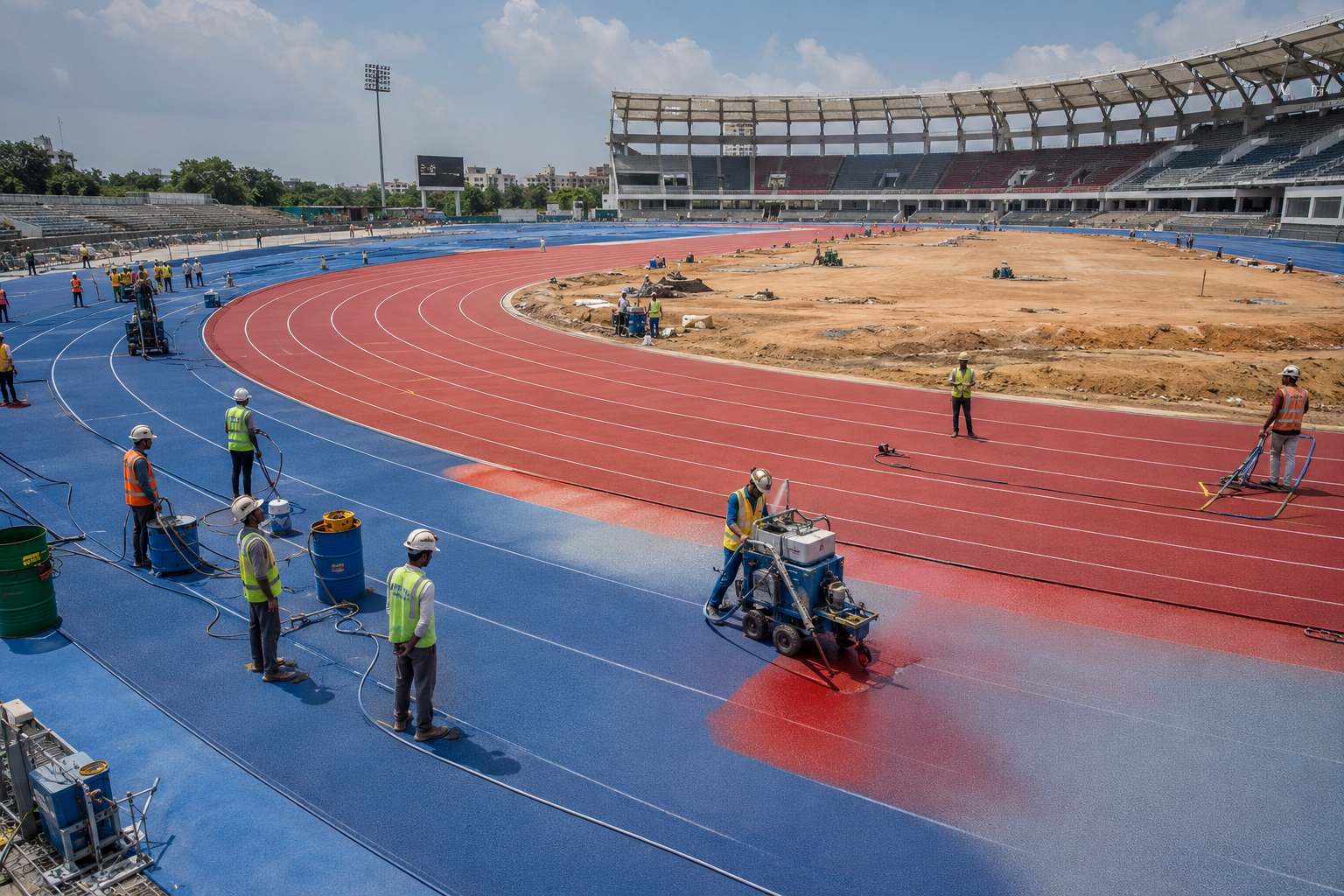
What is Spray Coating Running Track Construction?
Spray coating running track construction is a multi-layer synthetic sports flooring system in which EPDM rubber granules and polyurethane binder are spray-applied over a prepared elastic rubber cushion layer. The complete system is installed over a properly engineered asphalt or concrete foundation.
The construction generally includes a compacted soil subgrade, granular sub-base, asphalt or PCC structural base, polyurethane primer, SBR rubber cushion layer, PU sealing coat and EPDM spray-applied wearing surface.
The upper EPDM layer creates a textured and durable finish that provides surface traction, colour stability and resistance to outdoor exposure. The underlying SBR rubber cushion contributes to elasticity, impact absorption and running comfort.
Spray coating systems are particularly suitable for institutions and sports facilities looking for a practical synthetic running surface with a balance of construction investment, durability and athletic functionality.
Elastic Rubber Cushion
SBR rubber and polyurethane binder create a resilient foundation that helps absorb impact during running and athletic training.
Textured EPDM Surface
The spray-applied EPDM finish provides a textured surface designed to deliver dependable traction and abrasion resistance.
Durable PU System
Polyurethane primers and binders help establish bonding between the structural foundation and synthetic rubber layers.
Benefits of Spray Coating Running Tracks
Spray coating synthetic running tracks are designed to provide a combination of athlete comfort, surface grip, weather resistance and long-term usability. Their multi-layer construction makes them suitable for a wide range of educational, recreational and sports infrastructure projects.
1. Improved Running Comfort
The elastic SBR rubber cushion layer provides resilience and impact absorption, creating a more comfortable surface for jogging, running and athletic training.
2. Textured Anti-Slip Finish
EPDM rubber granules create a textured wearing surface that supports traction and grip during normal running and recreational fitness activities.
3. UV and Weather Resistance
Quality EPDM granules, pigments and polyurethane materials can be selected to withstand UV exposure, rainfall and changing outdoor climatic conditions.
4. Durable Synthetic Surface
A correctly designed foundation, suitable material selection and professional installation help the track withstand regular foot traffic and athletic use.
5. Easy Routine Maintenance
Regular cleaning, drainage maintenance and periodic inspections help preserve the surface appearance, traction and overall usability of the running track.
6. Economical Sports Infrastructure Solution
Spray coating systems provide a practical option for projects seeking a durable synthetic surface without the higher initial investment associated with certain premium track systems.
Applications of Spray Coating Athletic Track Construction
Spray coating running track systems can be customized for different facility sizes, track layouts and usage requirements. They are suitable for educational, institutional, commercial, recreational and government sports infrastructure projects.
School Running Tracks
Synthetic running tracks for school sports grounds, physical education, inter-school competitions and student fitness programs.
College and University Tracks
Durable athletic surfaces for university campuses, sports grounds, student athletics and regular physical training.
Sports Academies
Resilient synthetic tracks for athlete development, sprint training, endurance exercises and sports coaching facilities.
Athletic Stadiums
Synthetic track surfaces for stadium development, athletics infrastructure and outdoor sports complexes.
Public Parks and Jogging Tracks
Comfortable jogging and walking surfaces for public gardens, municipal parks and community fitness areas.
Government Sports Projects
Sports infrastructure development for government departments, municipal corporations and public sports facilities.
Residential Communities
Dedicated jogging and running facilities for residential townships, housing societies and gated communities.
Defence Training Centres
Outdoor fitness and running surfaces for physical training establishments and institutional fitness facilities.
Corporate Fitness Facilities
Recreational running and fitness tracks for corporate campuses, industrial facilities and employee wellness centres.
Spray Coating Track Construction Process in India
Building a high-quality synthetic running track requires proper site investigation, civil engineering, drainage planning, material selection and specialized sports flooring installation. Sports Facility India follows a systematic construction methodology to achieve a stable foundation and a consistent synthetic surface.
Step 1: Site Survey and Ground Assessment
The project begins with a detailed site inspection to evaluate existing ground conditions, soil stability, site levels, accessibility, surrounding infrastructure and drainage requirements. These observations help determine the suitable construction method.
Step 2: Track Design and Layout Planning
Track geometry, available space, lane configuration, running direction, surface slopes and supporting infrastructure are considered during the design stage. Layout planning is carried out according to the intended use and applicable project requirements.
- Track dimensions and layout
- Lane configuration and marking plan
- Curve radius and straight sections
- Surface slope and level planning
- Stormwater drainage arrangement
- Construction drawings and material estimation
Step 3: Site Clearing and Earthwork
Vegetation, loose soil, debris and unsuitable materials are removed from the construction area. Excavation, filling, grading and mechanical compaction are carried out to achieve the required formation level.
Step 4: Drainage System Development
Proper drainage is essential for maintaining outdoor synthetic running tracks. Depending on the project design, peripheral drains, catch pits, drainage pipes, stormwater channels and suitable surface gradients are incorporated to prevent water accumulation.
Step 5: Granular Sub-Base Installation
Suitable graded aggregates are placed over the prepared subgrade in controlled layers. Each layer is compacted to develop a stable and load-distributing foundation for the structural base.
Step 6: Asphalt or PCC Base Construction
An asphalt or plain cement concrete base is constructed according to the approved engineering design. The finished base is inspected for thickness, levels, slope, smoothness and surface integrity before synthetic flooring work begins.
Step 7: Polyurethane Primer Application
After suitable surface preparation and moisture checks, an appropriate polyurethane primer is applied to the structural base. This layer promotes bonding between the foundation and the rubber flooring system.
Step 8: SBR Rubber Cushion Installation
SBR rubber granules are blended with a suitable polyurethane binder and installed to form an elastic cushion layer. The thickness and application method are determined by the selected system specification.
Step 9: PU Sealing Application
A polyurethane sealing coat is applied over the cured rubber cushion layer to stabilize the surface, reduce open voids where specified and prepare the substrate for the EPDM spray finish.
Step 10: EPDM Spray Coating Application
EPDM rubber granules are combined with the specified polyurethane binder and spray-applied using suitable specialized equipment. This process creates the final textured, coloured and resilient wearing surface.
Step 11: Lane Marking and Surface Finishing
After the synthetic surface has cured sufficiently, lane markings, start lines, finish lines and other approved markings are applied. Measurements and alignment are checked against the project layout.
Step 12: Final Inspection and Project Handover
The completed installation is inspected for surface uniformity, dimensions, levels, drainage, markings, bonding and overall finishing. Following completion of the required checks, the running track is handed over to the client.
Spray Coating Running Track Layer Structure
A spray coating athletic track consists of multiple interconnected layers. Each layer has a specific role in supporting structural stability, rubber cushioning, adhesion and surface performance.
| Layer | Construction Material | Purpose and Function |
|---|---|---|
| EPDM Spray Finish | EPDM Granules and PU Binder | Provides textured wearing surface, traction, colour and abrasion resistance. |
| PU Sealing Layer | Polyurethane Sealer | Stabilizes the rubber cushion and prepares it for the top coating. |
| SBR Rubber Cushion | SBR Rubber Granules and PU Binder | Provides elasticity, resilience and impact absorption. |
| Primer Layer | Polyurethane Primer | Promotes adhesion between the prepared base and synthetic flooring. |
| Structural Base | Asphalt or PCC | Creates a stable and level load-bearing foundation. |
| Granular Sub-Base | Graded Crushed Aggregates | Supports load distribution and foundation stability. |
| Prepared Subgrade | Compacted Soil | Supports the complete running track structure. |
Materials Used for Spray Coating Track Construction
The selection of appropriate construction materials is essential for achieving a durable, resilient and visually consistent athletic track. Material grades, binder compatibility, application quantities and installation methods should follow the approved technical specifications.
1. Granular Sub-Base Materials
- Well-graded crushed stone aggregates
- Suitable granular sub-base material
- Compacted foundation aggregates
- Approved levelling and filling materials
2. Asphalt and Concrete Foundation Materials
- Dense bituminous asphalt mix
- Plain cement concrete
- Reinforced concrete where specified
- Concrete joint and surface treatment materials
3. Polyurethane Primer
- Compatible PU primer
- High-adhesion bonding formulation
- Suitable moisture-tolerant primer where specified
4. SBR Rubber Granules
- Recycled SBR rubber granules
- Selected rubber particle grading
- Polyurethane binder
- Elastic rubber compound
5. Polyurethane Sealing Materials
- PU sealing compound
- Compatible polyurethane coating
- Specified interlayer bonding materials
6. EPDM Rubber Granules
- EPDM rubber granules
- UV-stable coloured pigments
- Compatible polyurethane binder
- Weather-resistant finishing materials
7. Athletic Track Marking Materials
- Compatible PU line marking paint
- Sports flooring marking materials
- Weather-resistant marking compounds
Technical Specifications of Spray Coating Running Tracks
Spray coating running track specifications depend on the selected flooring system, project application, civil foundation and performance requirements. The following table describes a typical system configuration and should be finalized through project-specific technical approval.
| Technical Parameter | Typical Specification |
|---|---|
| Track System | Spray Coating Synthetic Athletic Track |
| Surface Type | Textured EPDM Spray Finish |
| Top Surface Material | EPDM Granules and PU Binder |
| Cushion Material | SBR Rubber Granules and PU Binder |
| Primer | Compatible Polyurethane Primer |
| Sealing System | Polyurethane Sealer |
| Structural Foundation | Asphalt or PCC |
| Sub-Base | Compacted Granular Aggregates |
| Typical System Thickness | Approximately 10–15 mm, subject to system design |
| Surface Texture | Textured Anti-Slip Finish |
| Colour Options | Brick Red, Terracotta, Green, Blue and Custom Colours |
| Outdoor Suitability | Subject to selected material specifications |
| Maintenance | Routine Cleaning and Periodic Inspection |
Spray Coating Track vs Sandwich Track vs Full PU Track
Different synthetic running track systems are available for sports infrastructure projects. The right option depends on the intended usage, performance requirements, construction budget, maintenance expectations and applicable athletic standards.
| Feature | Spray Coating Track | Sandwich Track | Full PU Track |
|---|---|---|---|
| Construction System | SBR Cushion with EPDM Spray Finish | Elastic Base with Additional PU and EPDM Layers | Predominantly PU-Based Synthetic System |
| Initial Investment | Generally Economical | Medium to High | Premium |
| Surface Texture | Textured Spray Finish | Textured Finish | Generally Smoother Finish |
| Shock Absorption | Depends on Cushion Design | Depends on System Design | Depends on PU System Design |
| Running Comfort | Suitable for Regular Training | Suitable for Regular Training | Designed for Higher Performance Applications |
| Maintenance | Routine Maintenance | Routine Maintenance | Routine Maintenance |
| School Facilities | Suitable | Suitable | Suitable |
| Sports Academies | Suitable | Suitable | Suitable |
| Competitive Athletics | Subject to Certification | Subject to Certification | Subject to Certification |
The actual performance of any synthetic track depends on its complete system design, material quality, installation process and independent testing. Competition-level facilities should verify compliance with the relevant World Athletics requirements before selecting a system.
Spray Coating Track Construction Cost in India
The spray coating running track construction cost in India varies according to project size, track layout, foundation condition, selected synthetic flooring system and overall construction requirements. Every project requires an individual assessment to determine the appropriate construction budget.
The cost of a spray coating athletic track is influenced not only by the EPDM and SBR rubber surface but also by civil construction, drainage, earthwork, asphalt or PCC foundation, transportation, equipment and installation.
Major Factors Affecting Running Track Construction Cost
- Overall track area and number of lanes
- Track geometry and layout complexity
- Existing ground and soil conditions
- Excavation, filling and compaction requirements
- Granular sub-base thickness and specifications
- Asphalt or PCC foundation requirements
- Drainage channels and stormwater arrangements
- Thickness of the SBR rubber cushion layer
- Quality and quantity of EPDM rubber granules
- Polyurethane binder and primer specifications
- Project location and transportation expenses
- Labour, machinery and installation requirements
- Lane marking and additional sports infrastructure
How to Get an Accurate Spray Coating Track Quotation
To prepare a reliable project estimate, the construction team should evaluate the available site area, proposed track layout, existing foundation, drainage conditions and selected synthetic flooring specification.
Sports Facility India can assist with project assessment and a customized quotation for schools, universities, sports academies, stadiums, jogging tracks and government sports infrastructure projects.
Get a Customized Running Track Construction Estimate
Planning a new synthetic running track? Share your site dimensions, location and project requirements with our team to receive a suitable technical proposal and cost estimate.
Request Project QuotationSpray Coating Running Track Construction Timeline
The construction duration depends on project area, civil work requirements, foundation readiness, weather conditions, material curing and installation specifications. The following stages represent an indicative construction sequence rather than a guaranteed project schedule.
| Construction Activity | Indicative Duration |
|---|---|
| Site Inspection and Assessment | 1–2 Days |
| Design and Layout Planning | 2–4 Days |
| Site Clearing and Earthwork | 3–7 Days |
| Drainage Development | 2–5 Days |
| Granular Sub-Base | 3–6 Days |
| Asphalt or PCC Base | 4–8 Days |
| Primer Application | Approximately 1 Day |
| SBR Rubber Cushion | 2–4 Days |
| PU Sealing Application | Approximately 1 Day |
| EPDM Spray Coating | 2–3 Days |
| Lane Marking and Finishing | 1–2 Days |
| Final Inspection and Handover | 1–2 Days |
These durations are indicative and may overlap in certain project stages. Actual schedules are finalized after reviewing site conditions, construction resources, curing requirements and weather forecasts.
Spray Coating Running Track Maintenance and Care
Proper maintenance is essential for preserving the appearance, surface traction and functionality of synthetic running tracks. A planned maintenance schedule helps identify drainage issues, surface damage and material deterioration at an early stage.
Daily Track Maintenance
- Remove leaves, dust and loose debris.
- Inspect the surface for visible damage.
- Check for standing water after rainfall.
- Keep sharp objects away from the track.
- Monitor areas with heavy foot traffic.
Weekly Track Maintenance
- Clean the surface using suitable equipment.
- Inspect lane markings and coloured areas.
- Remove debris from drainage channels.
- Check for loose rubber particles.
- Review high-use areas for wear.
Important Preventive Maintenance Practices
- Maintain proper drainage and stormwater outlets.
- Inspect the surface after heavy rainfall.
- Repair damaged areas using compatible materials.
- Restrict unauthorized vehicle movement.
- Prevent oil, fuel and chemical spills.
- Avoid dragging heavy equipment across the surface.
- Use manufacturer-approved cleaning methods.
- Arrange periodic professional surface inspections.
Why Choose Sports Facility India for Spray Coating Track Construction?
Sports Facility India provides integrated sports infrastructure and spray coating running track construction solutions for projects across India. Our approach combines civil engineering, synthetic sports flooring, project coordination and professional installation to develop functional athletic facilities.
From initial site assessment to final surface finishing, our team coordinates the major stages involved in building a synthetic running track.
Professional Project Planning
We evaluate site conditions, available space, track dimensions, drainage and foundation requirements before finalizing the construction approach.
Quality Synthetic Materials
We select suitable polyurethane binders, SBR rubber granules and EPDM materials according to the approved project specifications.
Complete Turnkey Construction
Our construction scope can include earthwork, drainage, sub-base, asphalt or PCC foundation, synthetic surfacing and lane marking.
Technical Installation Process
Proper surface preparation, material mixing, application methods, curing and finishing are important parts of our project execution approach.
Customized Running Track Designs
Track dimensions, layouts, lane configurations, surface colours and supporting infrastructure can be planned according to the facility requirements.
Sports Infrastructure Across India
We undertake sports flooring and athletic track construction projects for educational institutions, government facilities, private organizations and sports infrastructure developers.
Frequently Asked Questions About Spray Coating Track Construction in India
1. What is spray coating track construction?
Spray coating track construction is a synthetic athletic flooring system consisting of a prepared foundation, polyurethane primer, SBR rubber cushion layer, PU sealing coat and EPDM spray-applied top surface. It provides a textured and resilient surface for running, jogging and athletic training.
2. What materials are used in spray coating running tracks?
The system generally uses compacted granular aggregates, asphalt or PCC, polyurethane primer, SBR rubber granules, PU binder, polyurethane sealer and EPDM rubber granules. Compatible line marking materials are used for track markings.
3. What is the thickness of a spray coating running track?
The thickness depends on the selected system, rubber cushion design and performance requirements. A 10–15 mm synthetic surface may be specified for certain systems, but the actual thickness should be confirmed through approved technical specifications.
4. Is spray coating suitable for outdoor running tracks in India?
Yes. Properly selected EPDM and polyurethane materials can be used for outdoor running tracks in Indian climatic conditions. The design should consider UV exposure, temperature variations, rainfall, drainage and installation conditions.
5. What are the advantages of EPDM spray coating?
EPDM spray coating provides a textured surface with good traction, abrasion resistance and colour options. Suitable EPDM grades and polyurethane binders can also provide resistance to outdoor weather exposure.
6. How much does spray coating track construction cost in India?
The construction cost depends on track area, civil foundation, drainage, rubber layer thickness, EPDM material specifications, project location and installation requirements. A customized quotation should be prepared after evaluating the site and project scope.
7. How long does it take to construct a spray coating running track?
Construction time depends on the project size, earthwork, drainage, foundation readiness, weather and material curing. Smaller projects may be completed within a few weeks, while larger facilities require additional time.
8. Can spray coating tracks be installed over an existing concrete surface?
Yes, installation over an existing concrete surface may be possible if the base is structurally sound, stable, properly levelled and suitable for the selected synthetic flooring system. Surface preparation and moisture evaluation are essential before installation.
9. Are spray coating running tracks suitable for schools and colleges?
Yes. Spray coating tracks are suitable for many school and college sports facilities, physical education programs, jogging activities and regular athletics training, subject to the selected system specifications.
10. What colours are available for spray coating tracks?
Common colour options include brick red, terracotta, green and blue. Custom colour combinations may also be available depending on EPDM granule specifications and project requirements.
11. What maintenance is required for a spray coating athletic track?
Maintenance generally includes regular cleaning, debris removal, drainage inspection, surface condition monitoring and timely repair of damaged areas. Manufacturer-approved cleaning and repair methods should be followed.
12. What is the difference between spray coating and sandwich running tracks?
A spray coating track generally consists of an SBR rubber cushion layer with a polyurethane-bound EPDM spray finish. A sandwich track incorporates additional polyurethane and rubber layers according to its system design. The two systems differ in construction, material consumption, thickness and performance characteristics.
13. Can spray coating tracks be used for competitive athletics?
Suitability for competitive athletics depends on track dimensions, surface performance, installation quality and applicable competition requirements. Facilities intended for certified competitions should use a system that meets the relevant World Athletics requirements and obtain the necessary approvals.
14. Do you provide complete turnkey spray coating track construction?
Yes. Sports Facility India offers turnkey construction solutions that can include site assessment, design coordination, earthwork, drainage, civil foundation, PU primer, SBR rubber cushioning, EPDM spray coating, lane marking and final inspection.
15. Why choose Sports Facility India for running track construction?
Sports Facility India provides project planning, civil construction coordination, synthetic flooring installation, material selection and customized sports infrastructure solutions for running track projects across India.