
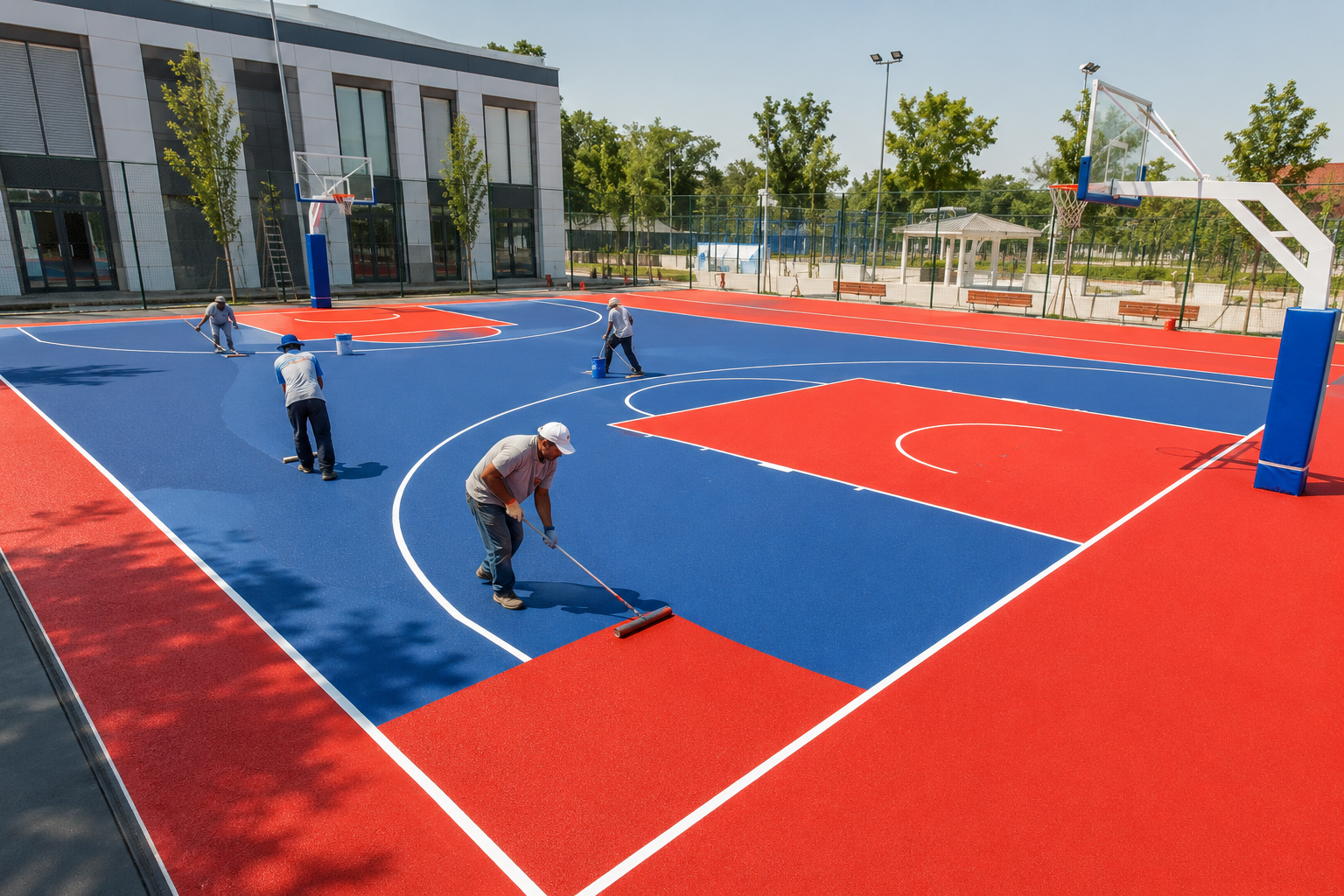
What is Synthetic Basketball Court Flooring?
Synthetic basketball court flooring is a purpose-built sports surface designed to provide a controlled playing environment for basketball activities. Depending on the system selected, it can consist of multiple layers of acrylic coatings, polyurethane materials, resilient cushioning layers, or modular sports tiles installed over a properly prepared concrete or asphalt base.
Unlike an untreated concrete surface, a professionally engineered synthetic basketball floor is designed around sports performance requirements. Surface texture, traction, resilience, coating quality, drainage, substrate condition, and court markings all contribute to the final playing experience.
For outdoor facilities, acrylic systems are commonly selected for their weather and UV resistance. Indoor facilities may use PU or other specialized resilient sports flooring systems where cushioning and player comfort are important. Modular tiles can also be considered where fast installation, drainage, or individual tile replacement is required.
Key Characteristics
- Sports-specific surface design
- Good traction and controlled grip
- Consistent playing characteristics
- Impact and wear resistance
- Weather-resistant options for outdoor courts
- UV-resistant coating options
- Textured anti-slip finishes
- Low routine maintenance
- Multiple color and design options
- Suitable for recreational and competitive facilities
Why Invest in Synthetic Basketball Court Flooring?
The quality of the playing surface can influence player movement, stopping, turning, jumping, and overall comfort. A properly designed synthetic basketball court provides a more controlled surface than an unfinished concrete floor and can be configured according to the requirements of the facility.
Modern synthetic sports flooring systems also provide an attractive appearance. Playing areas can be finished in different colors, with contrasting boundary zones, professional basketball markings, institutional branding, logos, or other approved graphics.
For facility owners, another important advantage is maintainability. A correctly installed flooring system with a suitable base and drainage arrangement can be cleaned and periodically inspected without requiring complex daily maintenance.
Major Benefits
- Improved player traction
- Controlled surface texture
- Consistent ball response
- Better player comfort than untreated hard surfaces
- Optional cushioned systems for enhanced resilience
- Good abrasion resistance
- UV-resistant options for outdoor applications
- Weather-resistant outdoor systems
- Attractive professional appearance
- Custom colors and court designs
- Simple routine cleaning
- Suitable for frequent sports use
- Resurfacing options for aging courts
- Flexible solutions for different budgets and facility types
Types of Synthetic Basketball Court Flooring
There is no single flooring system suitable for every basketball facility. The right solution depends on whether the court is indoor or outdoor, the condition of the base, expected playing frequency, performance requirements, available budget, and long-term maintenance plan.
Acrylic Basketball Court Flooring
Acrylic basketball court flooring is one of the most widely used synthetic systems for outdoor basketball courts. It is applied in multiple coating layers over a suitable concrete or asphalt substrate to create a textured, colorful and sports-ready surface.
Acrylic systems can be selected for schools, colleges, sports academies, parks, residential developments, clubs and community basketball courts where outdoor durability and practical maintenance are important.
Key Features
- Suitable for outdoor applications
- UV-resistant coating options
- Textured anti-slip surface
- Good weather resistance
- Multiple color options
- Professional court appearance
- Relatively simple maintenance
PU Basketball Court Flooring
Polyurethane or PU sports flooring is a seamless synthetic flooring solution commonly considered for indoor basketball facilities. Its resilient characteristics can provide improved comfort and impact management compared with conventional rigid surfaces.
PU systems are suitable for indoor stadiums, universities, sports academies, multipurpose halls and training facilities where a seamless, comfortable and professional sports surface is required.
Key Features
- Seamless sports surface
- Good elasticity
- Comfortable playing characteristics
- Impact-management options
- Suitable for indoor facilities
- Professional finish
- Easy routine cleaning
Cushioned Acrylic Basketball Flooring
Cushioned acrylic flooring combines acrylic sports coatings with resilient underlayers. This configuration is designed to provide additional cushioning while retaining the performance and appearance associated with acrylic sports surfaces.
It can be considered for schools, academies, clubs and other facilities where player comfort and reduced surface harshness are important considerations.
Key Features
- Resilient cushion layers
- Improved surface comfort
- Textured playing finish
- Good traction
- Suitable for selected indoor or outdoor applications
- Custom color options
- Professional sports appearance
Modular Interlocking Basketball Tiles
Modular sports tiles are prefabricated interlocking systems designed for efficient installation. Depending on the product, their raised construction can assist with drainage and ventilation beneath the playing surface.
These systems can be useful for outdoor recreational courts, schools, residential communities, parks and facilities where fast installation and easier replacement of individual sections are priorities.
Key Features
- Quick installation
- Interlocking construction
- Individual tile replacement
- Outdoor application options
- Good drainage characteristics in suitable systems
- Multiple colors and layouts
- Low routine maintenance
Synthetic Basketball Court Flooring Installation Process
Professional installation is essential for achieving a durable and consistent basketball playing surface. Flooring performance depends not only on the top coating but also on substrate quality, moisture condition, drainage, leveling, application technique and curing.
1. Site Inspection and Technical Planning
The project begins with an assessment of the proposed basketball court area. Dimensions, surface condition, drainage, accessibility, existing substrate, orientation and expected usage are reviewed before the flooring system is finalized.
2. Base Condition Assessment
The concrete or asphalt substrate is inspected for cracks, uneven areas, weak sections, contamination, moisture-related problems and other conditions that could affect flooring adhesion or performance.
3. Surface Cleaning and Preparation
Dust, dirt, loose material, grease and other contaminants are removed. Grinding, scarification, filling or other preparation methods may be used depending on the condition of the existing base.
4. Leveling and Crack Repair
Surface irregularities and suitable repair areas are corrected before synthetic flooring installation. Proper leveling helps create a more uniform playing surface.
5. Primer Application
Where required by the selected flooring system, an appropriate primer is applied to improve adhesion between the prepared substrate and subsequent flooring layers.
6. Cushion Layer Installation
For cushioned systems, resilient layers are installed according to the selected specification. The cushion configuration depends on the desired performance and flooring manufacturer's system requirements.
7. Synthetic Sports Coating Application
Acrylic, PU or another selected sports flooring system is installed in controlled layers. Proper application and curing between coats are important for achieving the required finish and durability.
8. Color Coating and Surface Finishing
The playing area and surrounding zones are finished in the selected colors. Texture and coating build-up are controlled according to the flooring system specification.
9. Basketball Court Line Marking
Court lines are measured and marked accurately using suitable sports marking materials. The markings should correspond to the intended playing configuration and applicable basketball regulations.
10. Final Quality Inspection
The completed surface is inspected for appearance, adhesion, uniformity, line accuracy, finishing quality and other project-specific requirements before handover.
Importance of Proper Basketball Court Base Preparation
The performance and durability of synthetic basketball flooring depend heavily on the condition of the substrate beneath it. Even premium sports coatings can develop problems if they are installed over an unstable, damp, contaminated, cracked or poorly leveled base.
For new outdoor courts, the supporting layers should be designed to provide adequate structural stability and drainage. For existing courts, cracks, damaged areas, uneven sections and moisture-related problems should be evaluated before resurfacing.
Important Base Preparation Considerations
- Proper compaction and structural stability
- Suitable drainage design
- Correct surface levels and falls
- Concrete or asphalt quality
- Crack and joint assessment
- Moisture evaluation
- Removal of dust and contaminants
- Correct surface profile for the selected system
- Appropriate curing time
- Compatibility between primer and flooring materials
Synthetic Basketball Court Flooring Technical Considerations
The final flooring specification should be selected according to the court's environment and intended use. Rather than choosing a flooring material based only on price, facility owners should consider surface performance, substrate condition, climate, expected usage and future maintenance.
| Factor | Why It Matters |
|---|---|
| Court Location | Indoor and outdoor environments require different performance considerations. |
| Substrate | Concrete or asphalt condition directly affects installation quality. |
| Surface Texture | Influences traction and player movement. |
| Cushioning | Can improve comfort and impact management where specified. |
| UV Resistance | Important for outdoor courts exposed to sunlight. |
| Drainage | Helps manage rainwater and standing water on outdoor facilities. |
| Usage Intensity | Heavy-use facilities may require higher-performance systems. |
| Maintenance | Routine cleaning and periodic refurbishment help preserve performance. |
Standard Basketball Court Dimensions
A basketball court should be designed according to the intended level of play and the applicable competition rules. A commonly referenced full-size basketball court is approximately 28 metres long and 15 metres wide. However, exact markings, clearances and other dimensions can vary according to the governing rules and facility requirements.
| Specification | Common Reference |
|---|---|
| Court Length | 28 m |
| Court Width | 15 m |
| Basket Ring Height | 3.05 m |
| Three-Point Line | 6.75 m radius reference |
| Free-Throw Line | 4.60 m reference from the backboard plane |
| Center Circle Diameter | 3.60 m |
For competition facilities, final dimensions and markings should always be verified against the applicable basketball governing body's current regulations before construction and line marking.
Indoor vs Outdoor Synthetic Basketball Court Flooring
Outdoor Basketball Flooring
- Acrylic systems are widely used.
- UV and weather resistance are important.
- Drainage planning is essential.
- Surface color should be selected for outdoor exposure.
- Periodic resurfacing may be required depending on use and exposure.
- Modular tiles can be considered for selected outdoor applications.
Indoor Basketball Flooring
- PU and other resilient sports systems may be considered.
- Cushioning can be specified according to performance requirements.
- Moisture control remains important during installation.
- Seamless finishes can provide a professional appearance.
- Indoor environmental conditions should be controlled where necessary.
- Flooring should be selected according to the intended sports use.
Features of High-Quality Synthetic Basketball Flooring
- Sports-specific surface construction
- Consistent surface texture
- Reliable traction
- Good abrasion resistance
- UV-resistant options
- Weather-resistant outdoor systems
- Resilient cushioning options
- Professional court appearance
- High-quality court markings
- Easy routine cleaning
- Multiple color combinations
- Branding and logo customization
- Suitable for frequent sports activity
- Repair and resurfacing possibilities
Customization Options for Basketball Court Flooring
Synthetic basketball flooring can be customized to match the visual identity and functional requirements of a sports facility. Color selection, playing-area contrast, boundary zones, logos, institutional branding and other design elements can be incorporated where technically appropriate.
Popular Court Color Options
- Blue
- Green
- Red
- Orange
- Grey
- Teal
- Contrasting multi-color combinations
Branding Options
- School or college logos
- Sports academy branding
- Corporate logos
- Sponsor graphics
- Custom center-court designs
- Custom playing and surrounding area colors
Applications of Synthetic Basketball Court Flooring
Synthetic basketball flooring can be used across a broad range of sports and recreational facilities. The flooring system can be selected according to the facility's playing level, environment and expected usage.
- Schools
- Colleges and universities
- Basketball academies
- Professional training centers
- Sports clubs
- Indoor sports complexes
- Outdoor basketball parks
- Residential townships
- Apartment communities
- Corporate campuses
- Government sports facilities
- Hotels and resorts
- Community recreation centers
- Commercial sports facilities
- Multipurpose sports halls
Basketball Court Flooring Maintenance Guide
Regular maintenance helps preserve the appearance, traction and overall performance of synthetic basketball flooring. The exact maintenance routine should follow the recommendations provided for the selected flooring system.
Routine Care
- Sweep or dust-mop the court regularly.
- Remove leaves, dirt and debris from outdoor courts.
- Clean spills promptly.
- Use suitable mild cleaning products.
- Avoid harsh chemicals and abrasive cleaning methods.
- Do not drag heavy equipment across the playing surface.
- Inspect court markings periodically.
- Keep drainage channels clear on outdoor courts.
- Check for cracks, peeling or damaged areas.
- Arrange professional inspection when significant surface deterioration occurs.
Basketball Court Flooring Resurfacing and Renovation
An existing basketball court does not always require complete reconstruction. If the structural base remains suitable, resurfacing can be an effective way to restore the appearance and playing characteristics of the court.
The renovation process may include surface cleaning, crack repairs, leveling of appropriate areas, primer application, new sports coating layers, color restoration and fresh basketball court markings. A detailed site assessment is recommended before deciding between resurfacing and complete reconstruction.
When Should a Court Be Resurfaced?
- Surface colors have significantly faded.
- Minor surface wear has developed.
- Court markings are difficult to see.
- Traction has deteriorated.
- Small cracks or localized surface defects are present.
- The existing base remains structurally suitable.
Factors Affecting Synthetic Basketball Court Flooring Cost
The cost of synthetic basketball court flooring varies from project to project. A final quotation can only be prepared after evaluating the site, substrate and required flooring specification.
- Type of synthetic flooring system
- Indoor or outdoor application
- Basketball court dimensions
- Existing base condition
- Concrete or asphalt requirements
- Surface preparation and repair work
- Required cushioning system
- Flooring thickness and product specification
- Number of courts
- Court color and design requirements
- Logo and branding requirements
- Line marking requirements
- Drainage requirements
- Site location and accessibility
- Transportation and logistics
- Additional sports equipment and infrastructure
For an accurate project estimate, the flooring system, base condition, court size, site location and installation requirements should be reviewed before finalizing the specification.
Why Choose Sports-Facility for Synthetic Basketball Court Flooring?
Sports-Facility provides complete sports flooring and basketball infrastructure solutions for projects across India. Our approach focuses on selecting the appropriate flooring system, preparing the substrate correctly and completing the installation with attention to surface quality, court dimensions and finishing.
- Professional sports flooring expertise
- Multiple synthetic flooring options
- Acrylic and PU flooring solutions
- Cushioned sports flooring systems
- Modular sports tile options
- New court flooring installation
- Existing court resurfacing and renovation
- Professional basketball court line marking
- Customized color and branding solutions
- Complete turnkey sports infrastructure support
- Project-specific technical consultation
- Installation support across India
- Post-installation maintenance guidance
Frequently Asked Questions About Synthetic Basketball Court Flooring
1. What is synthetic basketball court flooring?
Synthetic basketball court flooring is a sports-specific surface made using systems such as acrylic coatings, polyurethane flooring, cushioned acrylic layers or modular sports tiles. It is designed to provide suitable traction, surface consistency, durability and player comfort for basketball facilities.
2. Which synthetic flooring is best for an outdoor basketball court?
Acrylic flooring is one of the most commonly selected options for outdoor basketball courts because suitable acrylic systems can provide good UV resistance, weather durability, traction and attractive court finishes.
3. Which flooring is suitable for an indoor basketball court?
PU and other resilient indoor sports flooring systems can be suitable for indoor basketball facilities. The final choice depends on the required cushioning, performance characteristics, substrate and facility specifications.
4. Is synthetic basketball court flooring safe?
A properly designed and installed sports flooring system can provide good traction and controlled playing characteristics. Cushioned systems may additionally provide improved impact management and player comfort.
5. How long does synthetic basketball flooring last?
Service life varies according to the flooring system, product quality, substrate, climate, usage intensity, installation quality and maintenance. Outdoor courts exposed to heavy use and weather may require periodic resurfacing.
6. Can synthetic basketball flooring be installed over an existing court?
Yes, in many cases. The existing surface must first be inspected for structural stability, cracks, moisture, contamination, unevenness and other defects. Suitable preparation and repair work should be completed before resurfacing.
7. Can basketball court flooring be customized?
Yes. Depending on the flooring system, facilities can select different colors, playing-area combinations, logos, branding elements and court designs.
8. How do you maintain synthetic basketball flooring?
Regular sweeping, suitable damp cleaning, prompt removal of spills and periodic inspections are generally recommended. Outdoor courts should also have clear drainage paths and should be kept free from leaves and debris.
9. What factors determine basketball flooring cost?
Flooring type, court size, substrate condition, preparation requirements, cushioning, product specification, color and branding, line marking, location, drainage and installation complexity can all influence the final cost.
10. Do you provide complete basketball court flooring installation?
Yes. Our services can include site assessment, substrate preparation, synthetic sports flooring installation, court marking, resurfacing, finishing and other basketball infrastructure requirements based on the project scope.
People Also Ask About Basketball Court Flooring
- What is the best material for synthetic basketball court flooring?
- How much does synthetic basketball court flooring cost in India?
- Is acrylic flooring suitable for outdoor basketball courts?
- Is PU flooring suitable for indoor basketball courts?
- What is the difference between acrylic and PU basketball flooring?
- Can an old basketball court be resurfaced?
- How often should a synthetic basketball court be maintained?
- What is the standard size of a basketball court?
- Which basketball flooring is best for schools?
- How is synthetic basketball flooring installed?
Related Sports Facility Solutions
Along with synthetic basketball court flooring, Sports-Facility provides sports flooring and court construction solutions for a variety of indoor and outdoor sports facilities.
Badminton Court Flooring
Professional badminton flooring solutions including synthetic PVC, PU, acrylic and other sports surface systems for schools, clubs and academies.
Explore Badminton Court FlooringTennis Court Construction
Complete tennis court construction and synthetic acrylic sports flooring solutions for educational, residential, commercial and professional facilities.
Explore Tennis Court ConstructionBasketball Court Construction
End-to-end basketball court development including base construction, synthetic flooring, court markings, equipment and supporting infrastructure.
Explore Basketball Court ConstructionMulti-Purpose Sports Flooring
Sports flooring solutions designed for multipurpose indoor and outdoor facilities used for basketball, badminton, volleyball and other recreational activities.
Explore Sports FacilitiesGet Professional Synthetic Basketball Court Flooring
Planning a new basketball facility or upgrading an existing court? Choose a synthetic basketball flooring system based on your playing requirements, site conditions, budget and expected usage.
Sports-Facility provides complete basketball flooring support, from site evaluation and surface preparation to synthetic flooring installation, court markings, resurfacing and project completion.
Request a Flooring Consultation