
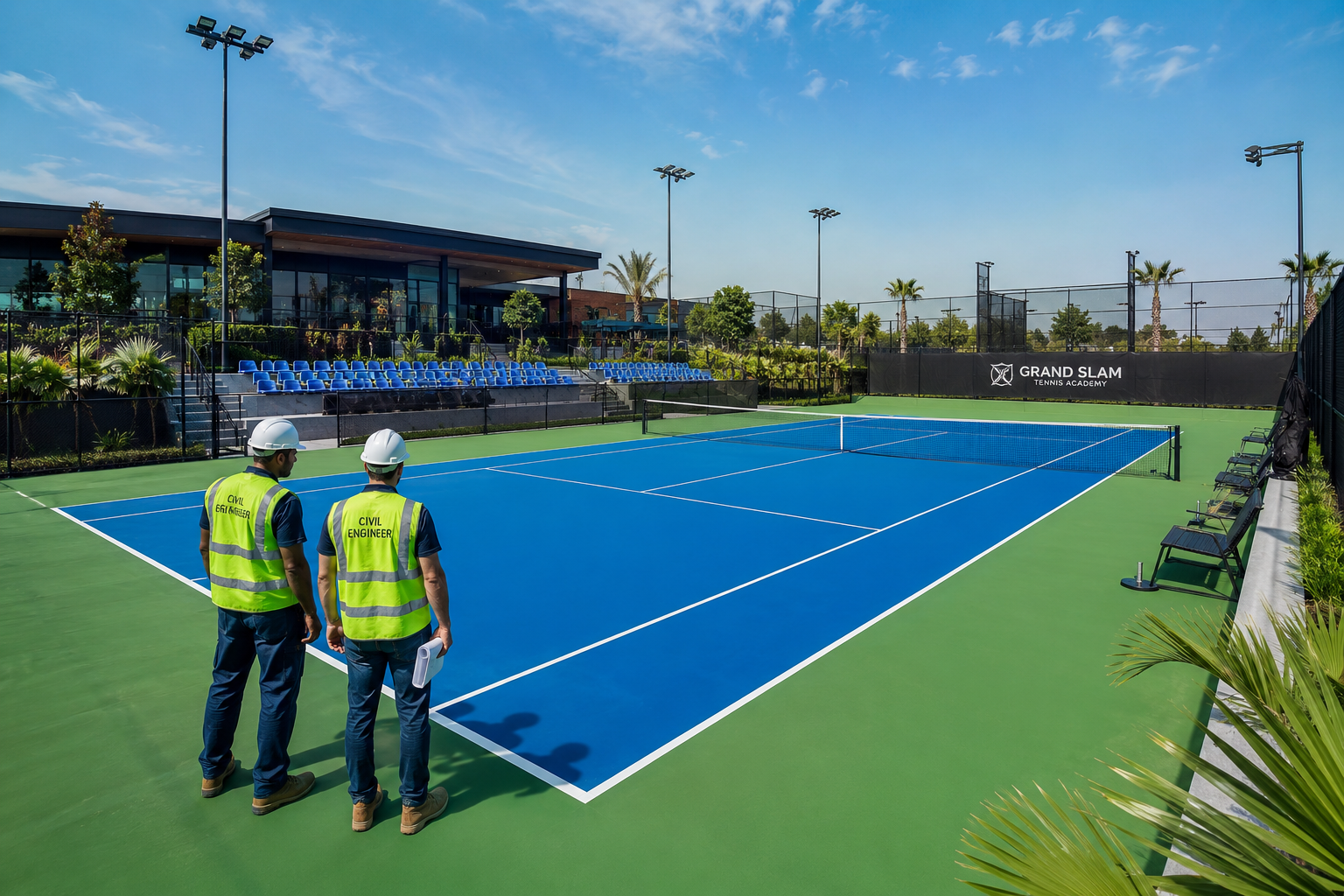
Why Professional Synthetic Tennis Court Construction Matters
A professionally constructed tennis court requires more than a quality top surface. Base stability, level tolerance, water drainage, material compatibility and accurate line marking all influence playing performance and the durability of the facility. Poor preparation can contribute to uneven areas, water accumulation, surface deterioration and avoidable maintenance.
With appropriate planning and installation, a synthetic tennis court can provide predictable ball response, reliable player traction and a neat, professional appearance. Choosing the right surface system also helps match the court to its intended use, whether it is designed for school sports, community recreation, coaching or competitive tennis.
Synthetic Tennis Court Surface Options
Acrylic Tennis Court Surfacing
Suitable for: Schools, clubs, sports academies and outdoor tennis facilities.
- Textured surface designed for tennis play
- Colour and playing-speed options, depending on the system
- Relatively straightforward routine cleaning
- Can be applied over a suitable prepared base
Cushioned Acrylic Tennis Courts
Suitable for: Training facilities and players seeking additional surface cushioning.
- Resilient layers beneath the acrylic finish
- Can improve underfoot comfort
- Surface response depends on the selected system
- Requires compatible base preparation and installation
Artificial Grass Tennis Courts
Suitable for: Recreational facilities, selected clubs, resorts and residential developments.
- Grass-like appearance and playing feel
- Infill and pile specifications can vary
- Requires brushing and periodic infill maintenance where applicable
- Performance depends on the turf system and installation quality
Hard Court Construction
Suitable for: Tennis facilities requiring a firm, consistent playing surface.
- Typically built with a stable asphalt or concrete base
- May use an acrylic sports coating system
- Supports a range of recreational and competitive uses
- Requires suitable drainage and periodic surface maintenance
The most suitable surface depends on the court's intended use, local weather, base condition, expected playing intensity and maintenance plan. Surface selection should be finalised after reviewing the site and the manufacturer's installation requirements.
Comparison of Synthetic Tennis Court Systems
| Surface Type | Typical Application | Maintenance Considerations | Key Planning Factor |
|---|---|---|---|
| Acrylic tennis court | Schools, clubs and sports complexes | Cleaning and periodic coating inspection | Base condition, coating system and drainage |
| Cushioned acrylic court | Training centres and facilities prioritising cushioning | Cleaning and inspection of the coating system | Cushion-layer specification and compatibility |
| Artificial grass court | Selected residential, club and recreational facilities | Brushing, debris removal and infill care where required | Turf quality, backing, infill and drainage |
| Hard court with sports coating | Recreational and competitive tennis facilities | Routine cleaning and surface-condition checks | Structural stability and coating suitability |
The service life of a tennis court cannot be determined by surface type alone. Usage, climate, construction quality, drainage, material specifications and maintenance all affect long-term performance. Ask for product-specific guidance when comparing quotations.
Our Synthetic Tennis Court Construction Process
- Site Survey and Project Planning: Assess the available area, ground conditions, access, court orientation and intended use before preparing the construction plan.
- Ground Preparation: Carry out the required excavation, grading and compaction based on the site design and soil conditions.
- Drainage Planning: Plan surface gradients and drainage provisions to reduce water accumulation and protect the court base.
- Sub-Base and Foundation Construction: Build a stable foundation suitable for the selected tennis court system, with appropriate levels and compaction.
- Base Inspection and Preparation: Check the base for level, surface condition and suitability before applying the selected surfacing system.
- Synthetic Surface Installation: Install the specified acrylic layers, cushioning system or artificial grass according to the product requirements.
- Court Line Marking: Mark the playing lines accurately according to the applicable tennis court dimensions and project specifications.
- Accessories and Finishing: Install agreed accessories such as net posts, nets, fencing and lighting, then complete the final inspection and handover.
Tennis Court Dimensions and Layout Planning
Standard tennis court planning should follow the applicable tennis rules and project requirements. The playing area for a doubles court measures 23.77 metres long and 10.97 metres wide, while the singles playing width is 8.23 metres. Additional space is required beyond the court lines for player movement, run-off areas, fencing, access and safe circulation.
The total land requirement is therefore larger than the marked playing area. Before construction begins, confirm the site dimensions, orientation, clearances, net-post locations, drainage layout and any requirements applicable to the intended competition level.
Benefits of Synthetic Tennis Court Construction
- Consistent Playing Conditions: A suitable, correctly installed surface supports predictable ball response and traction.
- Surface Options: Choose from different acrylic, cushioned and artificial grass systems according to the facility's needs.
- Outdoor Suitability: Appropriate systems can be specified for outdoor use with proper drainage and weather-related planning.
- Manageable Maintenance: Routine cleaning and scheduled inspections can help maintain the playing surface.
- Facility Appeal: Professional colours, line markings and accessories create a clean, organised sports environment.
- Flexible Applications: Suitable options are available for schools, academies, clubs, resorts, communities and sports complexes.
Factors Affecting Synthetic Tennis Court Construction Cost
The cost of synthetic tennis court construction varies with the site and the specifications selected. A reliable estimate should be based on an assessment of the project rather than a single generic price per square foot.
- Site location, access and existing ground conditions
- Excavation, soil preparation and foundation requirements
- Drainage provisions and base construction
- Type and specification of the synthetic surface
- Cushioning layers, coating system or artificial grass infill
- Court dimensions, surrounding run-off space and fencing
- Lighting, net posts, nets and other accessories
- Transport, labour, site logistics and finishing requirements
For an accurate project quotation, share your location, available area, preferred surface and any drawings or site photographs. The final scope and price can then be assessed against the actual site requirements.
Maintenance Tips for Synthetic Tennis Courts
- Remove leaves, dust and loose debris regularly.
- Use cleaning methods recommended for the selected surface system.
- Keep drainage outlets clear and check for standing water after rainfall.
- Inspect court lines, joints, coatings and surrounding fixtures periodically.
- For artificial grass, follow the specified brushing and infill maintenance routine.
- Repair surface defects promptly to help prevent further deterioration.
- Arrange professional inspections when significant wear or drainage issues appear.
Where Can Synthetic Tennis Courts Be Constructed?
Sports Facility India provides tennis court project solutions for a range of facilities, subject to site conditions and project scope, including:
- Schools, colleges and universities
- Tennis academies and sports training centres
- Private clubs and sports complexes
- Residential societies and community recreation areas
- Hotels, resorts and leisure facilities
- Corporate campuses and institutional sports facilities
- Public recreation areas and multipurpose sports developments
Frequently Asked Questions About Synthetic Tennis Court Construction
1. What is the best surface for a synthetic tennis court?
Acrylic surfacing is a widely used option for hard tennis courts because it offers a consistent playing surface and a range of surface-system choices. Cushioned acrylic and artificial grass may suit other preferences. The best option depends on playing requirements, site conditions, climate and budget.
2. How long does synthetic tennis court construction take?
The project timeline depends on excavation, weather, drainage, base construction, curing requirements, surface selection and site access. A realistic schedule can be provided after the site and scope have been assessed.
3. Can a synthetic tennis court be constructed outdoors?
Yes. Suitable acrylic and artificial grass systems can be installed outdoors when the foundation, surface specification and drainage are designed for the site conditions.
4. What is the standard tennis court size?
The marked playing area measures 23.77 metres by 10.97 metres for doubles and 23.77 metres by 8.23 metres for singles. Additional space is needed around the court for safe player movement, access and fencing.
5. How much does synthetic tennis court construction cost in India?
The cost varies according to the surface system, site preparation, drainage, foundation, court size, fencing, lighting and accessories. A site-specific quotation is the best way to establish the overall project budget.
6. How long does a synthetic tennis court last?
Service life varies by surface type, material quality, usage, weather exposure, base condition and maintenance. Follow the selected product's maintenance instructions and request a product-specific service-life estimate.
7. Do you provide complete tennis court construction services?
Sports Facility India can assist with project planning, site preparation, drainage, base construction, synthetic surfacing, line marking and agreed accessories. Confirm the precise scope of work when requesting a quotation.
8. What information is needed for a tennis court quotation?
Share your project location, approximate land dimensions, preferred surface, intended use, site photographs or drawings, and requirements for fencing and lighting. These details help determine the likely construction scope.
Plan Your Synthetic Tennis Court Construction Project
Looking for a tennis court construction company in India? Sports Facility India offers project-focused solutions for synthetic tennis court construction, including surface selection, site preparation, base development, drainage, surfacing and finishing according to the agreed requirements.
Contact our team to discuss your available space, preferred court surface and construction budget.
Request a Tennis Court Construction Consultation