
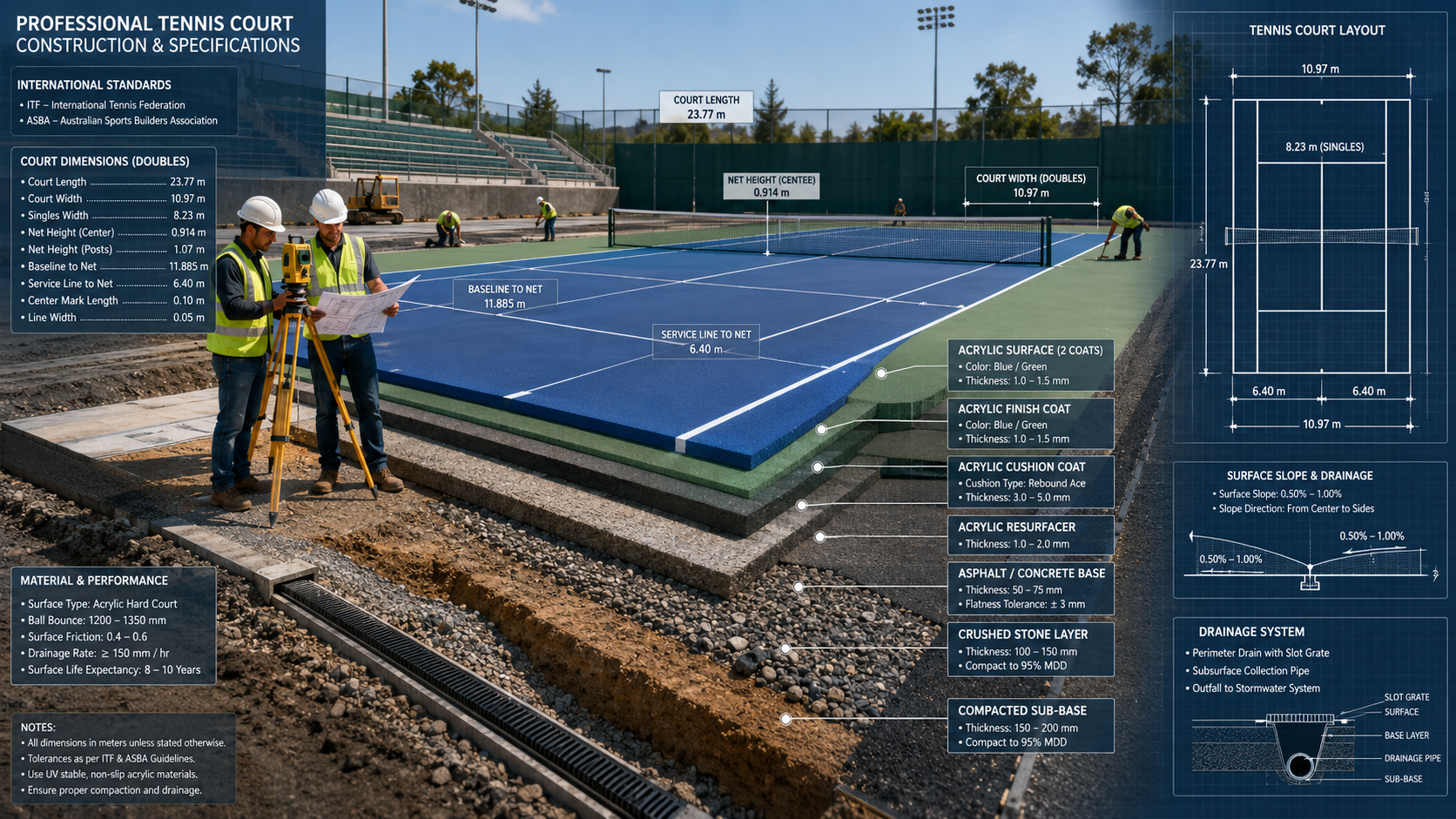
Tennis Court Construction Specifications
A well-designed tennis court combines a correctly measured playing area with a stable foundation and a surface system appropriate for the site's conditions. The construction method should be selected after assessing soil stability, drainage, slope, local climate, access for equipment, and expected playing frequency.
The specifications for an individual project may vary according to the surface system, site conditions, intended use, and applicable competition requirements. Court dimensions should be established at the planning stage, while the foundation and surface layers should follow the selected system's engineering and installation requirements.
Key Tennis Court Construction Specifications
- Court dimensions: The standard playing lines measure 23.77 m × 8.23 m for singles and 23.77 m × 10.97 m for doubles. Additional space is needed around the playing lines.
- Foundation and sub-base: The foundation must be suitable for the site's ground conditions and the selected court system. Proper preparation and compaction help reduce settlement and surface irregularities.
- Base construction: Concrete or asphalt may be specified for appropriate hard-court systems. Base design should account for load support, levels, drainage, and surface compatibility.
- Playing surface: Acrylic hard court, clay, natural grass, or a suitable synthetic surface can be considered according to the project's needs.
- Surface finishing: The chosen system should provide the intended playing characteristics, consistent texture, and appropriate traction.
- Drainage: Site grading, surface gradients, and drainage infrastructure should be planned to manage water effectively.
- Line marking: Court markings must follow the required playing dimensions and be compatible with the selected surface system.
- Net and accessories: Net posts, nets, anchors, and fittings should be appropriate for the intended use and installed securely.
- Fencing and lighting: Optional fencing, access gates, and sports lighting should be incorporated into the overall site plan.
- Maintenance planning: Cleaning access, drainage inspection, surface repairs, and future resurfacing should be considered during project planning.
Standard Tennis Court Dimensions
Correct court dimensions are essential for a consistent playing experience. The measurements below refer to the playing lines; the full facility requires additional room outside those lines for safe movement, fencing, and access.
| Specification | Measurement |
|---|---|
| Court length | 23.77 m (78 ft) |
| Singles court width | 8.23 m (27 ft) |
| Doubles court width | 10.97 m (36 ft) |
| Service line distance from the net | 6.40 m (21 ft) |
| Net height at the centre | 0.914 m (3 ft) |
| Net height at the posts | Approximately 1.07 m (3 ft 6 in) |
The overall site dimensions depend on the required run-off areas, fencing, access routes, and intended use. If the court is planned for sanctioned competition, confirm the current applicable rules and clearance requirements before finalizing the layout.
Tennis Court Foundation and Sub-Base Requirements
The foundation is one of the most important elements of tennis court construction. An unsuitable or poorly prepared base can contribute to settlement, cracking, uneven surfaces, and drainage problems. The construction method should therefore be based on a site assessment rather than a single standard build-up for every location.
Site Survey and Ground Preparation
Initial work generally includes measuring the available area, assessing ground levels, reviewing soil conditions, checking site access, and identifying how rainwater will be managed. Excavation, grading, and compaction are then completed according to the approved design.
Base Layer Design
The sub-base and structural base should provide adequate support for the selected playing surface. Depending on the design, the system may use prepared aggregate layers and a concrete or asphalt base. Layer thicknesses, reinforcement, compaction requirements, and material grades should be specified by the project designer according to ground conditions and engineering needs.
Surface Readiness
Before applying the playing surface, the base should be checked for levels, surface condition, drainage, and suitability for the chosen system. Moisture and curing requirements should be met in accordance with the surface manufacturer's installation instructions.
Tennis Court Drainage and Slope Specifications
Effective drainage is essential for outdoor tennis courts, particularly where rainfall is frequent or the site has challenging ground conditions. Water that remains on the court or enters unsuitable base layers can affect usability and contribute to deterioration.
- Assess natural ground levels and the direction of water flow.
- Design suitable gradients in accordance with the chosen court system.
- Provide appropriate drainage channels or outlets where required.
- Prevent surrounding runoff from flowing onto the playing surface.
- Consider soil permeability, groundwater, and local rainfall patterns.
- Check that drainage outlets remain accessible for routine maintenance.
Drainage design should be tailored to the site. There is no single slope or drainage layout that is appropriate for every court, so the final design should be confirmed before foundation work begins.
Tennis Court Surface Options
The right tennis court surface depends on the intended style of play, available budget, climate, maintenance capacity, and desired playing characteristics. The options below have different installation and upkeep requirements.
Acrylic Hard Court
Acrylic hard courts are a common choice for schools, clubs, sports academies, and recreational facilities. The coating system is applied over a suitable prepared base.
- Consistent playing characteristics when correctly installed
- Choice of colours and approved coating systems
- Routine cleaning and periodic surface maintenance
- Optional cushioning systems for specified applications
Clay Court
Clay courts provide a distinct playing experience, generally with a slower pace and different ball bounce compared with hard courts. Their construction and maintenance requirements differ from those of acrylic courts.
- Traditional playing characteristics
- Requires regular surface care and preparation
- Water management is an important design consideration
- Suitable for facilities able to maintain the surface
Natural Grass Court
Natural grass courts offer a traditional surface with distinctive ball speed and bounce. They require specialist turf establishment and regular grounds maintenance.
- Natural playing surface and appearance
- Grass growth and ground condition need monitoring
- Regular mowing and maintenance are required
- Performance can be affected by weather and wear
Synthetic Surface Systems
Synthetic tennis court surfaces may be considered for selected recreational and sports applications. Suitability depends on the product's intended use and its tennis-specific playing characteristics.
- Different product constructions are available
- Surface performance varies by system
- Installation must follow manufacturer specifications
- Maintenance needs depend on the selected material
Surface names alone do not guarantee competition suitability. If a project requires a particular performance classification or compliance with tennis competition rules, confirm the relevant requirements and selected product specifications before installation.
Important Factors in Tennis Court Design and Construction
1. Site Evaluation
The site survey should consider available space, terrain, soil stability, existing structures, access, and drainage. These findings guide the layout and construction method.
2. Local Climate
Temperature changes, rainfall, sunlight, and local environmental conditions can influence surface selection, drainage design, construction scheduling, and maintenance planning.
3. Player Safety and Comfort
The surface should be selected for suitable traction and playing characteristics. Where a cushioning system is specified, its compatibility with the base and surface should be checked. No surface can eliminate every risk of injury.
4. Intended Usage
A court for occasional residential use may have different requirements from a school court, coaching academy, club facility, or competition venue. The design should reflect the expected frequency of play and the level of performance required.
5. Budget and Long-Term Maintenance
The initial construction budget should be considered alongside cleaning, repairs, surface renewal, drainage upkeep, and any landscaping or lighting requirements. Comparing the full life-cycle needs of the available systems helps with long-term planning.
Tennis Court Line Marking, Net and Accessories
Accurate line marking and suitable court accessories are essential finishing components. Court lines should be measured and positioned according to the intended format of play, while marking materials must be compatible with the selected surface.
- Singles and doubles court lines
- Service lines and centre service line
- Baseline and sideline markings
- Net posts, anchors, and tennis net
- Access gates and perimeter fencing, where required
- Optional benches, seating, and player amenities
- Sports lighting for approved playing conditions
The final selection of accessories should match the intended facility use, applicable rules, and project specifications.
Indoor and Outdoor Tennis Court Construction
Outdoor Tennis Courts
Outdoor courts are directly exposed to rainfall, sunlight, and environmental changes. Planning should give particular attention to site drainage, weather-appropriate materials, surface exposure, surrounding clearances, and maintenance access.
Indoor Tennis Courts
Indoor tennis courts require suitable building clearance, lighting, ventilation, safe access, and a compatible playing surface. The available space should account for the playing area and the additional clearances needed for the intended use.
The construction specifications for indoor and outdoor projects should be finalized only after reviewing the site and the selected court system.
Our Tennis Court Construction Process
- Initial consultation: Discuss the proposed location, intended use, budget, and project requirements.
- Site assessment: Review the land, access, levels, soil, and drainage conditions.
- Design and specifications: Establish the court layout, surface selection, base design, and accessory requirements.
- Ground preparation: Complete excavation, grading, and compaction according to the approved plan.
- Foundation and drainage: Construct the designed base and provide the specified water-management provisions.
- Surface installation: Install the selected playing surface following the applicable system requirements.
- Finishing: Complete court line marking and install included accessories.
- Inspection and handover: Review the completed work against the agreed scope and specifications.
Maintenance and Service Life of Tennis Courts
The service life of a tennis court depends on its design, construction quality, surface material, weather exposure, intensity of use, and maintenance. A fixed lifespan cannot be guaranteed for every court.
- Remove leaves, dust, and other debris regularly.
- Inspect drainage channels and keep outlets clear.
- Check the playing surface for cracks, peeling, or uneven areas.
- Maintain court markings and accessories as required.
- Arrange suitable repairs when defects appear.
- Assess the surface periodically to determine whether recoating or resurfacing is needed.
Acrylic courts may need periodic recoating or resurfacing depending on their condition and usage. Clay and natural grass courts usually require more frequent specialist maintenance. Follow the maintenance instructions for the installed system and seek a professional assessment if significant cracking, settlement, or drainage problems occur.
Frequently Asked Questions About Tennis Court Construction Specifications
1. What are the standard dimensions of a tennis court?
The playing lines measure 23.77 m by 8.23 m for singles and 23.77 m by 10.97 m for doubles. Additional space is needed around the court for player movement and safety.
2. Which surface is suitable for tennis court construction?
Acrylic hard courts, clay, natural grass, and suitable synthetic surfaces are options. The choice depends on intended use, climate, maintenance, budget, and playing requirements.
3. What foundation is required for a tennis court?
A tennis court needs a properly designed and compacted foundation and base suitable for the site conditions and selected surface system. Drainage and surface-level requirements should be addressed during design.
4. Why is drainage important in tennis court construction?
Proper drainage helps manage rainwater, reduces standing water, and protects the playing surface and underlying base from avoidable water-related damage.
5. How long does a tennis court last?
Service life varies with construction quality, surface type, weather exposure, usage, and maintenance. Periodic inspection and timely repairs can help extend the useful life of a court.
6. Can a tennis court be customized for residential use?
Yes. A tennis court can be planned for a residential property according to the available land, site conditions, budget, intended use, and required safety clearances.
7. What maintenance does a tennis court require?
Maintenance depends on the surface type. It may include cleaning, drainage checks, surface inspections, line marking repairs, and resurfacing or specialist maintenance when required.
Planning a Tennis Court Construction Project?
Sports Facility India can help you explore tennis court dimensions, foundation requirements, surface systems, drainage, line marking, fencing, lighting, and other project specifications.
Contact our team to discuss your site, intended use, and construction requirements. We can help you identify the next steps toward planning a suitable tennis court facility.
Call for Consultation Request a Project Quote