
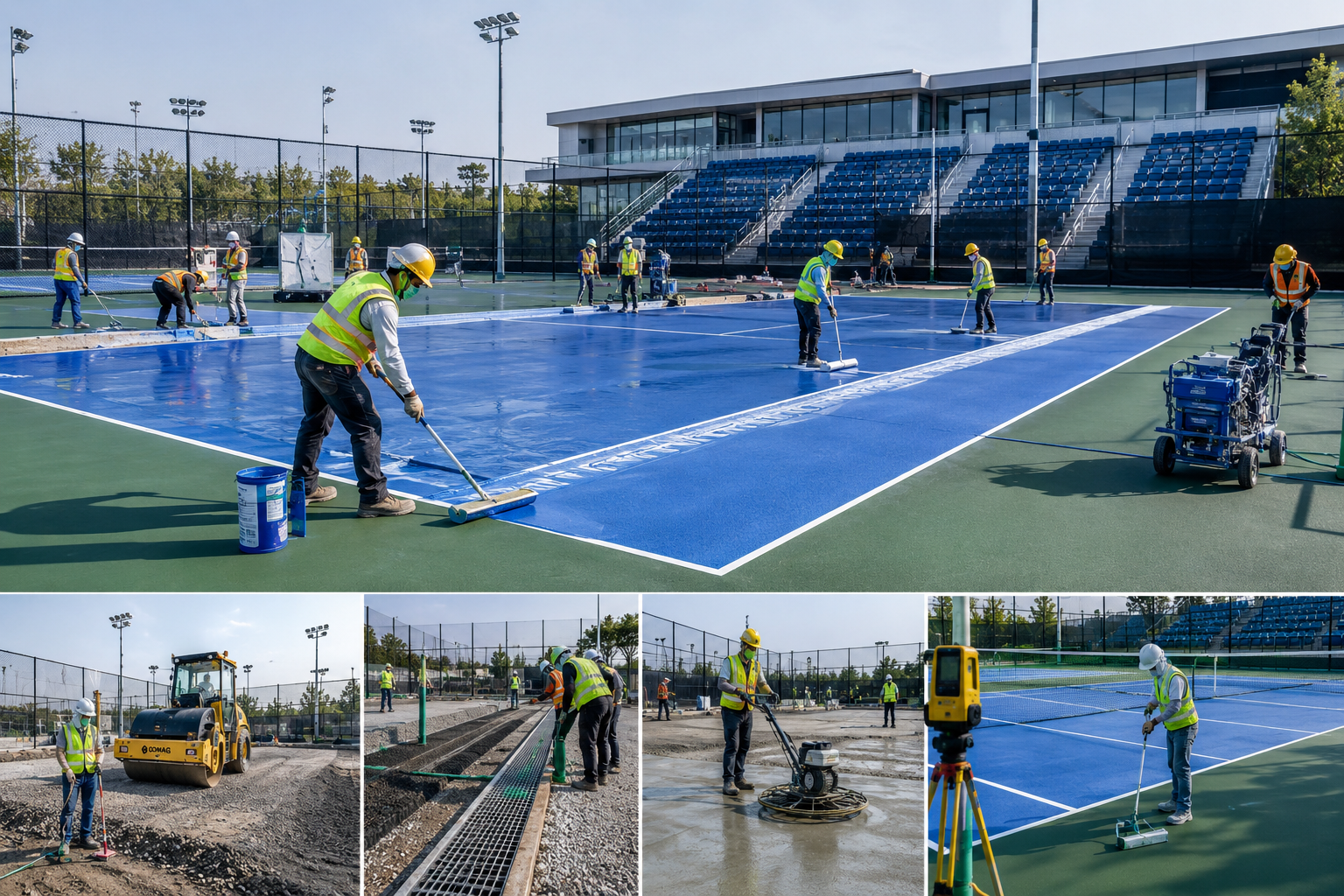
Why Professional Tennis Court Construction Matters
The quality of a tennis court affects player movement, ball response, surface consistency and the overall playing experience. Inadequate foundation preparation, poor drainage or unsuitable surfacing can lead to uneven areas, cracks and premature wear. Professional construction considers the court as a complete system rather than simply applying a coating to the ground.
- Stable foundation: Appropriate base preparation supports the playing surface and helps limit avoidable movement.
- Consistent play: Correct leveling and suitable surface application support predictable ball response and footing.
- Water management: Planned gradients and drainage help direct rainwater away from the court.
- Player comfort: Surface selection can be matched to the intended use and preferred playing characteristics.
- Durability: Suitable materials and correct installation help manage wear from regular use.
- Practical maintenance: Routine cleaning, timely repairs and appropriate resurfacing can help extend service life.
Best Tennis Court Construction Options
The right tennis court system depends on the project budget, site conditions, expected playing frequency and preferred surface characteristics. The options below should be assessed against the requirements of the specific facility.
Acrylic Tennis Court Construction
Suitable for: Schools, clubs, outdoor courts and many recreational or training facilities.
- Consistent playing surface when correctly installed
- Available in different colours and surface textures
- Relatively straightforward routine maintenance
- Can be applied over a properly prepared compatible base
Synthetic Tennis Court Systems
Suitable for: Selected training facilities and projects with specific surface requirements.
- System options vary by material and construction
- Surface characteristics can be selected for intended use
- Requires a compatible and properly prepared substrate
- Maintenance depends on the installed system
Concrete or Asphalt Base Construction
Suitable for: Projects requiring a stable foundation for a compatible tennis court surface.
- Base specification selected for site conditions
- Careful leveling and compaction where required
- Drainage and crack-control planning are important
- Can support compatible acrylic court systems
Cushioned Tennis Court Systems
Suitable for: Facilities prioritising additional cushioning and specific playing characteristics.
- Includes resilient layers within a compatible system
- Can provide a more cushioned feel underfoot
- Surface performance depends on the complete system
- Specify performance requirements before installation
If competition-level play is intended, the selected surface and court layout should be checked against the applicable International Tennis Federation (ITF) requirements. Do not assume that every acrylic or cushioned system is automatically certified or compliant.
Comparison of Tennis Court Construction Types
| Court System | Common Applications | Maintenance Considerations | Key Planning Requirement |
|---|---|---|---|
| Acrylic sports surface | Schools, clubs and outdoor courts | Cleaning, surface inspections and periodic recoating as required | Compatible, well-prepared base |
| Synthetic surface system | Selected academies and sports facilities | Depends on the product and installation system | Material suitability and installation specifications |
| Cushioned court system | Facilities seeking a more cushioned playing feel | Inspect surface layers and follow supplier guidance | Correct installation of the complete system |
| Concrete or asphalt base | Foundation for a compatible court surface | Monitor cracks, drainage and structural condition | Ground preparation, levels and drainage design |
Service life cannot be guaranteed by surface category alone. Actual durability depends on material quality, base condition, installation, climate, frequency of use and maintenance.
Our Tennis Court Construction Services
Sports Facility India can help coordinate the main components of a tennis court project, from initial planning to finishing work. The final scope is determined by the site assessment and the requirements agreed upon for the project.
Site Preparation and Base Development
Ground preparation may include clearing, excavation, grading, compaction and development of the specified base. The construction method should reflect soil conditions, site levels, drainage needs and the selected surface system.
Acrylic Tennis Court Flooring Installation
Acrylic tennis court surfacing involves preparing the base and applying compatible layers according to the product system. Application conditions, curing time and surface preparation are important for achieving an even and durable finish.
Tennis Court Fencing and Lighting
Fencing helps define the playing area and contain balls. Sports lighting can support evening use when designed for the court layout and intended activity. Both should be planned with access, safety and maintenance in mind.
Tennis Court Resurfacing and Renovation
Existing courts may need cleaning, recoating, line repainting or selected repairs as the surface ages. Where cracking, settlement or recurring water accumulation is present, the underlying cause should be evaluated before cosmetic repairs are undertaken.
- Outdoor tennis court construction
- Indoor tennis court planning and installation
- Acrylic sports flooring and court coating
- Selected synthetic and cushioned court systems
- Base preparation and leveling
- Drainage planning and development
- Court fencing and access gates
- Sports lighting installation
- Accurate court line marking
- Resurfacing, renovation and maintenance planning
- Turnkey sports infrastructure projects
Standard Tennis Court Dimensions and Layout
Court dimensions should be confirmed during the design stage. The standard marked playing area is 23.77 metres long. Its width is 8.23 metres for singles and 10.97 metres for doubles. Additional space is required beyond the marked lines for player movement, fencing and safe circulation.
| Measurement | Standard Dimension |
|---|---|
| Court length | 23.77 metres |
| Singles court width | 8.23 metres |
| Doubles court width | 10.97 metres |
The total plot requirement is larger than the marked playing area. Run-off space, gates, access routes, lighting positions and any spectator facilities must be included in the layout. For tournament use, check the relevant competition requirements before finalising the design.
Step-by-Step Tennis Court Construction Process
- Project consultation: Understand the intended use, budget, preferred surface and required facilities.
- Site inspection: Assess land dimensions, soil, ground levels, access and water runoff.
- Design and layout: Plan court orientation, dimensions, safety clearances and supporting infrastructure.
- Ground preparation: Complete the required clearing, excavation, grading and compaction.
- Foundation construction: Develop the specified base according to engineering and site requirements.
- Drainage installation: Incorporate appropriate water-management provisions for the site.
- Surface application: Install the selected tennis court surfacing system over a suitable prepared base.
- Court marking: Measure and apply the playing lines accurately.
- Supporting facilities: Install fencing, gates and lighting if included in the project.
- Final inspection: Check the completed work and review agreed handover requirements.
How to Choose the Right Tennis Court Construction System
- Intended use: Consider whether the court is for recreational play, coaching, regular club use or competitive training.
- Surface characteristics: Review grip, ball response, cushioning and the playing feel of the proposed system.
- Site conditions: Evaluate soil, ground levels, rainfall exposure, access and drainage.
- Available budget: Compare the complete project cost, not just the surface material.
- Maintenance: Understand cleaning, repair and resurfacing needs before choosing a system.
- Compliance requirements: Confirm applicable dimensions and surface performance requirements if competition use is planned.
- Supporting facilities: Account for fencing, lighting, access and any additional amenities.
Factors That Affect Tennis Court Construction Cost
Tennis court construction costs vary according to the site and project specification. A reliable estimate should account for the full construction scope instead of relying on a single per-square-foot rate.
- Land preparation and excavation requirements
- Soil condition and foundation design
- Concrete or asphalt base specifications
- Chosen acrylic, synthetic or cushioned surface system
- Drainage and water-management work
- Fencing, gates and lighting
- Site accessibility and material transportation
- Number of courts and project location
- Additional facilities and finishing requirements
For a project estimate, share your location, approximate plot dimensions, intended court use and requirements for surfacing, fencing, lighting and drainage. Final pricing should be confirmed against the actual project scope.
Tennis Court Maintenance for Long-Term Performance
Routine care helps preserve the playing surface and identify developing issues early. Maintenance requirements vary by surface system, climate and frequency of use.
- Remove leaves, dirt and loose debris regularly.
- Keep drainage outlets and channels clear.
- Inspect the court for cracks, peeling and uneven areas.
- Use cleaning methods suitable for the installed surface.
- Check line markings, gates, fencing and lighting periodically.
- Investigate recurring standing water or surface deterioration.
- Arrange repairs and resurfacing when the condition of the court requires it.
Applications of Professional Tennis Court Construction
Tennis courts can be designed for a wide range of educational, recreational and commercial settings. Each facility benefits from a layout and surface specification that reflects its users and expected playing schedule.
- Schools and educational campuses
- Colleges and universities
- Tennis academies and coaching centres
- Private clubs and recreation facilities
- Residential societies and townships
- Hotels, resorts and hospitality properties
- Corporate recreation facilities
- Government and community sports projects
- Private properties and dedicated training facilities
Why Choose Sports Facility India?
Sports Facility India provides sports infrastructure solutions with an emphasis on project planning, suitable material selection and coordinated execution. Our tennis court construction services can be tailored to different site conditions, playing requirements and facility objectives.
- Project planning based on site conditions and intended use.
- Options for acrylic, synthetic and cushioned court systems where suitable.
- Support for base preparation, surfacing and line marking.
- Coordination of drainage, fencing and lighting requirements.
- Construction solutions for educational, recreational and commercial facilities.
- Guidance on maintenance and future surface care.
Whether you are planning a new tennis court or renovating an existing facility, our team can discuss your requirements and help identify suitable next steps.
Frequently Asked Questions About Tennis Court Construction
1. What is the standard size of a tennis court?
A standard tennis court is 23.77 metres long, with a marked width of 8.23 metres for singles and 10.97 metres for doubles. Additional space is needed around the playing area for safe movement.
2. Which surface is best for tennis court construction?
Acrylic sports flooring is a popular choice for many outdoor tennis courts. Synthetic and cushioned systems may also suit particular projects. The best option depends on the base, intended use, budget and desired playing characteristics.
3. How long does tennis court construction take?
The construction schedule depends on site preparation, foundation work, drainage, weather, surface curing and supporting facilities. A realistic timeline can be provided after assessing the site and project specifications.
4. What is the cost of building a tennis court?
Cost depends on court dimensions, ground conditions, foundation, surfacing, drainage, fencing, lighting and location. A site-specific quotation is the best way to establish the expected project cost.
5. Can an existing tennis court be resurfaced?
Yes, depending on its condition. Resurfacing may involve cleaning, preparation, recoating, suitable repairs and line marking. Significant base or drainage defects should be evaluated before surface work begins.
6. Do you provide turnkey tennis court construction?
Project solutions can include site preparation, base construction, drainage planning, surfacing, line marking, fencing, lighting and final inspection, according to the agreed scope of work.
7. Can a tennis court be constructed for a school or residential society?
Yes. Tennis courts can be planned for schools, colleges, residential communities, clubs, resorts, academies and other suitable facilities. The layout should account for available land, safety clearances and the expected level of use.
8. How do I request a tennis court construction quotation?
Contact Sports Facility India by phone, WhatsApp or through the website contact page. Provide the project location, approximate site dimensions, preferred surface and any requirements for fencing, lighting or drainage.
Plan Your Tennis Court Construction Project
Looking for a tennis court construction company in India? Contact Sports Facility India to discuss court design, acrylic tennis court flooring, synthetic surface options, resurfacing and complete sports infrastructure requirements.
Call: +91 8009483311 WhatsApp Us Request a Consultation