
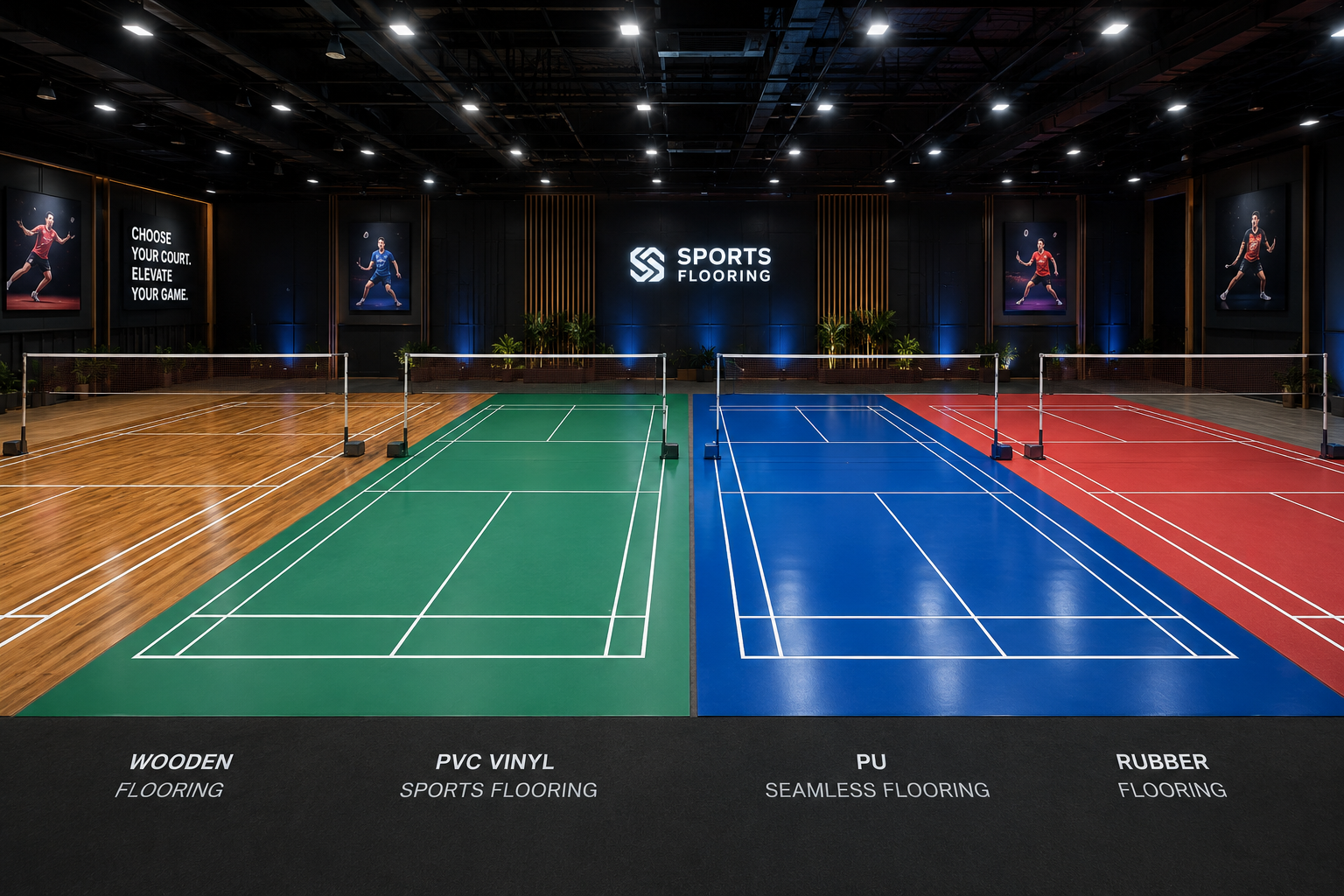
Why Choosing the Right Badminton Court Flooring Matters
Badminton requires fast footwork, frequent changes of direction, jumping, lunging and sudden stopping. The court surface must provide suitable traction and a consistent playing area while supporting the demands of repeated movement. Flooring that is too slippery, excessively hard or uneven can affect player confidence and increase the risk of slips and other injuries.
A professionally selected sports flooring system combines an appropriate playing surface with a suitable base construction. Depending on the material, the complete system may include cushioning layers, resilient supports, reinforcement, adhesives and protective finishes.
Benefits of Suitable Badminton Sports Flooring
- Reliable Grip: Sports-specific surface textures support controlled footwork and changes in direction.
- Player Comfort: Appropriate surface and subfloor characteristics can improve comfort during training and matches.
- Consistent Playing Conditions: A level, uniform floor supports predictable movement throughout the court.
- Durability: Correctly specified flooring can withstand regular use when installed and maintained properly.
- Easy Maintenance: Many synthetic flooring systems can be cleaned using straightforward, manufacturer-approved procedures.
- Professional Appearance: Dedicated playing colours and clear line markings improve the overall presentation of a sports facility.
- Application Flexibility: Different flooring materials accommodate a variety of indoor, outdoor and multipurpose facilities.
- Long-Term Value: Choosing the right system can help minimise avoidable repairs and premature replacement.
Types of Badminton Court Flooring Options
The best badminton court flooring depends on the facility type, expected player traffic, playing level, available budget and environmental conditions. The following options are commonly considered when planning a new court or upgrading an existing sports facility.
1. PVC Vinyl Badminton Court Flooring
PVC vinyl badminton court flooring is a popular option for indoor badminton courts because it is available in purpose-designed sports flooring constructions with different levels of cushioning, reinforcement and surface protection. It is frequently considered for badminton academies, schools, colleges, clubs, training centres and indoor sports halls.
Sports-grade PVC flooring typically incorporates several functional layers. Depending on the product, these may include a wear layer, printed or coloured surface, reinforcement and cushioning. The exact construction and playing characteristics vary between manufacturers and product ranges.
Advantages of PVC Vinyl Flooring
- Available in sports-specific constructions for indoor badminton.
- Surface textures designed for appropriate grip.
- Integrated or compatible cushioning options.
- Consistent appearance with clear court markings.
- Convenient routine cleaning and maintenance.
- Suitable for regular practice and recreational use when correctly specified.
- Available in different thicknesses, colours and performance categories.
Recommended Applications
- Indoor badminton academies.
- School and college sports halls.
- Sports clubs and training centres.
- Residential indoor sports facilities.
- Commercial indoor badminton courts.
PVC vinyl flooring should be installed over a suitable substrate in accordance with the manufacturer's requirements. Moisture testing, surface levelling, adhesive compatibility and installation quality are important considerations.
2. Wooden Badminton Court Flooring
Wooden sports flooring is a premium option for indoor badminton facilities where playing quality, resilience and professional presentation are priorities. Engineered timber sports floors can be constructed with resilient supports or sprung subfloor systems designed to provide controlled impact response and energy return.
The performance of a wooden badminton court depends on the timber species, floor assembly, surface finish, installation quality and environmental conditions. A properly designed sports floor can provide a high-quality playing environment for advanced training and competition.
Advantages of Wooden Sports Flooring
- Premium appearance for indoor sports facilities.
- Potential for excellent resilience with a suitable sprung system.
- Appropriate for selected professional training and competition venues.
- Some systems can be refinished to restore the playing surface.
- Can provide a long service life with appropriate care.
- Suitable for multipurpose sports halls when correctly designed.
Recommended Applications
- Professional indoor sports stadiums.
- High-performance badminton academies.
- University sports halls.
- Premium indoor badminton facilities.
- Selected tournament and training venues.
Wooden sports flooring requires careful management of humidity, ventilation, cleaning and surface condition. The complete flooring assembly should be evaluated rather than selecting timber solely on its appearance.
3. Polyurethane (PU) Badminton Court Flooring
Polyurethane sports flooring is a synthetic flooring option used in selected indoor sports environments. PU systems may consist of several layers designed to provide a resilient finish, surface protection and the performance characteristics required by the intended activity.
For badminton applications, the product must be specifically suitable for the sport. General-purpose PU coatings and industrial polyurethane floors should not automatically be treated as badminton sports flooring because their grip, hardness and impact characteristics may differ.
Advantages of PU Sports Flooring
- Seamless or near-seamless construction in suitable systems.
- Resilient surface options for indoor sports applications.
- Good wear resistance when properly specified.
- Choice of colours and finish options.
- Convenient cleaning with suitable maintenance products.
- Potential suitability for multipurpose indoor facilities.
Recommended Applications
- Selected indoor sports halls.
- Multipurpose sports facilities.
- Training facilities requiring a suitable synthetic surface.
- Projects where a compatible PU sports flooring system meets the playing requirements.
Before choosing PU flooring, review the technical specifications, intended sports applications, cushioning characteristics and installation requirements to confirm suitability for badminton.
4. Acrylic Badminton Court Flooring
Acrylic sports flooring is widely used for outdoor hard courts. It generally consists of sports-grade acrylic coatings applied over a suitable concrete or asphalt base. Depending on the specification, the system may include primers, resurfacing compounds, textured colour coats and additional cushioning layers.
Acrylic surfaces are commonly considered for recreational badminton courts in schools, residential societies, clubs and community sports areas. UV-resistant formulations and appropriate surface textures can help maintain appearance and provide suitable playing characteristics for outdoor use.
Advantages of Acrylic Sports Flooring
- Suitable for many outdoor sports court applications.
- UV-resistant coating options.
- Available in different colours and textures.
- Can be applied over a properly prepared compatible base.
- Routine cleaning is generally straightforward.
- Damaged surfaces can sometimes be repaired or recoated.
- Practical for selected recreational and community facilities.
Recommended Applications
- Outdoor recreational badminton courts.
- School playground sports areas.
- Residential society courts.
- Community sports facilities.
- Outdoor multipurpose hard courts.
Acrylic flooring is a coating system, not a substitute for a well-constructed base. Drainage, crack treatment, surface slope and weather conditions must be assessed before installation. For competitive badminton, the proposed surface should also be evaluated against the intended playing requirements.
5. Epoxy Flooring with Cushioning Systems
Epoxy flooring is generally associated with hard, seamless protective coatings used in commercial and industrial environments. Although epoxy may form part of certain specialised sports flooring assemblies, a conventional epoxy coating alone is not normally the preferred playing surface for badminton.
Where an epoxy-based system is being considered, the complete assembly must be designed and tested for the intended sports application. A compatible resilient layer and suitable sports surface may be necessary to achieve appropriate playing characteristics.
Potential Advantages of Specialised Systems
- Seamless finish in suitable constructions.
- Good surface protection for compatible applications.
- Potential integration into specially engineered flooring assemblies.
- Choice of colours and finishes for selected systems.
Important Considerations
- Standard industrial epoxy can be excessively hard for badminton.
- Surface traction and impact characteristics must be assessed.
- Any cushioning layer must be compatible with the complete system.
- The final floor should be intended for sports use rather than industrial service.
For most badminton projects, compare sports-specific PVC, engineered timber or suitable synthetic sports systems before selecting an epoxy-based assembly.
6. Modular Interlocking Sports Tiles
Modular interlocking tiles are prefabricated components that connect to form a sports surface. They are available in different materials, thicknesses and surface designs. Some products are intended for outdoor recreational sports, while others are developed for particular indoor or multipurpose applications.
These systems can be useful where rapid installation, access to the underlying base or replacement of individual sections is important. However, not every modular tile is appropriate for badminton, particularly where consistent foot grip and controlled movement are essential.
Advantages of Modular Sports Tiles
- Interlocking construction for convenient assembly.
- Individual tiles can often be replaced if damaged.
- Some outdoor designs allow water to drain through the surface.
- Potentially useful for temporary or recreational facilities.
- Available in a variety of colours and configurations.
Recommended Applications
- Selected outdoor recreational courts.
- Temporary sports installations.
- Community recreation areas.
- Facilities where modular construction is specifically required.
Before purchasing modular tiles for badminton, verify their suitability for rapid footwork, traction, surface stability and the intended playing level. A general-purpose outdoor tile should not be assumed to provide competition-quality badminton performance.
Badminton Court Flooring Options Comparison Table
Comparing materials helps determine which system is most appropriate for the project. The table below provides a general guide rather than a guarantee of performance. Actual results depend on product specifications, construction quality, site conditions and maintenance.
| Flooring Type | Typical Application | Playing Characteristics | Relative Cost | Maintenance Considerations |
|---|---|---|---|---|
| PVC Vinyl Sports Flooring | Indoor badminton courts | Product-dependent grip and cushioning | Varies by specification | Routine cleaning and inspection |
| Wooden Sports Flooring | Premium indoor sports halls | Resilience depends on floor construction | Generally premium | Careful humidity and finish management |
| PU Sports Flooring | Suitable indoor sports facilities | Depends on the sports-specific system | Varies by system | Routine cleaning and surface checks |
| Acrylic Sports Flooring | Outdoor hard courts | Hard-court feel; texture varies by product | Often economical for outdoor applications | Drainage checks and periodic resurfacing |
| Epoxy-Based Specialised System | Selected engineered sports assemblies | Depends on the complete floor assembly | Project-dependent | System-specific maintenance |
| Modular Interlocking Tiles | Selected recreational and outdoor courts | Depends on tile design and stability | Varies by tile specification | Cleaning and periodic connection checks |
How to Choose the Best Badminton Court Flooring
Selecting a flooring material should begin with the purpose of the court. A competitive indoor venue, a school practice area and an outdoor residential court may require very different flooring specifications. The best choice balances playing requirements, site conditions, installation costs and ongoing maintenance.
1. Consider the Playing Level
Professional and advanced training facilities should prioritise sports-specific performance, surface consistency and appropriate impact characteristics. A properly engineered wooden system or a suitable high-performance PVC sports floor may be worth considering, depending on the facility requirements.
2. Decide Between Indoor and Outdoor Installation
Indoor badminton courts commonly use PVC vinyl or engineered timber systems, with suitable PU systems available for selected applications. Outdoor courts often use acrylic coatings over an appropriate base. Modular tiles may be considered for specific recreational installations after checking their suitability for badminton.
3. Evaluate the Existing Base
A sound subfloor is essential for reliable installation. Cracks, uneven areas, moisture and drainage problems should be identified before the flooring material is selected. Some systems require a very smooth substrate, while others depend on a specially designed resilient subfloor.
4. Compare Initial and Long-Term Costs
Flooring selection should consider the total installed cost, including surface preparation, underlays, adhesives, line marking and accessories. Maintenance, repair requirements and potential replacement should also be considered when comparing alternatives.
5. Assess Maintenance Requirements
Different materials require different cleaning procedures and environmental conditions. Wooden sports floors need appropriate humidity management and finish care, while synthetic floors require suitable cleaning products and periodic inspections.
6. Check Technical Specifications
Review manufacturer documentation for intended sports applications, surface grip, impact characteristics, installation conditions and maintenance recommendations. Where competitive use is planned, confirm applicable federation requirements for the floor and the complete playing facility.
Badminton Court Flooring Options for Different Facilities
Flooring recommendations should be based on the operational requirements of each facility rather than material popularity alone. The following guidance can help narrow down the options before a technical assessment.
- Professional Indoor Courts: Evaluate engineered wooden sports flooring or high-performance PVC flooring appropriate for the required standard of play.
- Badminton Academies: Consider sports-grade PVC vinyl or a suitable engineered timber system according to player level and training intensity.
- Schools and Colleges: Compare suitable PVC systems and other indoor sports floors based on student usage, maintenance and budget.
- Multipurpose Indoor Halls: Consider a sports-specific PU or PVC system that meets the requirements of the activities taking place in the hall.
- Outdoor Recreational Courts: Evaluate acrylic surfacing over a properly constructed base with effective drainage.
- Temporary Sports Installations: Modular tiles may be considered where the selected product supports the intended type of badminton play.
- Existing Court Renovations: Assess the existing flooring and substrate to determine whether repair, recoating, resurfacing or complete replacement is appropriate.
Indoor vs Outdoor Badminton Court Flooring
Indoor and outdoor courts face different environmental and performance demands. Indoor systems are generally selected with a strong focus on playing characteristics and the condition of the building environment. Outdoor systems must also withstand sunlight, rainfall and changes in surface temperature.
Indoor Badminton Flooring Considerations
- Suitable traction for badminton movements.
- Appropriate resilience and impact characteristics.
- Moisture testing for compatible substrate preparation.
- Correct adhesives and installation methods.
- Adequate ventilation and suitable environmental conditions.
- Clear line markings and suitable lighting.
Outdoor Badminton Flooring Considerations
- Stable concrete or asphalt base.
- Effective drainage and suitable surface slope.
- UV-resistant materials where appropriate.
- Weather-compatible installation conditions.
- Surface texture suitable for the intended use.
- Maintenance access for cleaning, crack repairs and resurfacing.
Outdoor badminton courts can be affected by wind, changing light and wet conditions. Flooring selection alone cannot eliminate these factors, so site layout and environmental exposure should also be considered during planning.
Badminton Court Flooring Installation Process
Proper installation is essential for the performance and service life of badminton flooring. Although the procedure varies by material, a systematic approach helps ensure that the surface is appropriate for the site and intended use.
- Initial Consultation: Understand the facility requirements, budget and intended playing level.
- Site Inspection: Review the available space, existing floor and access conditions.
- Measurement and Layout: Confirm court dimensions, surrounding clearance and line-marking requirements.
- Substrate Assessment: Identify uneven areas, cracks, moisture concerns and surface defects.
- Base Preparation: Complete required repairs, levelling, cleaning and other preparation work.
- Moisture and Drainage Checks: Address relevant moisture concerns indoors and drainage requirements outdoors.
- Flooring System Installation: Install the specified surface, cushioning or subfloor assembly according to the manufacturer's requirements.
- Court Line Marking: Apply the required playing lines using compatible materials.
- Quality Inspection: Check the finished surface, visible defects and line-marking accuracy.
- Handover: Provide appropriate guidance on cleaning, maintenance and the period before the court can be used.
Badminton Court Dimensions and Playing Surface Requirements
Court dimensions and line markings must be accurate to support correct badminton play. A standard doubles court measures 13.40 metres long and 6.10 metres wide. The singles court uses the same length and a playing width of approximately 5.18 metres.
The flooring system should allow the required playing lines to remain clearly visible. The court layout must also account for the net, posts, surrounding clearance, ceiling height and lighting. Competition venues may have additional facility requirements that should be checked against the applicable badminton regulations.
Important Planning Requirements
- Accurate singles and doubles boundaries.
- Uniform surface level and finish.
- Suitable traction and playing characteristics.
- Correct net and post positions.
- Adequate clearance around the court.
- Suitable lighting without distracting glare.
- Appropriate flooring and facility specifications for the intended playing level.
Badminton Court Flooring Cost and Budget Planning
The cost of badminton court flooring depends on the selected material, total installation area, subfloor condition, cushioning requirements and complexity of the project. A new indoor court may require different construction work from an outdoor court resurfacing project or a flooring replacement.
Key Factors Affecting Flooring Cost
- Type and specification of the flooring material.
- Total court area and number of courts.
- Existing base condition and preparation work.
- Underlay, cushioning or sprung subfloor requirements.
- Adhesives, primers and finishing materials.
- Line marking and colour customisation.
- Transportation and material handling.
- Site accessibility and installation conditions.
- Drainage or moisture treatment requirements.
- Maintenance and future resurfacing considerations.
For a useful quotation, provide the project location, court dimensions, indoor or outdoor application, current base condition and preferred flooring type. A site inspection can help identify the work required and establish a more accurate project scope.
Badminton Court Flooring Maintenance Guide
Regular maintenance protects the appearance, usability and performance of a badminton court. Maintenance procedures should be appropriate for the selected flooring material and follow the manufacturer's recommendations.
- Remove dust and debris regularly.
- Use suitable mops and approved cleaning solutions.
- Clean spills promptly to help reduce slipping risks.
- Avoid abrasive tools and incompatible chemicals.
- Inspect the surface for damage, loose edges or wear.
- Protect the floor from dragging and impact caused by heavy equipment.
- Check line markings and arrange repairs when necessary.
- Maintain appropriate ventilation and indoor environmental conditions.
- Keep outdoor drainage channels clear.
- Schedule repairs and resurfacing when the condition of the floor requires it.
Why Choose Sports Facility for Badminton Court Flooring?
Selecting the right flooring contractor is an important part of creating a reliable badminton facility. A well-planned project considers the playing requirements, site conditions, material specifications and long-term maintenance needs before installation begins.
Our Sports Flooring Approach
- Consultation on suitable badminton flooring materials.
- Comparison of PVC, wooden, PU and acrylic systems.
- Site-specific flooring recommendations.
- Subfloor preparation and installation planning.
- Court layout and line-marking coordination.
- Project planning based on intended usage and budget.
- Flooring renovation, repair and resurfacing discussions.
- Maintenance guidance for the selected flooring system.
Every project should be evaluated according to its specific technical requirements. We can discuss the available options and help identify a suitable solution for your sports facility.
Frequently Asked Questions About Badminton Court Flooring Options
1. What are the best badminton court flooring options?
Sports-grade PVC vinyl and engineered wooden flooring are common choices for indoor badminton courts. Acrylic sports surfacing is often considered for outdoor courts. The best option depends on the playing level, site conditions, budget and maintenance requirements.
2. Which badminton court flooring is best for professional players?
A properly engineered wooden sports floor or a high-performance PVC sports flooring system may be suitable for professional use. The complete system should meet the required performance specifications and applicable competition requirements.
3. Which badminton flooring is suitable for schools?
Sports-grade PVC vinyl is a practical option for many indoor school badminton courts. Other suitable sports flooring systems may also be considered depending on usage, available budget, base conditions and maintenance arrangements.
4. What is the best flooring for outdoor badminton courts?
Acrylic sports flooring is a common choice for outdoor hard courts because suitable formulations can provide weather and UV resistance. Correct base construction, drainage and surface preparation are essential for reliable performance.
5. Is PU flooring suitable for badminton?
Certain PU sports flooring systems may be suitable for badminton, provided their traction, resilience and playing characteristics meet the intended requirements. General-purpose PU coatings should not be assumed to be suitable without checking their specifications.
6. Can epoxy flooring be used for a badminton court?
Standard epoxy coatings are generally hard and are not normally preferred as a badminton playing surface on their own. A specialised sports flooring assembly would need to be evaluated for suitable cushioning, traction and playing performance.
7. Are modular interlocking tiles good for badminton courts?
Modular tiles can be considered for selected recreational or temporary courts. However, the chosen product must provide appropriate grip, stability and playing characteristics for badminton. Not every outdoor sports tile is suitable for this purpose.
8. How long does badminton court flooring last?
Service life varies according to material quality, installation, usage, environmental exposure and maintenance. Instead of relying on a single lifespan estimate, review the product warranty, maintenance requirements and manufacturer's expected service conditions.
9. Which badminton court flooring requires less maintenance?
Suitable synthetic flooring systems can offer straightforward routine cleaning. However, all surfaces require inspections and appropriate care. Wooden floors may need specialised environmental management, while outdoor acrylic courts require attention to drainage, cracking and resurfacing.
10. What factors affect badminton court flooring prices?
Material type, court dimensions, base preparation, cushioning, installation requirements, line marking and site accessibility all influence the total project cost. A site assessment helps determine the appropriate specification and quotation.
11. Can existing badminton court flooring be replaced?
Yes. Depending on the existing floor and substrate condition, the project may involve repairs, resurfacing, removal of the old material or installation of a new flooring system. An inspection is recommended before selecting the replacement.
12. How do I choose the right badminton court flooring contractor?
Review the contractor's relevant sports flooring experience, product specifications, proposed installation method, substrate preparation plan, project scope and maintenance recommendations. Ask for documentation and references appropriate to the size and technical requirements of your project.
Find the Right Badminton Court Flooring for Your Facility
Planning a new badminton court or upgrading an existing sports facility? Sports Facility can help you explore PVC vinyl, wooden, PU and acrylic sports flooring options based on your project requirements.
Whether you are developing a badminton academy, school sports hall, residential court, commercial sports complex or outdoor recreational facility, choosing the appropriate flooring system is the first step towards creating a functional playing environment.
- Indoor badminton court flooring.
- Outdoor sports court surfacing.
- PVC vinyl sports flooring.
- Wooden sports flooring systems.
- PU sports flooring for suitable applications.
- Flooring repairs and resurfacing.
Contact our team to discuss your requirements and request a customised flooring consultation.