
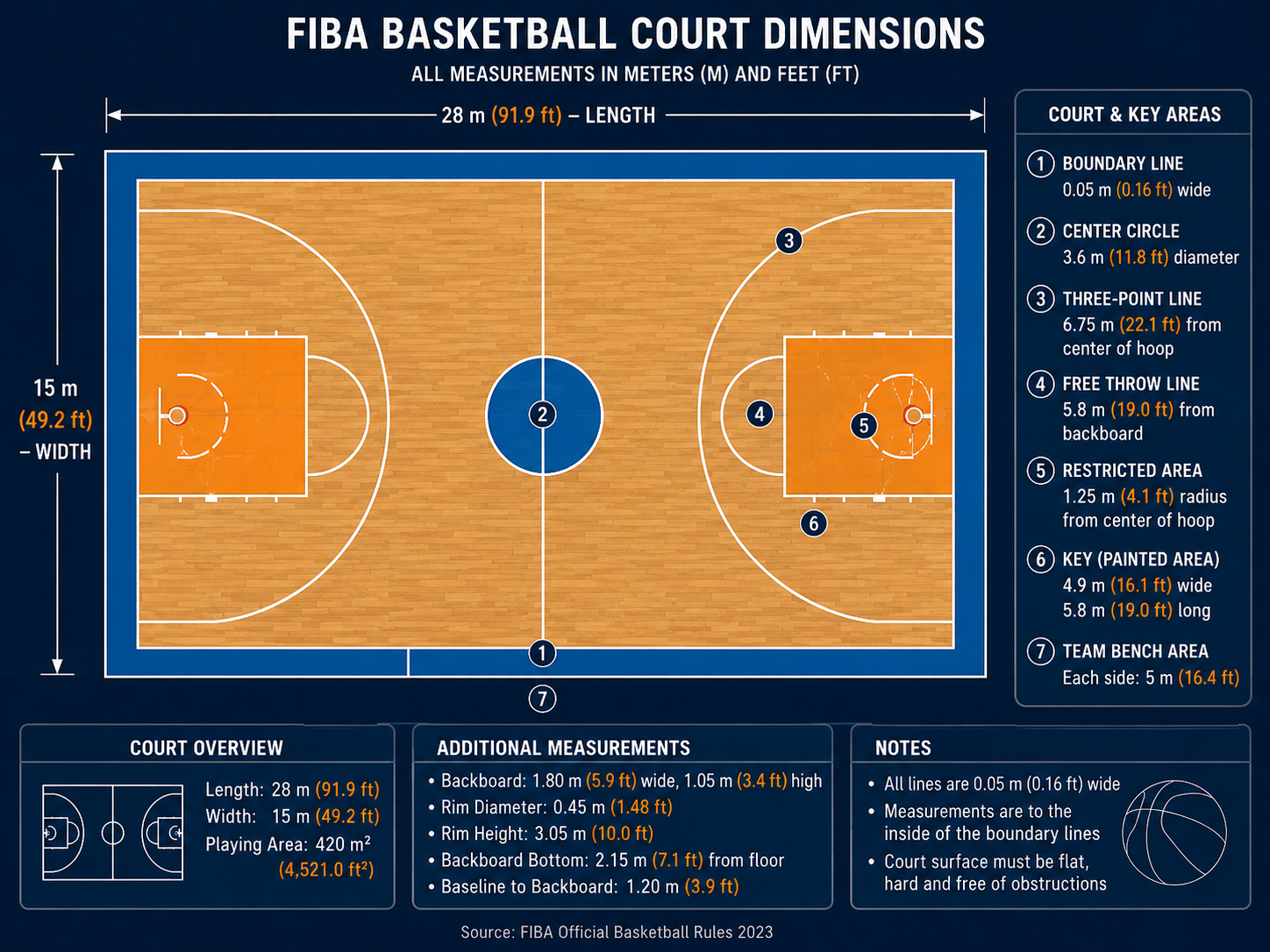
Standard Basketball Court Dimensions in Meter and Feet
Basketball court dimensions vary depending on the competition and governing body. FIBA standards are widely used for international basketball and many courts in India, while the NBA follows its own professional court specifications.
For most full-size international courts, the playing area is 28 m long and 15 m wide. Measurements are taken from the inner edges of the boundary lines. The recommended surrounding clear area must also be considered when planning the overall facility.
| Measurement | Meters | Feet |
|---|---|---|
| Full court length (FIBA) | 28 m | 91.9 ft |
| Full court width (FIBA) | 15 m | 49.2 ft |
| Approximate playing area | 420 m² | 4,521 sq ft |
| Minimum overall floor area with 2 m clearance on each side | 32 m × 19 m | 105.0 ft × 62.3 ft |
| Basket height | 3.05 m | 10 ft |
The 32 m × 19 m overall floor area includes a minimum 2 m unobstructed boundary area around the FIBA playing court. Actual building dimensions may need to be larger to accommodate spectator seating, team benches, access routes, equipment, lighting and other facility requirements.
FIBA Basketball Court Dimensions in Meter and Feet
FIBA, the International Basketball Federation, establishes the rules used in international basketball competitions. A standard FIBA court measures 28 meters in length and 15 meters in width. Correctly marking the centre circle, free-throw areas, restricted area and three-point line is important for consistent gameplay.
| Court component | Measurement in meters | Measurement in feet |
|---|---|---|
| Court length | 28 m | 91.86 ft |
| Court width | 15 m | 49.21 ft |
| Three-point line at the arc | 6.75 m from basket centre | 22.15 ft |
| Three-point line in the corners | Approximately 6.60 m | Approximately 21.65 ft |
| Free-throw line distance from the backboard plane | Approximately 4.60 m | 15.09 ft |
| Centre circle radius | 1.80 m | 5.91 ft |
| Free-throw semi-circle radius | 1.80 m | 5.91 ft |
| Basket height | 3.05 m | 10 ft |
| Backboard dimensions | 1.80 m × 1.05 m | 5.91 ft × 3.44 ft |
| Basket ring inside diameter | Approximately 0.45 m | Approximately 18 in |
| Line width | 0.05 m | Approximately 2 in |
FIBA measurements should be followed when constructing a court intended for competitions governed by FIBA rules. The precise positions of lines and markings should be checked against the current official court diagram before installation.
NBA Basketball Court Dimensions in Meter and Feet
The National Basketball Association uses a larger court than the standard FIBA playing area. An NBA court measures 94 feet long and 50 feet wide. These dimensions are equivalent to approximately 28.65 meters × 15.24 meters.
| Court component | Meters | Feet |
|---|---|---|
| Court length | 28.65 m | 94 ft |
| Court width | 15.24 m | 50 ft |
| Three-point line at the arc | Approximately 7.24 m | 23 ft 9 in |
| Three-point line in the corners | Approximately 6.71 m | 22 ft |
| Free-throw line distance from the backboard plane | 4.57 m | 15 ft |
| Lane width | 4.88 m | 16 ft |
| Centre circle radius | 1.83 m | 6 ft |
| Basket height | 3.05 m | 10 ft |
| Backboard dimensions | Approximately 1.83 m × 1.07 m | 6 ft × 3.5 ft |
The NBA three-point distance is measured from the centre of the basket to the arc. In the corners, the distance is shorter because the straight three-point sections run parallel to the sidelines. NBA markings should be used when the facility is specifically intended to meet NBA specifications.
FIBA vs NBA Basketball Court Size Comparison
Although both standards use the same 10-foot basket height, the court dimensions and some playing-area markings differ. Understanding these differences helps when selecting a layout for a sports academy, school, training facility or professional venue.
| Feature | FIBA | NBA |
|---|---|---|
| Length | 28 m (91.9 ft) | 28.65 m (94 ft) |
| Width | 15 m (49.2 ft) | 15.24 m (50 ft) |
| Playing area | 420 m² | Approximately 437 m² |
| Three-point distance at the arc | 6.75 m (22.15 ft) | 7.24 m (23 ft 9 in) |
| Corner three-point distance | Approximately 6.60 m (21.65 ft) | Approximately 6.71 m (22 ft) |
| Basket height | 3.05 m (10 ft) | 3.05 m (10 ft) |
For a general-purpose basketball facility in India, the FIBA court size is a practical starting point when international dimensions are required. Always confirm the relevant federation, competition and project specifications before finalising a design.
Half Basketball Court Dimensions in Meter and Feet
A half basketball court is suitable for shooting practice, individual training, school activities and residential sports facilities where space is limited. For a standard FIBA court divided across its length, one half measures approximately 14 meters × 15 meters, excluding any additional safety clearance.
| Court type | Meters | Feet |
|---|---|---|
| Half-court length | 14 m | 45.93 ft |
| Half-court width | 15 m | 49.21 ft |
| Approximate playing area | 210 m² | 2,260 sq ft |
A half court may be configured differently depending on whether it is intended for recreational basketball, practice or formal three-on-three competition. A half of a full-size five-on-five court is not automatically a regulation three-on-three court. The applicable rules should determine the final layout.
Important Basketball Court Markings and Measurements
Accurate court markings are essential for gameplay and player safety. The dimensions below describe common FIBA and NBA features; the exact measurements depend on the selected governing standard.
1. Centre Circle
The FIBA centre circle has a radius of 1.80 meters (approximately 5.91 feet), measured to the outer edge of the circumference. It is located at the centre of the court.
2. Free-Throw Line
The free-throw line is positioned 4.60 meters from the plane of the backboard under FIBA specifications and 15 feet from the backboard plane under NBA rules. This is not the same as measuring from the endline.
3. Three-Point Line
The FIBA three-point arc is 6.75 meters from the centre of the basket, while the NBA arc is 23 feet 9 inches from the basket centre. Both standards use shorter corner distances because the straight line sections run alongside the sidelines.
4. Restricted Area and No-Charge Semi-Circle
The restricted area, often called the key or paint, is the marked rectangular area near each basket. It should not be confused with the no-charge semi-circle beneath the basket. The FIBA no-charge semi-circle has a radius of 1.25 meters (approximately 4.10 feet); the NBA uses a 4-foot radius.
5. Basketball Backboard
A standard FIBA backboard measures 1.80 meters wide by 1.05 meters high. NBA backboards are approximately 6 feet wide by 3.5 feet high. Backboard material, mounting, padding and support structures should meet the requirements of the selected facility and competition.
6. Basket and Rim Height
The standard basket rim is 3.05 meters (10 feet) above the playing surface. The height should be measured from the finished court floor to the top of the rim. Secure installation and suitable padding are important for safe play.
How Much Space Is Required to Build a Basketball Court?
Planning a basketball court requires more than measuring the playing surface. The total available site should accommodate the court, unobstructed clearance, access routes, goal supports and any additional facility requirements.
For a FIBA-size playing court, the minimum surrounding clearance described in FIBA rules is 2 meters on each side. This results in an overall floor area of at least 32 meters × 19 meters, or approximately 105 feet × 62.3 feet. Spectator seating, fencing, lighting poles, drainage systems and building columns may require additional space or a different arrangement.
Before construction begins, assess the ground level, surface drainage, foundation, flooring system, weather exposure, lighting and accessibility. Indoor facilities also require sufficient overhead clearance and careful placement of structural elements.
Basketball Court Flooring and Construction Requirements
Choosing the right basketball court flooring is an important part of facility planning. The surface should be level, durable, suitable for the intended playing environment and compatible with the required court markings.
- Concrete or asphalt base: The foundation should be properly designed, stable and prepared for the selected outdoor or indoor surface system.
- Acrylic sports flooring: A common option for outdoor courts, with a system selected for the base condition and local climate.
- Wooden sports flooring: Used in many indoor sports venues where a suitable performance floor is required.
- Synthetic sports flooring: Available in different systems for indoor and outdoor basketball facilities.
- Court marking: Lines, circles and playing areas should be measured and marked according to the chosen FIBA, NBA or other applicable standard.
- Lighting and safety: Lighting, goal-post padding, fencing, drainage and surrounding clearance should be included in the design.
The right construction specification depends on the intended use, available budget, site conditions and competition requirements. A detailed site assessment helps determine suitable materials and installation methods.
Frequently Asked Questions About Basketball Court Dimensions
What are the standard basketball court dimensions in meter and feet?
A standard FIBA basketball court measures 28 meters × 15 meters, equivalent to approximately 91.9 feet × 49.2 feet.
What is the NBA basketball court size in feet and meters?
An NBA court is 94 feet long and 50 feet wide, or approximately 28.65 meters × 15.24 meters.
What is the standard basketball hoop height?
The standard basketball rim height is 10 feet (3.05 meters) above the playing surface.
What is the FIBA three-point line distance?
The FIBA three-point arc is 6.75 meters (approximately 22.15 feet) from the centre of the basket. The corner distance is shorter, at approximately 6.60 meters.
What is the NBA three-point line distance?
The NBA three-point arc is 23 feet 9 inches (approximately 7.24 meters) from the basket centre. In the corners, the distance is 22 feet (approximately 6.71 meters).
What is the half basketball court size?
Half of a standard FIBA court is approximately 14 meters × 15 meters, or 45.9 feet × 49.2 feet. Additional clearance is required around the playing area.
How much total space is needed for a FIBA basketball court?
A FIBA court measures 28 meters × 15 meters. With a minimum 2-meter unobstructed area around the court, the overall floor dimensions are at least 32 meters × 19 meters.
Which basketball court dimensions are suitable for schools in India?
A 28-meter × 15-meter FIBA-size court is suitable when a full-size international playing area is required. Smaller training courts may be planned according to the available space and the intended age group or level of play.
Which flooring is suitable for an outdoor basketball court?
Acrylic sports flooring is one common option for outdoor basketball courts. The final choice should account for the base, drainage, climate, maintenance requirements and intended level of use.
Planning to Build a Basketball Court?
Sports-Facility provides basketball court planning and construction solutions, including sports flooring, court marking, fencing and lighting. Contact our team to discuss your available space, preferred court dimensions and construction requirements.
Request a Basketball Court Construction Quote