
Understanding Basketball Court Dimensions
Understanding basketball court dimensions is important when planning, designing, constructing and marking a basketball court. Court dimensions can vary depending on the governing body, competition level and intended use.
FIBA, NBA and NCAA basketball courts have different specifications for overall court size and certain playing-area markings. Before beginning construction, the applicable rules and current specifications should be confirmed for the intended level of play.
This guide explains basketball court size in meters and feet, including overall length and width, hoop height, three-point line, free-throw area, key dimensions and other important planning considerations.
Standard Basketball Court Dimensions
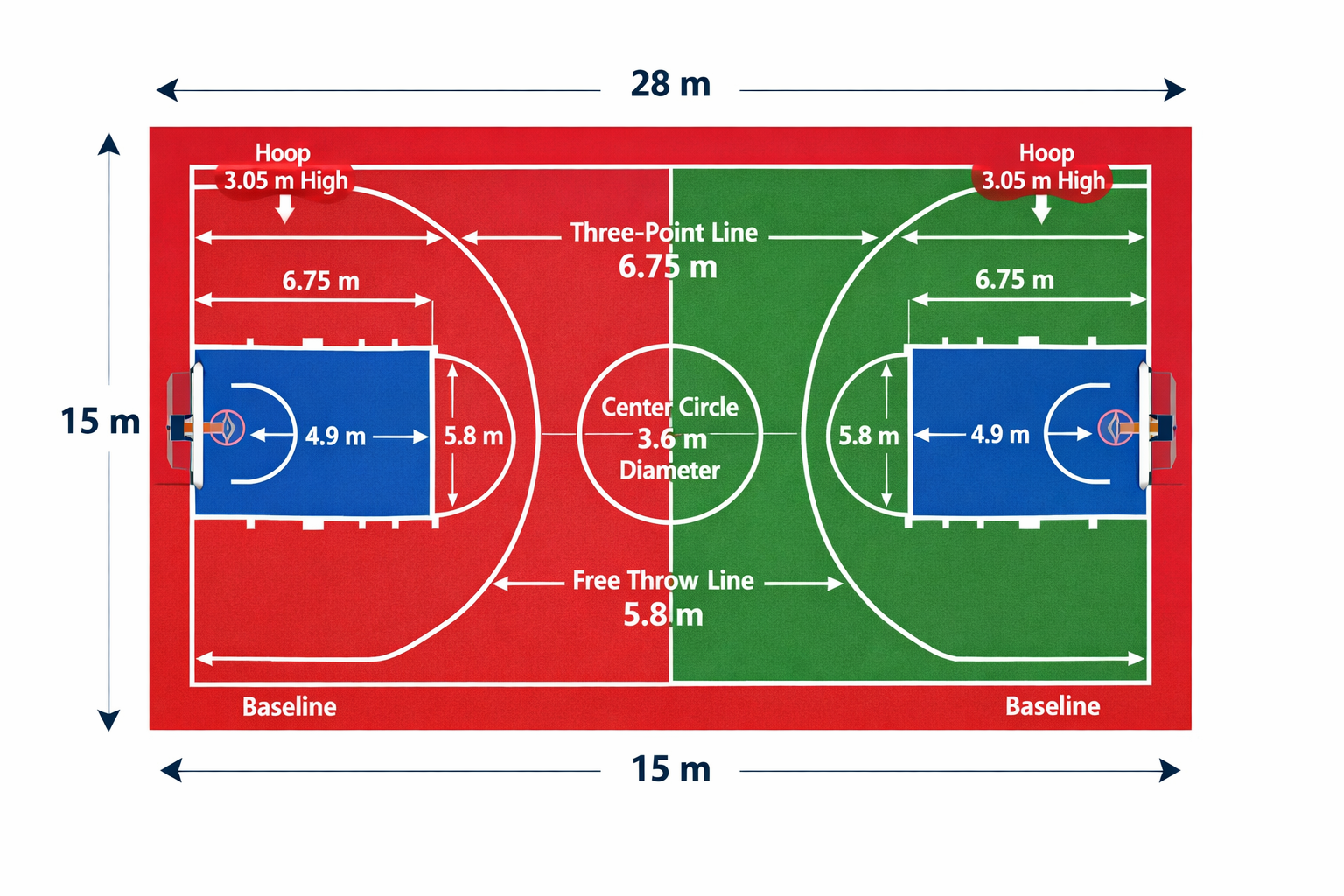
The FIBA basketball court size is one of the most widely referenced international court standards. A FIBA playing court measures 28 metres long and 15 metres wide.
NBA and NCAA full-size courts use a larger playing area measuring 94 feet by 50 feet, which is approximately 28.65 metres by 15.24 metres.
| Standard | Length | Width | Approximate Metric Size |
|---|---|---|---|
| FIBA | 28 m | 15 m | 28 m × 15 m |
| NBA | 94 ft | 50 ft | 28.65 m × 15.24 m |
| NCAA | 94 ft | 50 ft | 28.65 m × 15.24 m |
| High School | 84 ft | 50 ft | 25.60 m × 15.24 m |
FIBA Basketball Court Dimensions
A standard FIBA basketball playing court measures 28 metres in length and 15 metres in width. This measurement refers to the playing court and should not be confused with the additional safety and circulation space required around the court.
- Length: 28 metres
- Width: 15 metres
- Approximate feet: 91.9 ft × 49.2 ft
- Basket height: 3.05 metres / 10 feet
- Three-point arc distance: 6.75 metres
NBA Basketball Court Dimensions
An NBA basketball court measures 94 feet long and 50 feet wide. In metric units, this is approximately 28.65 metres by 15.24 metres.
The NBA also uses its own specifications for three-point distance, restricted areas, lane markings and other court features. Therefore, an NBA-specific court should be laid out using the applicable NBA specifications rather than simply converting FIBA measurements.
NCAA Basketball Court Dimensions
NCAA basketball courts use a full-court playing area of 94 feet by 50 feet. However, NCAA court markings and other details can differ from NBA specifications.
For an NCAA facility, the current applicable NCAA rules and court diagrams should be checked before construction and line marking.
FIBA vs NBA vs NCAA Basketball Court Dimensions
| Feature | FIBA | NBA | NCAA |
|---|---|---|---|
| Full Court Length | 28 m | 94 ft | 94 ft |
| Full Court Width | 15 m | 50 ft | 50 ft |
| Approx. Metric Size | 28 × 15 m | 28.65 × 15.24 m | 28.65 × 15.24 m |
| Hoop Height | 3.05 m / 10 ft | 3.05 m / 10 ft | 3.05 m / 10 ft |
| Three-Point Specification | 6.75 m arc | NBA specification | NCAA specification |
Key Basketball Court Measurements
Basketball Hoop Height
The standard basketball hoop is positioned 3.05 metres (10 feet) above the playing surface. This height is widely used in professional, collegiate and standard adult basketball facilities.
Three-Point Line
The three-point distance varies between basketball governing bodies. For example, the FIBA three-point arc is positioned at 6.75 metres from the basket, while the NBA uses its own three-point geometry with a maximum distance of 23 feet 9 inches.
Free-Throw Line
The free-throw line is a key part of the restricted and free-throw area. Its exact layout should be marked according to the applicable governing body's current court specifications.
Key or Paint Area
The key, also called the paint or restricted lane area, forms an important part of the basketball court layout. Its dimensions vary between governing bodies, so the correct competition specification should be used when marking the court.
Half Basketball Court Dimensions
A half basketball court generally represents one end of the full playing court and includes one basket, free-throw area, key and three-point area. The exact dimensions and markings depend on the governing standard being followed.
| Standard | Full Court | Approximate Half-Court Length |
|---|---|---|
| FIBA | 28 m × 15 m | 14 m × 15 m |
| NBA | 94 ft × 50 ft | 47 ft × 50 ft |
| NCAA | 94 ft × 50 ft | 47 ft × 50 ft |
Basketball Court Space Requirements
The playing court is only part of the space required for a complete basketball facility. Additional clearance is necessary around the playing area for player safety, movement, officials, spectators, equipment and facility access.
Important Planning Considerations
- Provide appropriate safety clearance around the playing court.
- Consider ceiling height and overhead obstructions for indoor courts.
- Plan suitable lighting without creating glare on the playing surface.
- Consider drainage and water management for outdoor basketball courts.
- Allow space for basketball equipment, fencing and access routes.
- Use the applicable governing body's current court layout for competition-specific construction.
Basketball Court Line Marking Dimensions
Accurate line marking is essential for a properly laid-out basketball court. The lines identify the boundaries, centre circle, free-throw areas, three-point areas and other important playing zones.
Line width and marking geometry should be selected according to the applicable FIBA, NBA, NCAA or other governing specifications. For professional and competition courts, the current official court diagrams should be followed rather than relying on a generic layout.
Basketball Court Dimensions for Construction
Accurate measurements are particularly important during basketball court construction because the court layout affects the positioning of the flooring, line markings, basketball equipment and surrounding infrastructure.
- Site Measurement: Measure the available land or indoor floor area.
- Court Layout: Select the applicable basketball court standard.
- Base Preparation: Prepare a stable and suitably level playing base.
- Flooring Installation: Install the selected sports flooring or outdoor coating system.
- Court Marking: Mark the playing lines according to the selected standard.
- Equipment Installation: Install basketball poles, backboards, hoops and nets.
- Final Inspection: Check dimensions, markings, surface finish and equipment.
Basketball Court Flooring and Surface Options
Basketball court dimensions determine the playing layout, while the flooring system determines the surface characteristics of the court. Flooring should be selected according to whether the court is indoor or outdoor and according to the intended usage.
| Flooring Type | Typical Application | Key Considerations |
|---|---|---|
| Hardwood | Indoor basketball facilities | Premium playing surface with regular maintenance requirements |
| PU Sports Flooring | Indoor sports halls | Cushioning and sports-performance characteristics |
| Acrylic Sports Flooring | Outdoor basketball courts | Suitable for outdoor sports surfaces when correctly installed |
| Synthetic Sports Flooring | Indoor and multi-purpose courts | Performance characteristics depend on the selected system |
Basketball Court Dimensions in Feet
For projects using imperial measurements, the commonly referenced full-court dimensions are:
- FIBA: approximately 91.9 ft × 49.2 ft
- NBA: 94 ft × 50 ft
- NCAA: 94 ft × 50 ft
- High School: 84 ft × 50 ft
When converting between metric and imperial measurements, small differences can appear because of rounding. Construction teams should use the official dimensions for the selected governing standard.
Basketball Court Dimensions in Meters
| Basketball Court Type | Length | Width |
|---|---|---|
| FIBA | 28 metres | 15 metres |
| NBA | 28.65 metres | 15.24 metres |
| NCAA | 28.65 metres | 15.24 metres |
| High School | Approximately 25.60 metres | Approximately 15.24 metres |
Frequently Asked Questions About Basketball Court Dimensions
What are the standard basketball court dimensions?
A standard FIBA basketball court measures 28 metres by 15 metres. NBA and NCAA full courts measure 94 feet by 50 feet.
What are basketball court dimensions in feet?
A FIBA court is approximately 91.9 feet by 49.2 feet, while an NBA and NCAA full court measures 94 feet by 50 feet.
What is the height of a basketball hoop?
The standard basketball hoop height is 3.05 metres, or 10 feet, above the playing surface.
What is the FIBA basketball court size?
A FIBA basketball playing court measures 28 metres long and 15 metres wide.
What is the NBA basketball court size?
An NBA basketball court measures 94 feet long and 50 feet wide, which is approximately 28.65 metres by 15.24 metres.
What is the difference between NBA and FIBA basketball courts?
The NBA and FIBA use different court dimensions and specifications for several markings. The NBA court is 94 feet by 50 feet, while the FIBA court is 28 metres by 15 metres. Their three-point geometry and some other markings also differ.
What is the size of a half basketball court?
A half court is approximately 14 metres by 15 metres when based on the FIBA full-court dimensions, or 47 feet by 50 feet when based on the NBA or NCAA full-court dimensions.
How much space is needed to build a basketball court?
The playing court needs additional surrounding clearance for safety, access, equipment and facility operations. The total site requirement depends on the selected court standard and the design of the facility.
Can Sports Facility India help with basketball court design?
Yes. Sports Facility India provides basketball court design, construction, flooring, surfacing and line-marking solutions for sports facilities across India.
Need Professional Basketball Court Design & Construction?
Planning a basketball court in India? Sports Facility India provides basketball court design, layout planning, flooring, construction, surfacing and line-marking solutions based on the applicable project specifications.
Whether you are developing a school court, sports academy, residential facility, club, indoor stadium or outdoor basketball court, proper dimensions and accurate layout planning are essential for a functional playing environment.
Get a Basketball Court Quote