
What Is Basketball Court Measurement?
Basketball court measurement is the process of determining the length, width and precise layout of a basketball playing surface. It includes measuring the boundary lines, centre line, centre circle, basket positions, restricted areas, free-throw lines and three-point arcs. These measurements work together to establish the complete playing layout.
Accurate dimensions are important for basketball courts in schools, colleges, universities, sports academies, residential communities, indoor stadiums and outdoor recreation facilities. A properly measured court helps coaches conduct training sessions, enables players to practise consistently and supports the intended playing standard.
Before beginning construction, the project team should decide whether the court will follow FIBA, NBA, school-level or custom recreational dimensions. This decision affects the overall layout, equipment positions and permanent line markings.
Standard Basketball Court Dimensions in Feet and Meters
The term standard basketball court size does not refer to one universal measurement for every level of basketball. International competitions, professional leagues and school programmes can follow different court specifications. The following table provides a convenient comparison of commonly referenced full-court dimensions.
| Basketball Court Type | Length | Width | Approximate Area | Rim Height |
|---|---|---|---|---|
| FIBA standard | 28 m / 91.86 ft | 15 m / 49.21 ft | 420 m² | 3.05 m / 10 ft |
| NBA standard | 94 ft / 28.65 m | 50 ft / 15.24 m | 4,700 sq ft / 436.64 m² | 3.05 m / 10 ft |
| High school reference | 84 ft / 25.60 m | 50 ft / 15.24 m | 4,200 sq ft / 390.19 m² | 3.05 m / 10 ft |
The high school dimensions shown are a commonly used reference in the United States; actual requirements depend on the relevant school or competition authority. The court area in this table refers to the playing rectangle only and does not include the surrounding safety clearance.
For an Indian school, academy or private sports project, the most suitable basketball court size should be selected according to the available land, player age group, expected usage and competition requirements. If official matches are planned, confirm the required standard before preparing the final drawing.
FIBA Basketball Court Measurement
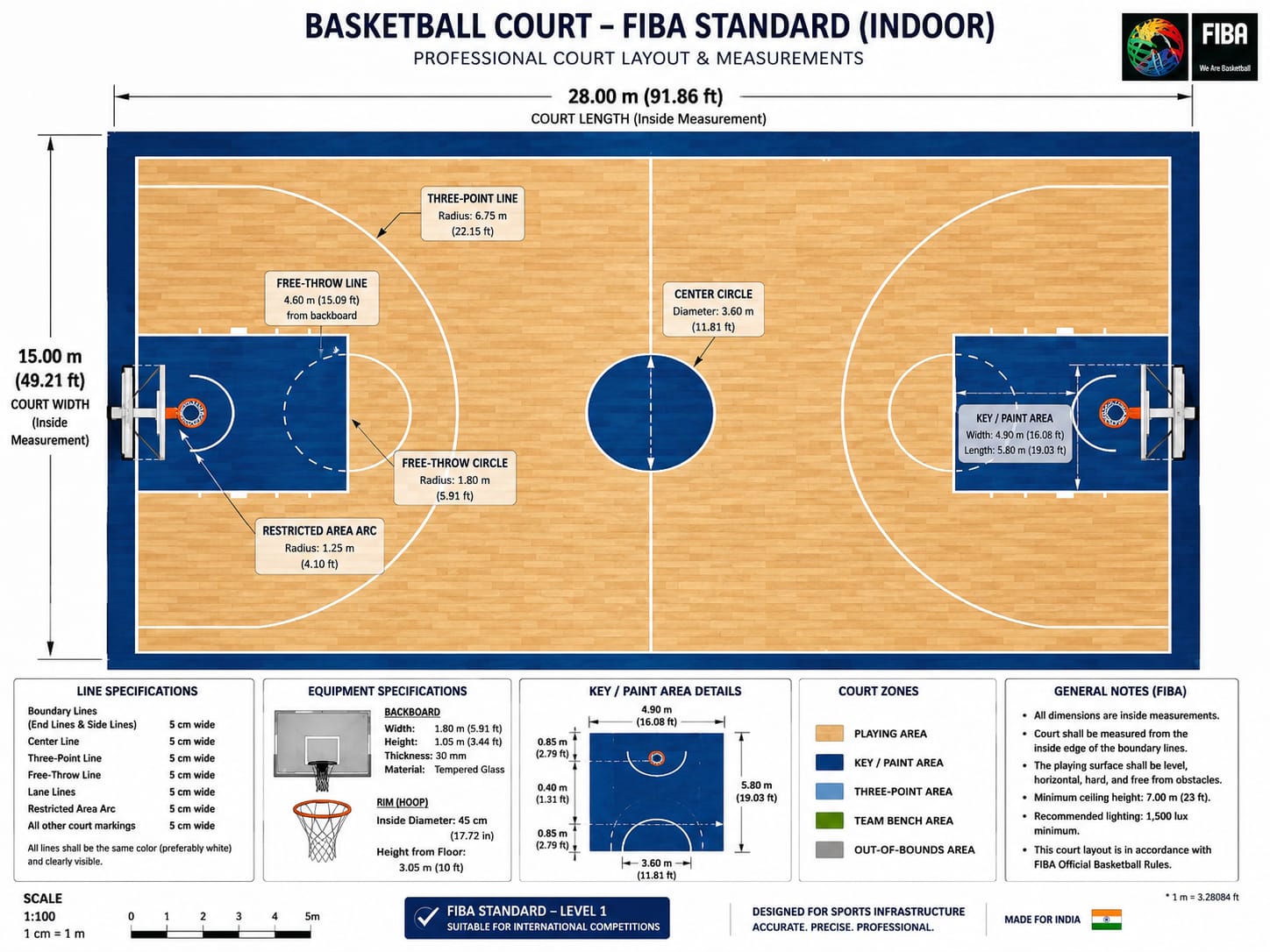
The FIBA basketball court dimensions used for standard international basketball are 28 metres in length and 15 metres in width, measured from the inner edges of the boundary lines. These dimensions provide the reference for laying out the playing area and positioning the court markings.
A FIBA court also requires accurately positioned centre-court markings, free-throw areas, restricted areas and three-point arcs. The basket, backboard and other equipment must be installed according to the relevant equipment specifications.
Important FIBA Court Measurements
- Playing court: 28 m × 15 m.
- Three-point arc: 6.75 m radius from the basket centre, with the prescribed corner geometry.
- Centre circle: 1.80 m radius.
- Free-throw line: Positioned 5.80 m from the inner edge of the endline.
- Free-throw semicircle: 1.80 m radius.
- Rim height: 3.05 m above the playing surface.
- Line width: Generally 5 cm under the FIBA court rules.
The measurements above are a planning reference. For competition-level construction, verify the full court drawing and equipment requirements against the current official FIBA rules before installation.
NBA Basketball Court Measurement
An NBA basketball court measures 94 feet long and 50 feet wide, equivalent to approximately 28.65 metres by 15.24 metres. Although the NBA court is similar in overall size to a FIBA court, its line markings and certain playing-area dimensions differ.
The NBA three-point line uses a 23-foot-9-inch distance at the arc and a shorter 22-foot distance near the corners. The NBA free-throw line is 15 feet from the plane of the backboard face. NBA court layouts also use a wider free-throw lane than the standard FIBA layout.
NBA Court Measurement Summary
- Full-court length: 94 ft / 28.65 m.
- Full-court width: 50 ft / 15.24 m.
- Three-point arc distance: 23 ft 9 in / approximately 7.24 m.
- Corner three-point distance: 22 ft / approximately 6.71 m.
- Basket rim height: 10 ft / 3.05 m.
An NBA-style basketball court should be laid out using the NBA court diagram rather than simply copying the markings of a FIBA court. This is particularly important when planning the key, three-point arc and free-throw area.
Half Basketball Court Measurement
A half basketball court is a practical option for shooting practice, individual training, school activities, recreational games and sites where a complete basketball court cannot fit. Its final dimensions depend on the selected playing standard and the amount of space available.
| Half-Court Layout | Approximate Dimensions | Suitable Use |
|---|---|---|
| FIBA-style half court | 14 m × 15 m | Practice and recreational play |
| NBA-style half court | 47 ft × 50 ft | Training and recreational use |
| Compact practice court | Custom dimensions | Homes, schools and small training areas |
The half-court dimensions above represent planning examples, not a universal competition specification. A reduced court may need modified markings depending on the intended activity. Measure the site carefully before deciding where to position the basket, baseline and safety area.
For a residential basketball court or a small school practice area, the available space should be considered alongside the expected movement of players. A compact layout may support shooting and basic drills, but it should not be described as a regulation court unless it meets the relevant requirements.
Basketball Court Line Markings and Their Purpose
Basketball court markings divide the playing surface into functional areas. Each line has a defined location and purpose, so the complete marking layout should be prepared before applying paint or installing permanent sports lines.
Boundary Lines
The sidelines define the long edges of the court, while the endlines define the short edges behind each basket. The dimensions of the playing rectangle are established using the applicable rules for measuring these boundaries.
Centre Line and Centre Circle
The centre line divides the playing court into two halves. The centre circle is located at the middle of the court and is used for the opening jump ball under the applicable rules. Both markings must be aligned accurately with the court's measured centre point.
Free-Throw Area
The free-throw area contains the free-throw line, circle and lane markings near each basket. Its alignment is important for foul shots, training drills and consistent court layout.
Restricted Area or Key
Commonly called the key, paint or lane, this area sits in front of each basket. Its dimensions and markings vary according to the governing basketball standard.
Three-Point Line
The three-point line separates the two-point field-goal area from the three-point scoring area. It consists of an arc and, depending on the standard, connecting or parallel sections near the sidelines. The correct centre point and radius are essential for accurate marking.
No-Charge Semicircle
Where required by the chosen rules, the no-charge semicircle is marked around the area directly below the basket. Its placement must follow the relevant court diagram.
Basketball Key or Paint Area Measurement
The basketball key is the marked rectangular area extending from the endline towards the free-throw line. Players and coaches often refer to it as the paint or lane. The key helps organise play near the basket and contains important free-throw and lane markings.
The width of the key is not identical in every basketball competition. NBA and FIBA layouts have different specifications, so the correct drawing must be selected before the court is marked. The free-throw line and circle should be centred in relation to the basket and aligned with the court's longitudinal axis.
During construction, surveyors or installers should establish fixed reference points before marking the key. Measuring from a reliable baseline and basket centre reduces the risk of uneven lines, incorrect spacing and costly repainting.
Basketball Three-Point Line Measurement
The three-point line measurement is one of the most important parts of basketball court marking. Its distance from the basket determines whether a successful field goal counts for two or three points under the applicable rules.
| Basketball Standard | Three-Point Measurement |
|---|---|
| FIBA | 6.75 m arc radius, with prescribed corner geometry |
| NBA | 23 ft 9 in at the arc; 22 ft near the corners |
| Common US high school reference | 19 ft 9 in / approximately 6.02 m |
These values should not be mixed when preparing a court. The three-point arc must be drawn from the correct basket reference point using the prescribed radius and geometry. The corner sections also need to be positioned according to the relevant rules.
For professional court line marking, installers should use accurate layout equipment and verify the distance at several points along the arc before applying the final marking material.
Basketball Free-Throw Line Measurement
The free-throw line is positioned in front of the basket and provides the reference point for free-throw attempts. Its location must be measured in relation to the endline and backboard as specified by the applicable basketball standard.
Under FIBA court rules, the free-throw line is positioned 5.80 metres from the inner edge of the endline. The free-throw semicircle has a radius of 1.80 metres. Other basketball standards may define the corresponding positions differently.
Accurate free-throw line measurement supports consistent training and reliable court markings. During installation, check the line's parallel alignment with the endline and confirm that its centre corresponds with the basket's centreline.
Basketball Hoop Height and Backboard Dimensions
Correct basketball hoop measurement is essential for a functional court. The basket must be mounted at the appropriate height, securely attached to a suitable support system and positioned in alignment with the backboard and court markings.
| Basketball Equipment | Common Standard Measurement |
|---|---|
| Rim height | 3.05 m / 10 ft |
| Rim inside diameter | Approximately 450–459 mm under FIBA equipment specifications |
| Full-size backboard width | Approximately 1.80 m |
| Full-size backboard height | Approximately 1.05 m |
The 10-foot basketball hoop height is the common standard for adult basketball. Youth programmes may use lower adjustable baskets according to player age and training objectives. Confirm the selected equipment specification before installation.
Backboard supports, poles, anchors and protective padding should be selected according to the location and expected use of the court. Outdoor installations also need suitable foundations and corrosion- resistant components where appropriate.
Basketball Court Run-Off Area and Total Space Required
The basketball playing rectangle is not the same as the total space required to build a court. Additional room may be needed outside the sidelines and endlines for player movement, officials, equipment, access routes and safe circulation.
For a FIBA venue layout with a 2-metre surrounding boundary area, the minimum overall floor footprint is approximately 32 metres long by 19 metres wide. The actual space requirement depends on the intended competition level, venue design, seating, equipment and local safety requirements.
When planning an outdoor basketball court in a school, residential complex or sports academy, also consider drainage, fencing, lighting, nearby walls and fixed objects. These elements should be assessed before the court location and finished dimensions are finalised.
Basketball Court Flooring Options for Indoor and Outdoor Courts
Basketball court flooring affects traction, ball response, player movement, maintenance and the overall playing experience. The best surface depends on whether the court is indoors or outdoors, the expected playing frequency, the site conditions and the project budget. Flooring selection should take place alongside court measurement and construction planning.
Acrylic Basketball Court Flooring
Acrylic sports flooring is commonly considered for outdoor basketball courts and suitable prepared concrete or asphalt bases. It provides a coloured playing surface with defined line markings and can be configured as part of a sports coating system. Base quality, drainage and correct application are important to long-term performance.
PVC Sports Flooring
PVC sports flooring may be used for selected indoor basketball applications. Product construction, cushioning, surface grip and suitability for basketball should be checked against the intended usage and relevant performance requirements.
Wooden Basketball Court Flooring
Wooden sports flooring is used in many indoor basketball venues where the specified system is designed for sports use. Installation requires appropriate subfloor preparation, moisture control and consideration of the complete flooring system.
PU and Cushioned Sports Flooring
Polyurethane and multi-layer cushioned sports surfaces may be suitable for certain indoor or outdoor projects, depending on the product specification. Check impact response, slip resistance, durability and maintenance needs before choosing a system.
Sports Facility India offers basketball court development and flooring solutions according to project requirements. To explore related services, visit our sports facility solutions page.
Basketball Court Measurement and Construction Process
A successful basketball court project starts with site assessment and a clearly defined layout. Court dimensions, flooring specifications, equipment installation and line marking should be coordinated before work begins.
- Site inspection: Assess the available area, ground conditions, drainage and surrounding obstacles.
- Select the court standard: Identify the required FIBA, NBA, school-level or recreational layout.
- Prepare a measurement plan: Establish the court boundaries, centre point, basket locations and required clearance areas.
- Prepare the base: Complete the required civil work and check levels, stability and drainage according to the selected flooring system.
- Install the flooring: Apply or install the selected sports surface following the manufacturer's technical instructions.
- Mark the court: Measure and apply the boundary lines, centre circle, key, free-throw lines and three-point arcs.
- Install basketball equipment: Secure the baskets, backboards and supports in the specified positions.
- Inspect the completed court: Recheck the critical dimensions, equipment alignment, surface finish and required safety clearances.
This structured approach helps reduce measurement errors and avoid unnecessary rework. For competition facilities, the final layout should be verified against the current rules and project specifications before the court is approved for use.
Why Accurate Basketball Court Measurement Matters
Accurate basketball court dimensions are important for both construction quality and the usability of the finished facility. Even small errors in key measurements can affect line alignment, basket positioning and the relationship between different court areas.
- Consistent playing layout: Keeps the court aligned with the selected dimensions.
- Correct equipment placement: Helps position baskets and backboards accurately.
- Reliable line markings: Supports correct placement of the key, centre circle and three-point arc.
- Better project coordination: Connects civil work, flooring installation and court marking.
- Appropriate safety planning: Makes room for clearances and surrounding equipment.
- Long-term usability: Helps create a court suitable for its intended training or recreational use.
- Standard-based construction: Supports compliance with the specified competition rules when the complete requirements are followed.
Where Basketball Court Measurement Is Needed
Basketball court measurement and layout planning are relevant to many types of sports projects. The dimensions and equipment requirements should be adapted to the intended players, available area and level of competition.
- School and college basketball courts
- University sports facilities
- Basketball coaching academies
- Indoor sports complexes
- Outdoor community courts
- Residential society sports areas
- Private home basketball courts
- Commercial recreation facilities
- Hotels and resort sports facilities
- Multi-sport training centres
- Professional and competitive basketball venues
Before beginning any of these projects, confirm the required court dimensions, surface specification, lighting and equipment layout. A site-specific plan is more useful than choosing dimensions solely on the basis of the available floor area.
Frequently Asked Questions About Basketball Court Measurement
1. What is the standard basketball court size in meters?
A standard FIBA basketball court measures 28 metres long and 15 metres wide. This is the playing area and does not include the surrounding clearance required for the venue.
2. What is the basketball court size in feet?
A FIBA court measures approximately 91.86 feet long and 49.21 feet wide. An NBA court measures 94 feet long and 50 feet wide.
3. What is the standard NBA basketball court measurement?
An NBA court measures 94 feet by 50 feet, or approximately 28.65 metres by 15.24 metres. NBA line markings differ from FIBA markings.
4. What is the standard basketball hoop height?
The standard basketball rim height is 10 feet, equivalent to 3.05 metres, above the playing surface. Youth training facilities may use adjustable baskets when appropriate.
5. What is the FIBA three-point line distance?
The FIBA three-point arc has a radius of 6.75 metres from the basket centre, with the corner portions following the prescribed court geometry.
6. What is the NBA three-point line distance?
The NBA three-point arc is 23 feet 9 inches from the basket centre at the arc and 22 feet near the corners.
7. What is the size of a half basketball court?
A FIBA-style half-court planning example is approximately 14 metres by 15 metres. The appropriate layout depends on whether the court is for practice, recreation or a particular competition format.
8. How much total space is needed for a FIBA basketball court?
The playing area is 28 metres by 15 metres. A FIBA venue layout with a 2-metre surrounding boundary area requires approximately 32 metres by 19 metres in total. Confirm the clearance requirements for the intended facility before construction.
9. What flooring is suitable for an outdoor basketball court?
Acrylic sports flooring is a common option for suitable outdoor court bases. The right system depends on base condition, drainage, climate, expected use and the product specification.
10. Which flooring is suitable for an indoor basketball court?
Depending on the project, options may include wooden sports flooring, PVC sports flooring, PU systems or other purpose-designed sports surfaces. Select a system based on its technical performance and suitability for basketball.
11. Why should basketball court dimensions be checked before flooring installation?
Measuring before installation helps coordinate the playing boundary, basket positions, court markings and surrounding clearances. It also reduces the likelihood of rework after the flooring has been completed.
12. Can a basketball court be built in a limited space?
Yes. A smaller practice court or half-court layout may be possible if the available space is measured carefully. However, a custom-sized court should not be represented as a regulation competition court unless it meets the relevant specifications.
13. Does Sports Facility India provide basketball court solutions?
Sports Facility India provides basketball court-related flooring and sports facility solutions. Contact the team to discuss your site area, preferred court layout and project requirements.
Planning a Basketball Court Project?
Whether you are developing a school basketball court, a sports academy, an indoor facility or an outdoor recreational court, accurate measurement is the starting point for a well-planned project.
Sports Facility India can help you explore basketball court flooring options, layout requirements and court development solutions suited to your project.
Share your available site dimensions and intended use to discuss the next steps for your basketball court.
Contact Sports Facility India