
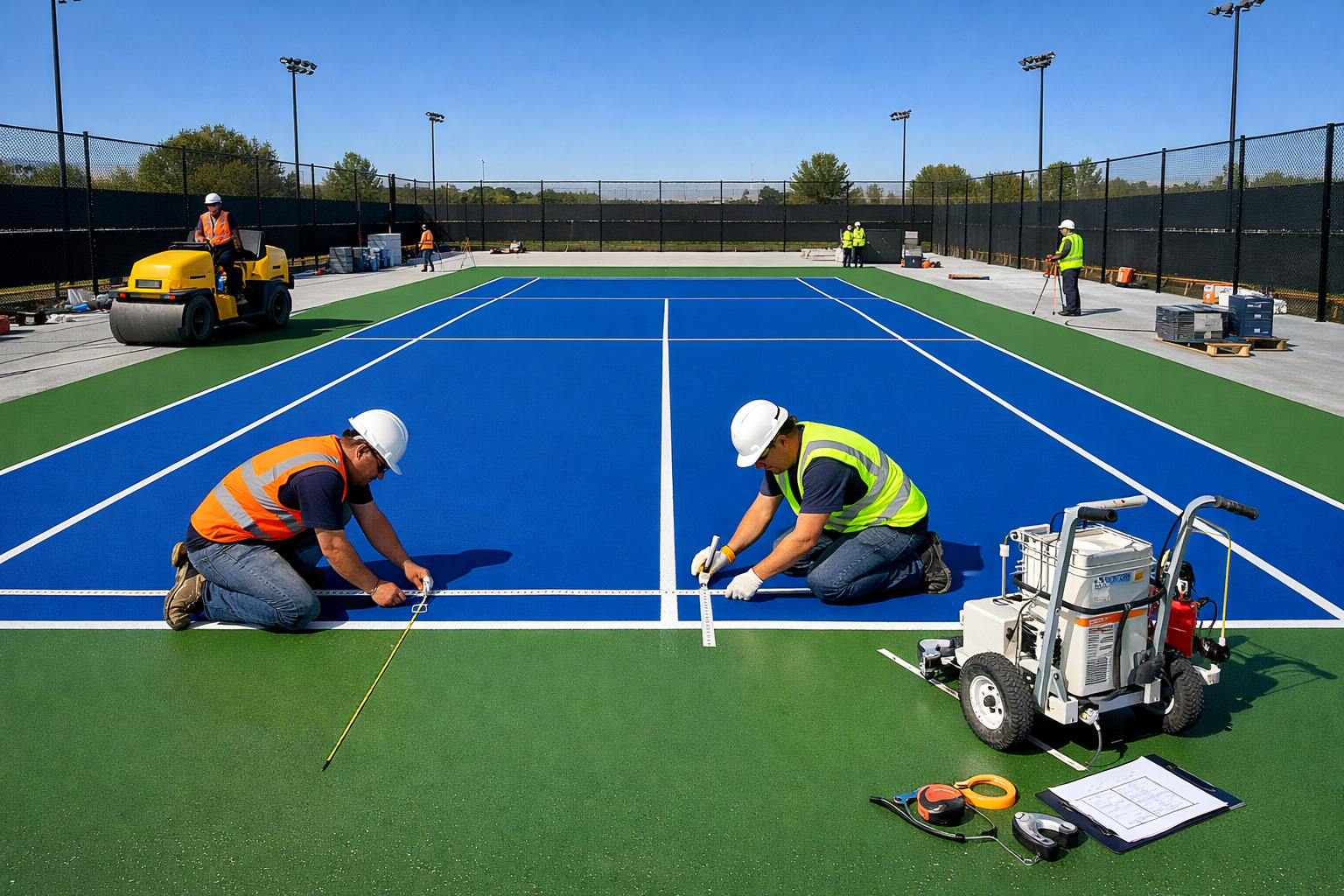
Tennis Court Construction Services
A complete tennis court project requires coordination between civil construction, surface installation and court accessories. The exact scope depends on the existing site conditions and the type of tennis court being developed.
1. Tennis Court Design and Planning
Court layouts are planned according to the available area, intended level of play, site orientation, access requirements and applicable tennis court specifications.
2. Site Preparation and Civil Work
Excavation, grading, levelling and ground preparation help establish a suitable foundation for the tennis court. The work is planned according to the existing ground conditions.
3. Concrete and Asphalt Base Construction
Concrete or asphalt base systems can be considered according to the selected sports surface, engineering requirements and site conditions. Proper preparation is essential for surface consistency and long-term performance.
4. Tennis Court Flooring and Surfacing
Acrylic and synthetic tennis court surfacing options can be selected according to the intended playing characteristics, environmental exposure, maintenance needs and project budget.
5. Professional Court Line Marking
Accurate court markings establish the playing layout for singles and doubles tennis. Line dimensions should be checked against the applicable rules before the final marking work.
6. Tennis Court Drainage
Drainage planning helps control rainwater and reduce standing water around the playing area. The drainage arrangement should suit the site levels, weather conditions and surface system.
7. Tennis Court Fencing and Gates
Perimeter fencing and access gates can be included according to the court location, facility layout, security needs and expected use.
8. Tennis Court Lighting and Accessories
Lighting, net posts, tennis nets and other accessories can be incorporated into the overall project where required. Lighting should be planned according to the intended playing schedule and facility requirements.
Tennis Court Construction and Flooring Options
Selecting the right tennis court surface is an important part of the construction process. Each surface has different playing characteristics, installation requirements, maintenance needs and suitability for local conditions.
1. Acrylic Tennis Court Construction
Acrylic tennis court surfacing is a widely used option for outdoor tennis facilities. It is generally applied over a properly prepared concrete or asphalt base using a suitable sports coating system.
Depending on the selected specification, an acrylic system can provide a uniform coloured surface, suitable traction and weather-resistant performance. Correct base preparation and installation are important for achieving the intended result.
Benefits of Acrylic Tennis Courts
- Suitable for many outdoor tennis court applications
- Available in different colour combinations
- Designed for regular sports use
- Can provide consistent surface characteristics
- Weather-resistant coating options are available
- Routine cleaning is generally straightforward
- Can be resurfaced when required, depending on condition
2. Synthetic Tennis Court Construction
Synthetic tennis court surfaces are considered for facilities seeking a purpose-designed sports flooring system. The appropriate material and system depend on the intended playing experience, site conditions, expected usage and maintenance plan.
Benefits of Synthetic Tennis Courts
- Designed for regular tennis activities
- Surface options can be selected for specific project needs
- Suitable systems are available for different environments
- Can provide a consistent playing surface when properly installed
- Maintenance requirements can be planned in advance
- Available specifications vary by product and installation system
3. Clay Tennis Court Construction
Clay tennis courts offer distinctive playing characteristics and are often considered by clubs and training facilities that prefer a traditional clay-court experience. Construction requires suitable materials, proper grading and careful surface preparation.
Moisture management and regular maintenance are particularly important for clay courts. The construction and upkeep plan should be designed for the local climate and expected playing frequency.
Benefits and Considerations
- Traditional clay-court playing experience
- Suitable for selected clubs and training facilities
- Distinctive ball response and movement characteristics
- Requires routine surface care and moisture management
- Maintenance planning should be considered before construction
4. Grass Tennis Court Construction
Grass tennis courts provide a natural playing surface and may be considered for private properties, specialist facilities, luxury clubs and selected resort environments. Site preparation, grass selection, drainage and ongoing turf care all influence the condition of the court.
Benefits and Considerations
- Natural appearance and distinctive playing experience
- Suitable for selected premium or specialist facilities
- Requires appropriate soil preparation and drainage
- Regular mowing and turf maintenance are necessary
- Maintenance requirements should be evaluated in advance
Which surface is best? There is no single surface that suits every tennis court project. Acrylic, synthetic, clay and grass options should be evaluated according to the intended use, site conditions, playing requirements, available budget and long-term maintenance plan.
Tennis Court Dimensions and Layout Planning
Accurate dimensions are essential when planning a tennis court. The playing area must accommodate the required singles or doubles markings, net position and surrounding clearance. The overall construction footprint is larger than the marked playing court because players need space beyond the sidelines and baselines.
| Planning Element | Standard Playing Dimension or Consideration |
|---|---|
| Singles Playing Court | 23.77 metres long × 8.23 metres wide |
| Doubles Playing Court | 23.77 metres long × 10.97 metres wide |
| Net Position | Across the centre of the court |
| Surrounding Clearance | Additional space is required beyond the playing lines |
| Base and Surface | Selected according to the proposed court system |
| Drainage and Site Levels | Designed according to ground conditions and water management needs |
| Fencing and Access | Planned according to the overall facility layout |
The dimensions above describe the marked singles and doubles playing areas, not the complete land requirement. Before construction, confirm the latest applicable tennis rules and the clearance requirements for the intended level of play. The final layout should also account for fencing, gates, walkways, lighting and maintenance access.
Tennis Court Construction Process Step by Step
A structured construction process helps coordinate civil work, surfacing and equipment installation. The exact sequence can vary according to the selected court type and the condition of the site.
- Site Inspection: Assess the available area, existing ground, access, levels, soil conditions and drainage requirements.
- Design and Planning: Finalize the court layout, surface type, orientation, surrounding clearance, fencing, lighting and accessories.
- Excavation and Ground Preparation: Prepare the site to achieve the required formation levels and foundation conditions.
- Sub-Base and Base Construction: Develop the specified sub-base and concrete or asphalt base system according to the project design.
- Levelling and Base Inspection: Check surface levels and address defects before installing the final sports surfacing.
- Sports Surface Installation: Install the selected acrylic, synthetic, clay, grass or other specified tennis court surface system.
- Line Marking: Mark the court lines accurately according to the required playing configuration.
- Fencing and Equipment Installation: Install the planned fencing, gates, net posts, net system, lighting and other accessories.
- Final Inspection: Review the surface finish, court markings, drainage, equipment and overall construction quality.
Importance of Tennis Court Base Preparation and Drainage
The foundation is one of the most important elements of tennis court construction. Even a suitable sports surface can develop problems if it is installed over an unstable, uneven or improperly prepared base. Base design should be matched to ground conditions and the selected surfacing system.
Drainage is especially important for outdoor courts exposed to rain. Poor water management can lead to standing water, surface deterioration and increased maintenance needs. Site grading and drainage provisions should therefore be considered during the initial planning stage.
Important Base Construction Considerations
- Assessment of ground and soil conditions
- Proper grading and formation levels
- Stable sub-base construction
- Suitable concrete or asphalt base specification
- Accurate levelling and surface preparation
- Inspection and treatment of base defects
- Effective drainage and water management
- Compatibility between the base and selected surface
Benefits of Professional Tennis Court Construction
Professional planning and installation help create a court that is appropriate for its intended use. Construction quality, suitable materials and routine maintenance all contribute to the long-term performance of the facility.
Consistent Playing Environment
Appropriate dimensions, surface preparation and finishing help establish a consistent environment for tennis practice and recreational or competitive activities.
Suitable Surface Performance
Choosing and installing the right surface system helps provide the intended traction and playing characteristics.
Long-Term Durability
A suitable base, correct installation methods and effective drainage can help reduce avoidable construction-related problems.
Planned Maintenance
Considering maintenance during the design stage helps owners understand the care required for their selected surface.
Professional Appearance
Accurate line marking, consistent surface colours and appropriate finishing contribute to a well-presented facility.
Integrated Court Infrastructure
Fencing, lighting, net systems and access arrangements can be coordinated with the main construction project.
Where Tennis Court Construction Services Are Used
Tennis court facilities can be planned for educational, institutional, residential, recreational and commercial environments. The design and surface selection should reflect the needs of the people who will use the court.
- Schools and educational institutions
- Colleges and universities
- Tennis academies and training centres
- Sports clubs and recreation centres
- Stadiums and sports complexes
- Residential societies and housing developments
- Private homes and residential properties
- Hotels, resorts and hospitality facilities
- Commercial sports facilities
- Government and institutional sports projects
- Multi-sport and community recreation facilities
How to Choose the Best Tennis Court Construction Company
Selecting a tennis court contractor involves more than comparing quotations. Review the proposed construction method, surface specifications, project scope and long-term maintenance considerations before making a decision.
- Review Relevant Experience: Ask about previous tennis court projects and experience with sports flooring and court construction.
- Compare Surface Options: Check whether the proposed surface is appropriate for the intended use, local weather and maintenance expectations.
- Understand the Base Specification: Ask for details about ground preparation, sub-base, concrete or asphalt construction and levelling.
- Confirm Layout Requirements: Verify playing dimensions, surrounding clearances, line markings and any requirements for the intended level of play.
- Review Drainage Planning: Ensure that rainwater management and site levels are addressed in the project proposal.
- Check the Complete Project Scope: Confirm whether fencing, lighting, gates, net systems and accessories are included or quoted separately.
- Discuss Maintenance: Ask about cleaning, inspection, repairs and resurfacing requirements for the selected court surface.
- Request a Detailed Quotation: Compare material specifications, quantities, inclusions, exclusions and project-specific costs rather than relying only on the final price.
Tennis Court Construction Cost in India
Tennis court construction cost in India depends on the size of the project, the existing site conditions, the selected surface system and the infrastructure required. A court built on an already prepared base may have different costs from a project that requires excavation, extensive civil work and drainage.
Factors That Affect Tennis Court Construction Cost
- Number of courts to be constructed
- Playing dimensions and total site area
- Existing ground and soil conditions
- Excavation, filling and civil work requirements
- Sub-base and concrete or asphalt specifications
- Selected acrylic, synthetic, clay or grass surface
- Drainage design and installation requirements
- Fencing, gates and access arrangements
- Sports lighting and electrical work
- Net posts, nets and other court equipment
- Transportation and site location
- Additional landscaping or supporting infrastructure
For a reliable estimate, the scope of work should be finalized and the site conditions assessed before preparing the quotation. A detailed proposal should identify the proposed surface system, base construction, accessories and any exclusions.
To discuss your requirements, visit our contact page and share your project location, approximate area and preferred tennis court surface.
Tennis Court Maintenance After Construction
Routine maintenance helps preserve the appearance and playing characteristics of a tennis court. The maintenance schedule depends on the surface type, frequency of use, weather exposure and recommendations for the installed system.
General Tennis Court Maintenance Practices
- Remove leaves, dust and loose debris regularly.
- Clean the surface using suitable methods for its material.
- Inspect cracks, worn areas and surface damage.
- Keep drainage channels and outlets free of blockages.
- Inspect fencing, gates and access points.
- Check net posts, anchors and net systems.
- Arrange timely repairs when defects appear.
- Follow the surface manufacturer's cleaning recommendations.
- Consider resurfacing when the condition of the court requires it.
- Follow specialist care requirements for clay and grass courts.
Regular inspection and timely maintenance can help identify minor issues before they develop into more extensive repairs. Maintenance work should always be suitable for the installed surface system.
Why Choose Sports Facility for Tennis Court Construction?
Sports Facility provides sports infrastructure solutions for tennis court projects. Our project approach covers the key construction stages, from site preparation and base development to sports surfacing and supporting court infrastructure.
- Tennis court planning and construction solutions
- Acrylic and synthetic sports surfacing options
- Clay and grass court development options, subject to project scope
- Site preparation and base construction
- Drainage planning and site-level considerations
- Professional court line marking
- Tennis court fencing and access gates
- Sports lighting solutions
- Net posts, tennis nets and court accessories
- Coordination of turnkey sports infrastructure requirements
- Maintenance and resurfacing guidance
Every tennis court project has different requirements. The proposed construction method and surface specification should be finalized after reviewing the site, intended use and project budget.
You can also explore our sports construction services for other sports facility requirements.
Tennis Court Construction Services Across India
Tennis court projects can be developed for schools, colleges, sports academies, clubs, residential developments and commercial sports facilities across India. Each project requires planning based on the local site conditions, climate, access and intended playing requirements.
Whether you are planning a single outdoor acrylic tennis court, a residential tennis facility, an academy training court or a multi-court sports complex, the construction scope can be tailored to the project requirements.
Before work begins, confirm the playing dimensions, surface specification, foundation requirements, drainage arrangement and equipment schedule. These details help establish a clear construction plan and project-specific quotation.
Frequently Asked Questions About Tennis Court Construction
1. What makes a good tennis court construction company?
A professional tennis court construction company should understand site preparation, base construction, drainage, sports surfacing, line marking and court finishing. It should also explain the proposed materials, project scope and maintenance requirements.
2. Which tennis court surface is best?
The best surface depends on the intended playing experience, location, budget and maintenance plan. Acrylic, synthetic, clay and grass surfaces each have different characteristics and should be evaluated for the specific project.
3. What is the standard size of a tennis court?
The marked singles playing area is 23.77 metres long and 8.23 metres wide. The marked doubles playing area is 23.77 metres long and 10.97 metres wide. Additional space is needed around the playing lines for safe movement and facility planning.
4. What is the most common outdoor tennis court surface?
Acrylic surfacing is a widely used option for outdoor tennis courts. The final choice should consider the base condition, local weather, playing requirements and maintenance needs.
5. Can tennis courts be constructed for schools and colleges?
Yes. Tennis court projects can be planned for schools, colleges, universities, sports academies, clubs, residential communities and commercial facilities. The design should match the available space and intended use.
6. Do you provide turnkey tennis court construction?
The project scope can be planned to include site preparation, base construction, drainage, surfacing, line marking, fencing, lighting, net systems and finishing. Confirm the exact inclusions with the project team before finalizing an order.
7. How much does tennis court construction cost in India?
Cost depends on the court size, site conditions, base specification, surface type, drainage, fencing, lighting and equipment. A project-specific quotation is recommended because requirements differ from site to site.
8. How long does a tennis court last?
The service life depends on construction quality, surface system, usage, weather exposure and maintenance. Regular inspection, timely repairs and resurfacing when needed can help maintain the court over time.
9. Why is drainage important for outdoor tennis courts?
Effective drainage helps manage rainwater and reduce standing water. Proper site grading and a suitable drainage plan can help protect the court and reduce avoidable maintenance issues.
10. How can I get a tennis court construction quotation?
Share your project location, approximate court area, preferred surface and required facilities. The site conditions and construction scope can then be reviewed to prepare a more accurate project estimate.
Build Your Tennis Court with Sports Facility
Planning a new tennis court or upgrading an existing sports facility? Discuss your requirements for court construction, acrylic surfacing, synthetic flooring, drainage, fencing, lighting and tennis court accessories with our team.
Contact Sports Facility to discuss your site, preferred surface, project specifications and construction requirements.
Get a Tennis Court Construction ConsultationProfessional Tennis Court Construction Company in India
Sports Facility provides tennis court construction solutions for projects requiring a planned and professionally finished playing area. A complete tennis court project involves site assessment, ground preparation, base construction, drainage, sports surfacing, line marking and supporting infrastructure.
Tennis court flooring should be selected according to the intended use and project conditions. Acrylic tennis court surfacing is a common choice for outdoor facilities, while synthetic, clay and grass options may be considered where their playing characteristics and maintenance requirements are suitable.
Proper construction starts with a suitable foundation. Accurate levels, appropriate base materials and effective drainage are important considerations before the final sports surface is installed. Fencing, lighting, net systems and access arrangements can also be planned as part of the overall facility.
Schools, colleges, sports academies, clubs, residential developments and commercial sports operators should define their playing requirements, site constraints and budget before construction begins. A clear project specification makes it easier to assess the required work and prepare an appropriate quotation.
For tennis court construction enquiries, visit the Sports Facility contact page to discuss your proposed project.