
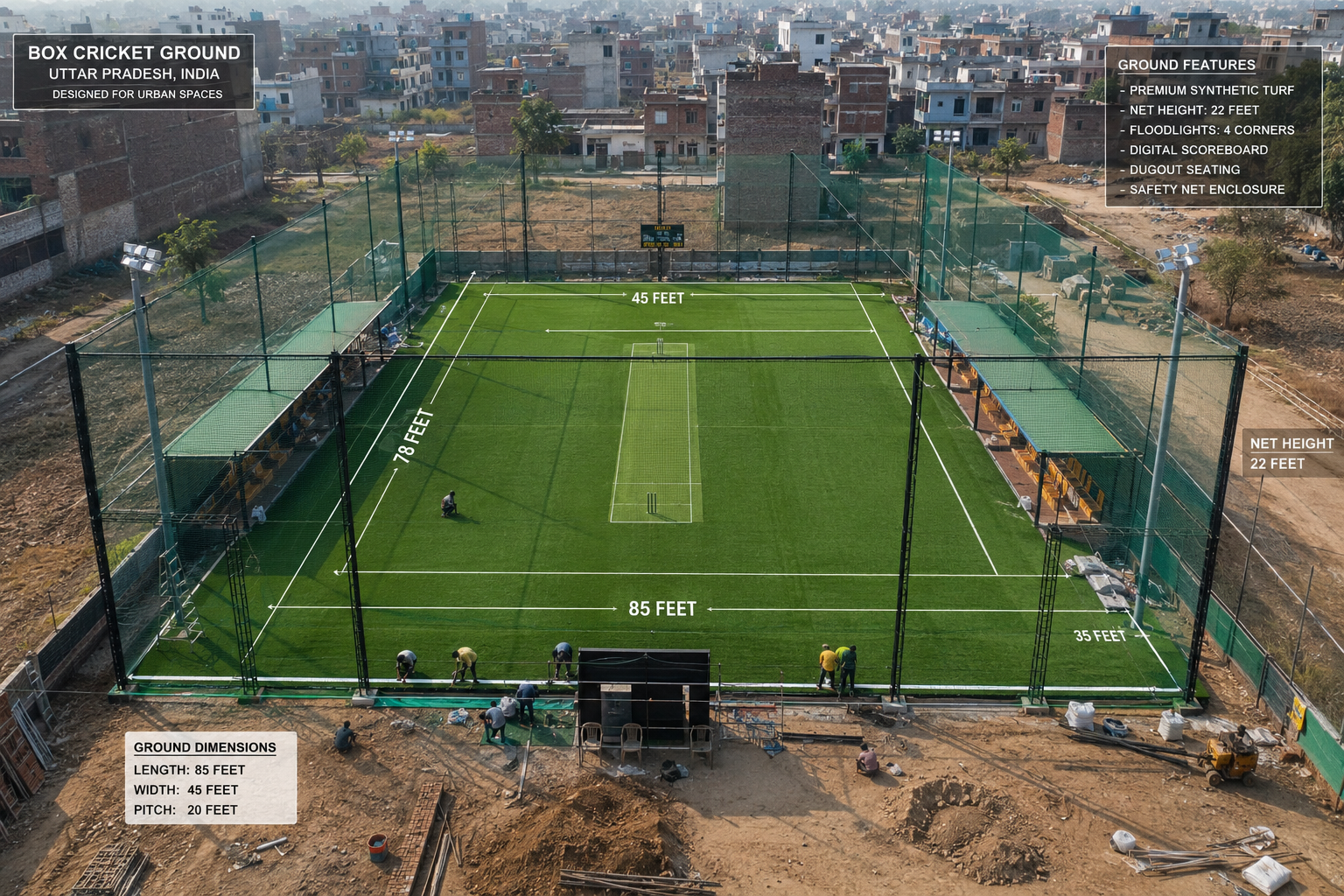
Standard Box Cricket Ground Size Options
Box cricket does not have one universal ground dimension that applies to every recreational or commercial facility. The following rectangular footprints are useful starting points for preliminary space planning. Final dimensions should be confirmed against the intended playing format, site conditions and safety requirements.
36 ft × 60 ft Box Cricket Ground
A compact layout for properties where available space is limited. It may suit recreational cricket, selected school activities, practice sessions and smaller residential facilities.
- Approximate footprint: 2,160 sq ft.
- Suitable for compact recreational layouts.
- Requires careful pitch and movement planning.
- May limit the available fielding and safety space.
48 ft × 80 ft Box Cricket Ground
A medium-sized planning option for cricket turf projects that need a balance between available land and playing space. It can be evaluated for recreational facilities, academies and selected commercial applications.
- Approximate footprint: 3,840 sq ft.
- Provides more layout flexibility than a compact footprint.
- Can accommodate different recreational formats.
- Final player capacity depends on the match rules.
60 ft × 100 ft Box Cricket Ground
A larger planning option for projects requiring more playing space, additional fielding room or a more flexible commercial layout, subject to site suitability.
- Approximate footprint: 6,000 sq ft.
- Offers greater layout flexibility.
- May suit selected training and tournament formats.
- Requires a corresponding construction and maintenance budget.
Custom Box Cricket Ground Dimensions
A customized footprint can be designed for irregular plots, indoor buildings, rooftop projects or specialized sports facilities where conventional rectangular dimensions may not fit.
- Designed around available land or floor area.
- Allows site-specific pitch positioning.
- Can accommodate indoor and outdoor projects.
- Requires careful assessment of clearances and access.
Important: These are example planning dimensions, not official or mandatory standards. Confirm the actual usable playing area separately from the overall construction footprint.
Box Cricket Ground Size Comparison Chart
Compare the example dimensions below to understand how the overall footprint changes between compact, medium and larger facilities. Player numbers and net heights should be finalized according to the selected playing format and site-specific design.
| Ground Dimensions | Approximate Area | Potential Application | Planning Consideration |
|---|---|---|---|
| 36 ft × 60 ft | 2,160 sq ft | Compact recreational facilities | Efficient layout and careful clearance planning |
| 48 ft × 80 ft | 3,840 sq ft | Medium-sized recreational or commercial projects | Balance playing space with construction requirements |
| 60 ft × 100 ft | 6,000 sq ft | Larger training or commercial facilities | More space for gameplay and layout flexibility |
| Custom dimensions | Calculated from the selected layout | Indoor, rooftop or irregular sites | Site-specific technical assessment |
The areas in this table represent the rectangular footprints only. Additional land may be required for foundations, access, circulation, reception, spectator seating, equipment storage and other facilities.
Box Cricket Pitch Length and Playing Area Dimensions
Pitch length is one of the most important considerations when determining the internal layout of a box cricket ground. The appropriate distance between the batting and bowling ends depends on the intended match format, player age group, ball type and available space.
Some preliminary designs consider a pitch length in the approximate range of 18–20 metres. This should not be treated as a universal requirement for every box cricket ground. Compact recreational facilities may require a different arrangement, while more specialized training facilities may follow different specifications.
When planning the pitch, account for the crease markings, bowler's approach, batter's stance, wicket position and available clearance from the surrounding netting. The usable playing length should be distinguished from the total ground length.
- Finalize the playing format before approving pitch dimensions.
- Allow sufficient space for the batter and bowler to move safely.
- Position the pitch to maintain practical clearance from boundaries.
- Choose a surface appropriate for the intended cricket activity.
- Confirm all measurements in the final construction drawing.
Recommended Box Cricket Ground Net Height
Protective netting helps contain cricket balls within the playing area and can reduce the risk of balls entering nearby properties or public spaces. Net height should be selected according to the ground dimensions, ball type, intended gameplay, surrounding buildings and site-specific safety requirements.
A preliminary planning range of approximately 20–25 feet may be considered for some box cricket facilities. However, this range is not a universal standard. The required height can differ for compact grounds, indoor facilities, rooftop projects and sites with particular containment requirements.
The complete netting system includes more than the mesh itself. Structural posts, foundations, support cables, connections, gates and the selected net material must be appropriate for the installation environment and anticipated loads.
- Consider both side netting and overhead containment where required.
- Choose net material suitable for the intended playing conditions.
- Plan secure connections and appropriate structural support.
- Check clearances around lights, roofs, buildings and access gates.
- Arrange professional structural assessment for the proposed system.
Important Components of a Box Cricket Ground Layout
Selecting the right box cricket ground size involves planning the entire facility, not just measuring the playing rectangle. Every component should be considered during the layout stage to avoid conflicts during construction and operation.
Playing Area and Boundary Clearance
Define the usable playing rectangle and allow suitable clearance around the pitch, boundaries, posts and netting. Consider player movement and safe access to the playing area.
Pitch Position and Run-Up
Plan the pitch position, bowling approach, wicket placement and crease markings according to the selected cricket format.
Structural Framework
Account for the space occupied by structural posts, foundations, beams and support connections. Structural design should reflect site conditions and applicable engineering requirements.
Safety Netting and Fencing
Include side and overhead netting where needed, along with suitable fencing, access gates and ball-containment arrangements.
Artificial Cricket Turf
Select a synthetic turf system appropriate for cricket and compatible with the proposed base. Consider installation, maintenance and the intended playing conditions.
Lighting and Electrical Layout
Position LED sports lighting to support the intended playing hours. Consider glare, shadows, wiring, maintenance access and electrical safety.
How Much Land Is Required for a Box Cricket Ground?
The total land requirement depends on the playing footprint and the space needed for supporting infrastructure. A ground measuring 48 ft × 80 ft has a rectangular footprint of 3,840 square feet. A 60 ft × 100 ft layout covers 6,000 square feet.
These figures do not automatically include additional areas for structural foundations, entry gates, circulation, reception, seating, washrooms or parking. A site plan should show the usable playing dimensions and the complete project footprint separately.
For rooftop or indoor projects, available floor space is only one consideration. Structural load capacity, building height, emergency access, ventilation, drainage and applicable permissions may also affect feasibility.
Before purchasing materials or beginning construction, have the site measured and prepare a layout that accounts for all required playing, structural and operational areas.
Indoor vs Outdoor Box Cricket Ground Size Planning
Indoor and outdoor cricket turf facilities can use different dimensions according to their available space and operational requirements. The environment also affects the design of the base, netting, lighting and supporting infrastructure.
| Factor | Indoor Box Cricket | Outdoor Box Cricket |
|---|---|---|
| Space planning | Must account for internal columns, walls and clear height. | Must account for plot boundaries, access and surrounding properties. |
| Net height | Limited by the available clear height and roof structure. | Determined by containment needs and structural design. |
| Base preparation | Existing floor condition and load capacity must be checked. | Ground preparation, levels and base construction must be assessed. |
| Drainage | Depends on the building, floor and possible water entry. | Requires consideration of rainfall and surface runoff. |
| Lighting | Artificial lighting is usually essential. | May combine daylight with artificial lighting. |
| Weather exposure | Generally more protected from direct weather. | Requires consideration of sunlight, rain and wind. |
How to Choose the Right Box Cricket Ground Size
The most suitable dimensions are determined by the purpose of the facility, available land and proposed construction budget. Consider the following factors before selecting a layout.
- Measure the available site: Record the length, width, access points, obstructions and usable construction area.
- Identify the target users: Consider whether the facility is intended for children, recreational players, coaching groups, clubs or commercial bookings.
- Determine the playing format: Establish the expected number of players, match rules, ball type and pitch requirements.
- Assess the site environment: Check available indoor height, outdoor drainage, ground conditions, nearby buildings and access restrictions.
- Plan safety components: Include netting, structural supports, access gates and the clearances required for safe use.
- Consider future operations: Allow for maintenance, equipment storage, player circulation and additional facilities where required.
- Estimate the complete project cost: Include civil work, turf, structural fabrication, fencing, lighting, drainage, installation and finishing.
Box Cricket Ground Size and Construction Cost
Box cricket ground construction cost depends partly on the selected dimensions, but ground size alone does not determine the complete investment. Two facilities with similar footprints may have different budgets because of differences in site preparation, turf specification, structural design and supporting amenities.
Important cost factors include:
- Total playing area and overall construction footprint.
- Excavation, filling, compaction and base construction.
- Artificial cricket turf specification and installation.
- Structural steel, foundations and fabrication requirements.
- Side netting, overhead netting and fencing.
- Lighting equipment and electrical installation.
- Drainage and water-management arrangements.
- Indoor building modifications or outdoor weather protection.
- Access gates, markings and optional amenities.
A site-specific quotation helps identify the materials, quantities, construction scope and additional requirements. For a more accurate estimate, provide the proposed dimensions, site photographs, location, preferred playing format and indoor or outdoor requirements.
Benefits of Proper Box Cricket Ground Size Planning
Correctly planned dimensions can make a box cricket facility more practical to operate and maintain. The goal is to balance playing space, safety, user requirements and construction feasibility.
- Better use of available land or indoor floor space.
- Improved planning of the pitch and playing boundaries.
- More practical player movement and access arrangements.
- Better coordination of fencing, netting and structural supports.
- Suitable positioning of lighting and electrical equipment.
- Clearer construction quantities and project cost estimates.
- More effective planning for maintenance and future upgrades.
- A layout aligned with the intended playing format and users.
Professional Box Cricket Ground Size Planning Services in India
Sports Facility India provides sports infrastructure solutions for clients planning box cricket ground dimensions, artificial turf installation and complete cricket facility construction. The project layout can be developed around the available site, intended gameplay and operational requirements.
Planning services can cover playing-area measurements, pitch positioning, boundary clearance, structural framework, safety netting, access gates, LED sports lighting, drainage and supporting facilities. Civil construction and artificial turf installation can be coordinated according to the agreed project scope.
Whether you are planning a compact school cricket area, a residential recreation facility, an indoor cricket centre or a commercial box cricket arena, the design should account for the complete construction footprint rather than the playing area alone.
For box cricket ground size consultation in India, contact Sports Facility India to discuss your proposed dimensions, available land, playing requirements and construction plans.
Frequently Asked Questions About Box Cricket Ground Size
1. What is the standard box cricket ground size?
There is no single universal box cricket ground size for every format. Example planning footprints include 36 ft × 60 ft, 48 ft × 80 ft and 60 ft × 100 ft. The final dimensions depend on available space, intended gameplay and safety requirements.
2. Which box cricket ground size is suitable for commercial use?
A 48 ft × 80 ft or 60 ft × 100 ft footprint may be considered for commercial projects, depending on available land, the intended match format, supporting facilities and construction budget. Neither size is mandatory for every commercial facility.
3. What is the ideal pitch length for box cricket?
Pitch length depends on the playing format, bowling distance, ball type, player age group and available space. Some preliminary designs consider approximately 18–20 metres, but the final measurement should be confirmed during layout planning.
4. What is the recommended net height for a box cricket ground?
A preliminary planning range of approximately 20–25 feet may be considered for some facilities. The final height should reflect the playing format, site restrictions, ball containment requirements and structural design.
5. Can box cricket ground dimensions be customized?
Yes. Dimensions can be customized for available land, indoor buildings, rooftop facilities and irregular plots. The layout should maintain suitable playing space, clearances and access.
6. How much land is required for a box cricket ground?
A 48 ft × 80 ft playing footprint covers 3,840 square feet, while a 60 ft × 100 ft footprint covers 6,000 square feet. Additional space may be required for structural supports, access, seating and other facilities.
7. Is netting necessary for box cricket?
Protective netting is an important component of most box cricket facilities because it helps contain cricket balls. The material, height, positioning and supporting framework should be selected for the site and intended use.
8. Can a box cricket ground be constructed indoors?
Yes. Indoor facilities can be planned in suitable warehouses, sports halls and commercial buildings. Available clear height, floor suitability, ventilation, lighting, structural capacity and emergency access must be assessed.
9. Does a larger box cricket ground cost more to construct?
A larger ground generally requires more turf and may require additional structural materials, netting and lighting. However, the final cost also depends on site conditions, material specifications and the overall construction scope.
10. Does Sports Facility India provide ground size planning?
Sports Facility India provides sports infrastructure solutions that can include layout planning, artificial turf installation, civil work, structural fabrication, fencing, netting and lighting according to the agreed project requirements.
Need Help Choosing the Right Box Cricket Ground Size?
Planning a box cricket ground for a school, sports academy, residential society, corporate campus or commercial sports centre? Get assistance with site measurements, playing dimensions, pitch layout, netting, artificial turf and construction planning.
Share your available land area and project requirements to discuss a suitable layout and construction scope with Sports Facility India.
Request a Project Consultation