
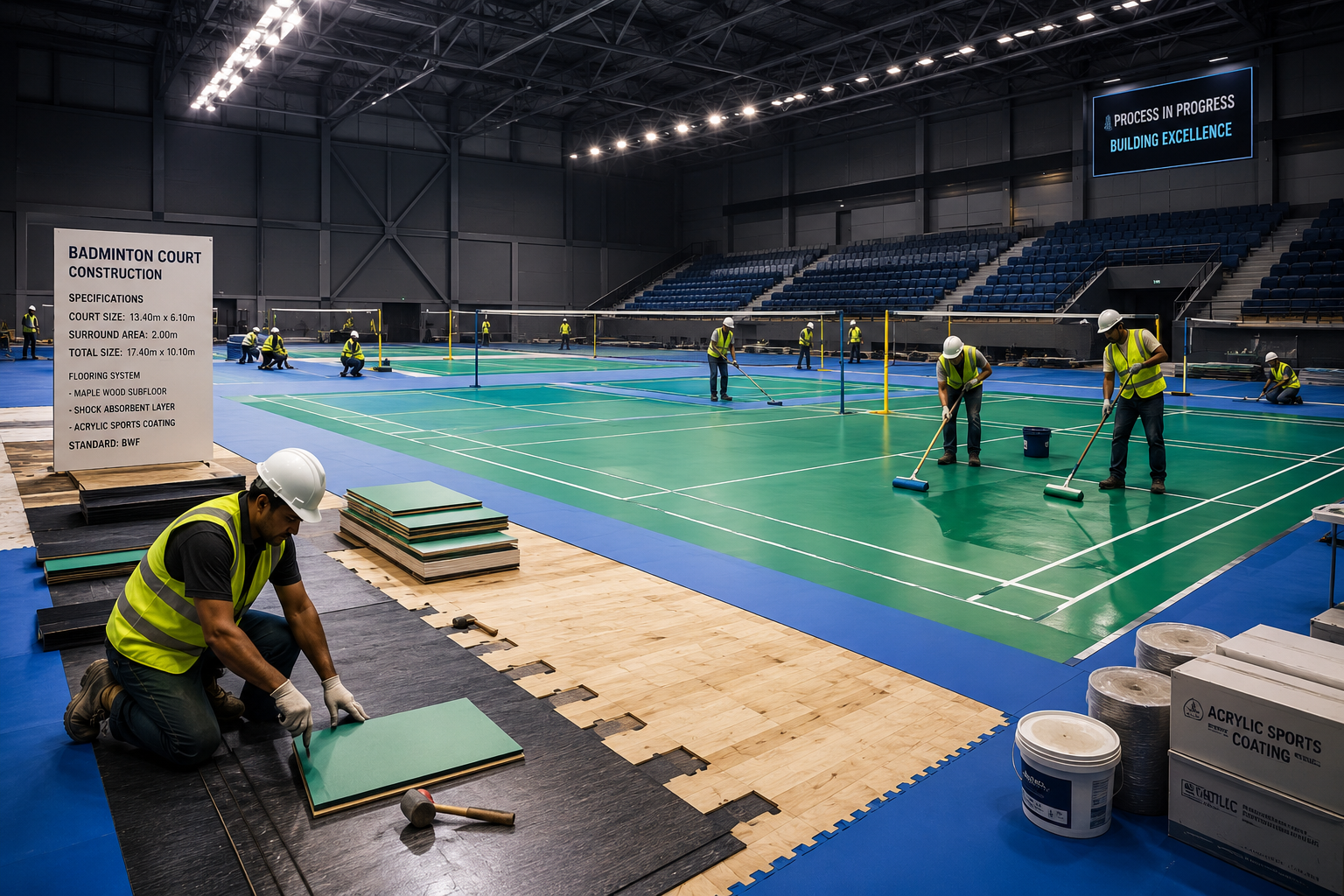
What Is Badminton Court Construction?
Badminton court construction is the process of developing a dedicated playing facility with the correct court layout, suitable sports flooring, a stable subfloor, net and post systems, lighting and other essential infrastructure. Depending on the project, the work may involve constructing a new sports building, converting an existing indoor hall or renovating an old badminton court.
The construction method depends on the site condition, intended level of play, number of courts, available floor area and selected flooring technology. A recreational court may have different requirements from a professional training facility or a multi-court sports complex.
Proper planning helps address surface consistency, player movement, durability, maintenance and efficient use of space. Selecting materials according to the intended application is therefore important for the long-term performance of a badminton facility.
Why Professional Badminton Court Construction Matters
Badminton involves quick acceleration, sudden stops, jumps, lunges and frequent changes of direction. The playing surface should provide suitable traction, stability and resilience for the intended use. An uneven base, unsuitable flooring or inaccurate court markings can affect the usability of the facility.
Professional badminton court construction considers the complete playing environment, including:
- Accurate badminton court dimensions and line marking
- A stable, clean and suitably level subfloor
- Sports flooring appropriate for badminton
- Suitable surface grip and playing characteristics
- Resilience or cushioning where required
- Correct badminton net and post positioning
- Uniform lighting with controlled glare
- Adequate space around the playing area
- Ventilation designed to limit disruptive air movement
- Practical cleaning and maintenance arrangements
Coordinating these elements from the beginning can help reduce installation problems and support a more functional sports facility.
Badminton Court Flooring Options
Choosing the right badminton court flooring is one of the most important parts of the construction process. The ideal system depends on the expected playing frequency, type of facility, subfloor condition, maintenance requirements and project budget.
1. PVC and Vinyl Badminton Court Flooring
Sports-grade PVC or vinyl flooring is a popular option for indoor badminton courts. Depending on the product specification, these systems may include resilient layers and a textured wear surface designed for indoor sports activities.
- Suitable for many schools, clubs and sports academies
- Available in different colours and surface designs
- Can provide a consistent playing surface when properly installed
- Supports routine cleaning and maintenance
- May be available with different cushioning specifications
The product should be selected specifically for badminton or the intended indoor sports application rather than relying on ordinary commercial vinyl flooring.
2. PU Synthetic Badminton Court Flooring
Polyurethane (PU) sports flooring can be considered for indoor facilities that require a seamless synthetic finish. The characteristics of the finished surface depend on the complete system, including its base preparation, layers and installation specifications.
- Seamless finished appearance
- System configurations suited to different project requirements
- Potential for integrated resilient layers
- Suitable for selected indoor sports applications
- Requires correct substrate preparation and curing
A PU system should be specified according to its suitability for badminton, expected use and manufacturer recommendations.
3. Wooden Badminton Court Flooring
Engineered wooden sports flooring is an option for premium indoor sports halls, dedicated badminton facilities and venues where the appearance and playing characteristics of a timber sports floor are important.
- Premium indoor sports-hall appearance
- Engineered flooring and subfloor configurations
- Can be specified with sports-performance features
- Suitable for selected training and competition venues
- Requires appropriate environmental and maintenance controls
Wooden flooring specifications should account for moisture, subfloor construction, expansion requirements and the maintenance needs of the selected system.
How to Select the Right Flooring System
There is no single flooring solution that suits every badminton court. Before selecting a system, consider the playing level, frequency of use, available budget, building conditions, installation requirements and long-term maintenance. Product specifications should be reviewed before finalizing the flooring.
Badminton Court Construction Process
A structured construction process helps coordinate the playing surface, court layout, equipment and building services. The exact work sequence varies between new facilities and renovation projects.
Step 1: Site Inspection and Feasibility Assessment
The project begins with an assessment of the proposed site or existing building. Available floor area, ceiling height, floor condition, access, moisture, ventilation and electrical arrangements are reviewed to identify important construction requirements.
Step 2: Court Layout and Space Planning
The court layout is prepared according to the applicable badminton dimensions and the intended use of the facility. The plan should include playing boundaries, net positions, surrounding clearances, movement routes and equipment locations. Multi-court projects also require adequate space between playing areas.
Step 3: Existing Floor Assessment
For renovation work, the existing floor is checked for cracks, settlement, unevenness, moisture and surface contamination. Structural or substrate problems should be addressed before installing new flooring.
Step 4: Subfloor Preparation
A suitable base is essential for a consistent sports surface. Preparation may involve cleaning, grinding, crack repairs, localized leveling or other corrective work, depending on the floor condition and flooring manufacturer's requirements.
Step 5: Moisture Assessment
Excess moisture can affect adhesives and certain flooring materials. The subfloor should be tested where required, and appropriate moisture-control measures should be implemented before installation.
Step 6: Cushioning and Resilient Layer Installation
Depending on the selected sports flooring system, a resilient or cushioned layer may be incorporated. The type and thickness of this layer should be selected according to the system specification and intended playing characteristics.
Step 7: Badminton Sports Flooring Installation
The specified PVC, vinyl, PU or wooden sports flooring is installed according to the product's technical requirements. Alignment, bonding, joints, curing and surface finishing must be handled carefully to achieve a consistent result.
Step 8: Court Line Marking
Court markings are measured and applied for singles and doubles play according to the applicable rules. Correct dimensions and clearly visible lines help establish the playing boundaries.
Step 9: Net and Post Installation
Badminton posts and net systems are positioned at the correct locations. Fixed, socket-mounted or movable equipment can be considered depending on the facility layout and operating requirements.
Step 10: Lighting and Electrical Coordination
Lighting should provide suitable and uniform illumination across the playing area while minimizing glare and distracting shadows. Fixture placement should be coordinated with the court layout, ceiling structure and intended level of play.
Step 11: Ventilation and Airflow Planning
Indoor ventilation should maintain a comfortable environment without creating excessive drafts across the court. Fans, air-conditioning outlets and air-distribution systems should be planned with the effect of airflow on shuttle movement in mind.
Step 12: Final Quality Inspection and Handover
Before handover, the completed court can be inspected for flooring finish, surface defects, dimensions, line marking, net positioning, lighting and equipment installation. Any identified installation issues should be addressed before the facility is put into regular use.
Standard Badminton Court Dimensions
Badminton court dimensions vary according to the playing format. The court layout should follow the applicable badminton rules, with separate markings defining singles and doubles boundaries.
| Specification | Standard Dimension |
|---|---|
| Court length | 13.40 metres |
| Doubles court width | 6.10 metres |
| Singles court width | 5.18 metres |
| Net height at the centre | 1.524 metres |
| Net height at the posts | 1.55 metres |
These measurements describe the marked playing area, not the entire building or floor space required. Additional clearance is needed around the court for safe player movement, equipment and circulation. Multi-court layouts require further space planning.
Facilities intended for formal competition should be designed against the current requirements of the relevant governing body, including any applicable clearance and overhead-height requirements.
Indoor Badminton Court Construction Requirements
An indoor badminton facility should be designed as a complete sports environment. Court flooring alone cannot compensate for inadequate space, unsuitable lighting or poorly planned building services.
Important planning considerations include:
- Adequate clear height above the playing area
- Minimal overhead obstructions
- Suitable sports flooring and subfloor construction
- Uniform lighting with controlled glare
- Ventilation that limits disruptive drafts
- Suitable wall and ceiling finishes
- Safe player circulation and emergency access
- Storage for nets, posts and sports equipment
- Spectator seating where required
- Maintenance access and cleaning arrangements
Requirements may differ between a recreational court, a school sports hall and a competition venue. The building design should be finalized according to the intended use and applicable regulations.
Benefits of Professional Badminton Court Construction
Suitable Playing Surface
Selecting a sports flooring system designed for badminton helps provide appropriate surface characteristics for regular training and recreational play.
Consistent Court Layout
Accurate measurements and professional line marking establish clear playing boundaries for singles and doubles matches.
Player Comfort and Surface Performance
A suitable flooring system may provide resilience and playing comfort appropriate to the intended use. Performance depends on the complete system and correct installation.
Durability and Maintenance Planning
Correct subfloor preparation, suitable material selection and routine maintenance can help preserve the floor's condition and reduce avoidable repair work.
Professional Facility Appearance
Coordinated flooring colours, clear court markings, properly installed nets and suitable lighting create a more organized sports environment.
Multiple Uses
A well-planned badminton facility can support coaching, school sports, academy training, recreational activities and tournaments according to its layout and equipment.
Badminton Court Construction for Different Facilities
Badminton Courts for Schools
Schools can develop badminton courts for physical education, student training, recreational activities and school competitions. Flooring, layout and equipment should reflect student usage, available space and maintenance requirements.
Badminton Courts for Colleges and Universities
Colleges and universities may need courts for regular practice, inter-college competitions and student sports programs. Multiple-court layouts can be planned where the building dimensions permit.
Badminton Courts for Sports Academies
Training academies often require courts that accommodate frequent use and structured coaching. Flooring, lighting, court spacing and equipment should be selected according to the training program.
Badminton Courts for Clubs and Sports Complexes
Clubs and sports complexes can combine multiple badminton courts with reception areas, equipment storage, changing rooms, spectator facilities and other supporting infrastructure.
Badminton Courts for Residential Communities
Residential developments can include badminton courts as part of their indoor recreation and fitness facilities. Layout and flooring should be selected according to the available building space and expected community use.
Commercial Badminton Courts
Commercial facilities can use badminton courts for coaching, memberships, hourly bookings, corporate sports activities and tournaments. Durable materials and practical maintenance arrangements are important considerations.
Badminton Court Construction Cost in India
The cost of badminton court construction in India depends on the project scope, flooring selection, site condition and supporting infrastructure. Constructing a new facility can involve substantially different work from upgrading an existing hall.
Factors Affecting Badminton Court Construction Cost
- Number of badminton courts
- Total playing and circulation area
- New construction or renovation
- Existing floor condition and repairs
- Subfloor preparation and leveling
- Moisture-control requirements
- Selected PVC, vinyl, PU or wooden flooring system
- Cushioning and resilient layers
- Court line marking
- Net posts and badminton equipment
- Lighting fixtures and electrical work
- Ventilation and air-conditioning requirements
- Building, ceiling and structural modifications
- Storage, partitions and supporting facilities
- Project location, material transport and installation logistics
A single per-square-foot rate may not accurately represent every project because the required materials and construction work can vary considerably. A site assessment and detailed specification help establish a more realistic budget.
For a project-specific estimate, share the proposed location, number of courts, available dimensions, existing floor condition and preferred flooring type with our team.
Comparison of Badminton Court Flooring Systems
| Flooring Type | Typical Applications | Key Considerations |
|---|---|---|
| PVC or vinyl sports flooring | Schools, clubs, academies and commercial indoor courts | Product quality, resilience, surface texture and maintenance |
| PU synthetic sports flooring | Selected indoor sports facilities | System design, substrate preparation, curing and sports suitability |
| Engineered wooden sports flooring | Premium indoor sports halls and selected competition venues | Subfloor engineering, moisture control and maintenance |
The best flooring option depends on the requirements of the individual facility. Compare the technical specifications, installation requirements and maintenance recommendations of the complete systems before making a final decision.
Badminton Court Lighting Requirements
Appropriate lighting helps players follow the shuttlecock during fast rallies. Poor fixture placement can cause glare, uneven illumination and distracting shadows, making the playing environment less comfortable.
A badminton court lighting plan should consider the required illumination level, uniformity, fixture position, ceiling height and intended level of play. Lighting should be coordinated with the court layout and building structure.
Competition facilities should follow the applicable lighting criteria for their intended use. Suitable controls and energy-efficient fixtures may also help manage operating costs.
Ventilation and Airflow Planning for Indoor Badminton Courts
Indoor badminton facilities need a comfortable environment for players and spectators. However, excessive air movement can affect shuttlecock flight and interfere with play.
Fans, HVAC outlets and air-distribution systems should be coordinated with the court layout. The aim is to provide suitable ventilation while avoiding strong drafts directly across the playing areas.
Badminton Court Flooring Maintenance
Routine maintenance helps protect the appearance and playing characteristics of a badminton court. Cleaning methods should always follow the flooring manufacturer's recommendations.
- Remove dust and loose debris regularly.
- Use approved cleaning products for the selected flooring.
- Avoid abrasive equipment and unsuitable chemicals.
- Prevent unnecessary water accumulation.
- Inspect seams, joints and surface finishes periodically.
- Repair damaged flooring areas promptly.
- Check net posts, sockets and other equipment.
- Inspect lighting and electrical fittings.
- Maintain suitable indoor ventilation.
- Arrange professional assessment when surface defects appear.
Maintenance requirements differ between PVC, vinyl, PU and wooden flooring. A planned maintenance schedule can help identify minor issues before they require more extensive repairs.
Common Mistakes to Avoid in Badminton Court Construction
Construction problems can often be prevented by assessing the site carefully and specifying the flooring system before installation begins.
- Installing sports flooring over an unsuitable subfloor
- Ignoring moisture or structural movement
- Failing to correct floor unevenness
- Selecting flooring based only on its initial price
- Using inaccurate court dimensions or line markings
- Providing inadequate space around the court
- Ignoring lighting glare and uneven illumination
- Allowing excessive airflow across playing areas
- Failing to coordinate equipment before flooring installation
- Using inappropriate cleaning chemicals
- Neglecting regular maintenance and inspections
A coordinated construction plan helps align the building, flooring, equipment and operating requirements before work begins.
Turnkey Badminton Court Construction Solutions
Turnkey badminton court construction involves coordinating the major components of a facility through an integrated project plan. Depending on the agreed scope, the work may cover site assessment, layout planning, subfloor preparation, flooring installation, line marking, equipment and final inspection.
Coordinating the different stages can help maintain consistent specifications and simplify project management. The precise scope of work should be agreed upon before construction starts.
Our Badminton Court Construction Services
- Site inspection and feasibility assessment
- Badminton court layout and space planning
- Subfloor preparation and leveling
- PVC and vinyl sports flooring solutions
- PU synthetic sports flooring solutions
- Wooden sports flooring solutions
- Cushioning system coordination
- Badminton court line marking
- Net, post and sports equipment installation
- Lighting and ventilation coordination
- Existing badminton court renovation
- Final inspection and project handover
Badminton Court Renovation and Resurfacing
An existing badminton court may be upgraded without rebuilding the entire facility, depending on the condition of the underlying floor and building structure. Renovation can include surface preparation, crack treatment, leveling, replacement of damaged flooring, new line marking and equipment improvements.
The existing substrate should be assessed before new flooring is installed. Structural movement, settlement, moisture or other underlying issues should be corrected where necessary to reduce the risk of recurring defects.
A renovation plan should identify which components can be retained, which require repair and which should be replaced. The final scope depends on the inspection findings and the technical requirements of the selected flooring system.
Why Choose Sports Facility India for Badminton Court Construction?
Sports Facility India offers sports infrastructure solutions for badminton courts and other indoor and outdoor sports facilities. Each project should be planned around the actual site conditions, intended use, available space and selected sports flooring system.
A school court, sports academy, residential facility and commercial badminton centre may require different specifications. Reviewing these requirements before installation helps establish a practical scope of work and supports better coordination between flooring, markings, equipment and building services.
Whether you are planning a new badminton court, developing a multi-court facility or upgrading an existing playing area, our team can discuss the project requirements and potential construction approach.
Contact Sports Facility India to discuss your badminton court construction project.
Frequently Asked Questions About Badminton Court Construction
1. What is included in badminton court construction?
Depending on the project scope, badminton court construction may include site inspection, layout planning, subfloor preparation, sports flooring, line marking, net and post installation, lighting coordination and final inspection.
2. What is the standard size of a badminton court?
A standard badminton court is 13.40 metres long. The doubles court is 6.10 metres wide, while the singles playing width is 5.18 metres. Additional clearance is required around the marked playing area.
3. Which flooring is best for a badminton court?
Sports-grade PVC or vinyl, PU synthetic flooring and engineered wooden sports flooring are options for selected indoor facilities. The right system depends on the intended use, technical specifications, subfloor condition, maintenance requirements and budget.
4. What is the cost of badminton court construction in India?
The cost depends on the number of courts, available area, site condition, flooring system, subfloor preparation, lighting, equipment and supporting building work. A site-specific assessment is recommended for an accurate estimate.
5. How long does badminton court construction take?
The timeline depends on the project size, whether it involves new construction or renovation, the condition of the existing floor, material specifications and supporting work. A project schedule can be prepared after the scope is established.
6. Is PU flooring suitable for badminton courts?
PU synthetic flooring may be suitable when the selected system is designed for the intended indoor sports application and installed over a properly prepared base. Its technical specifications should be reviewed before selection.
7. Can multiple badminton courts be constructed in one hall?
Yes. Multiple courts can be planned for schools, academies, clubs and commercial sports facilities where sufficient space is available. The layout should account for court spacing, circulation, lighting, ventilation and safety.
8. Can an existing badminton court be renovated?
Yes. Depending on the condition of the existing floor, renovation may include repairs, leveling, flooring replacement, new line marking and equipment upgrades. Underlying moisture or structural problems should be addressed before resurfacing.
9. What factors affect badminton court flooring durability?
Durability depends on the flooring system, product quality, installation, usage intensity, environmental conditions and maintenance. Following the manufacturer's cleaning and maintenance recommendations helps preserve the surface.
10. Do you provide badminton court construction services across India?
Sports Facility India offers sports infrastructure solutions for projects across India, subject to project scope, location and site requirements. Contact the team to discuss your proposed facility.
Plan Your Badminton Court Construction Project
Looking to build a badminton court for a school, college, sports academy, club, residential community or commercial sports centre? Discuss your requirements for court layout, flooring, subfloor preparation, lighting and equipment with Sports Facility India.
Share your project location, number of courts, available dimensions and preferred flooring system to help define the construction scope.
Professional Badminton Court Construction in India
Professional badminton court construction involves the coordinated planning of court dimensions, sports flooring, subfloor preparation, equipment, lighting and ventilation. Each component contributes to the usability and maintenance of the completed facility.
Sports Facility India provides badminton court construction solutions for schools, colleges, academies, clubs, residential communities and commercial sports facilities. Project specifications should be selected according to the intended use, building conditions and available budget.
From indoor badminton court construction and synthetic badminton flooring to court line marking, equipment installation and renovation, careful planning helps create a consistent and practical sports environment.
Contact Sports Facility India for Badminton Court Construction