
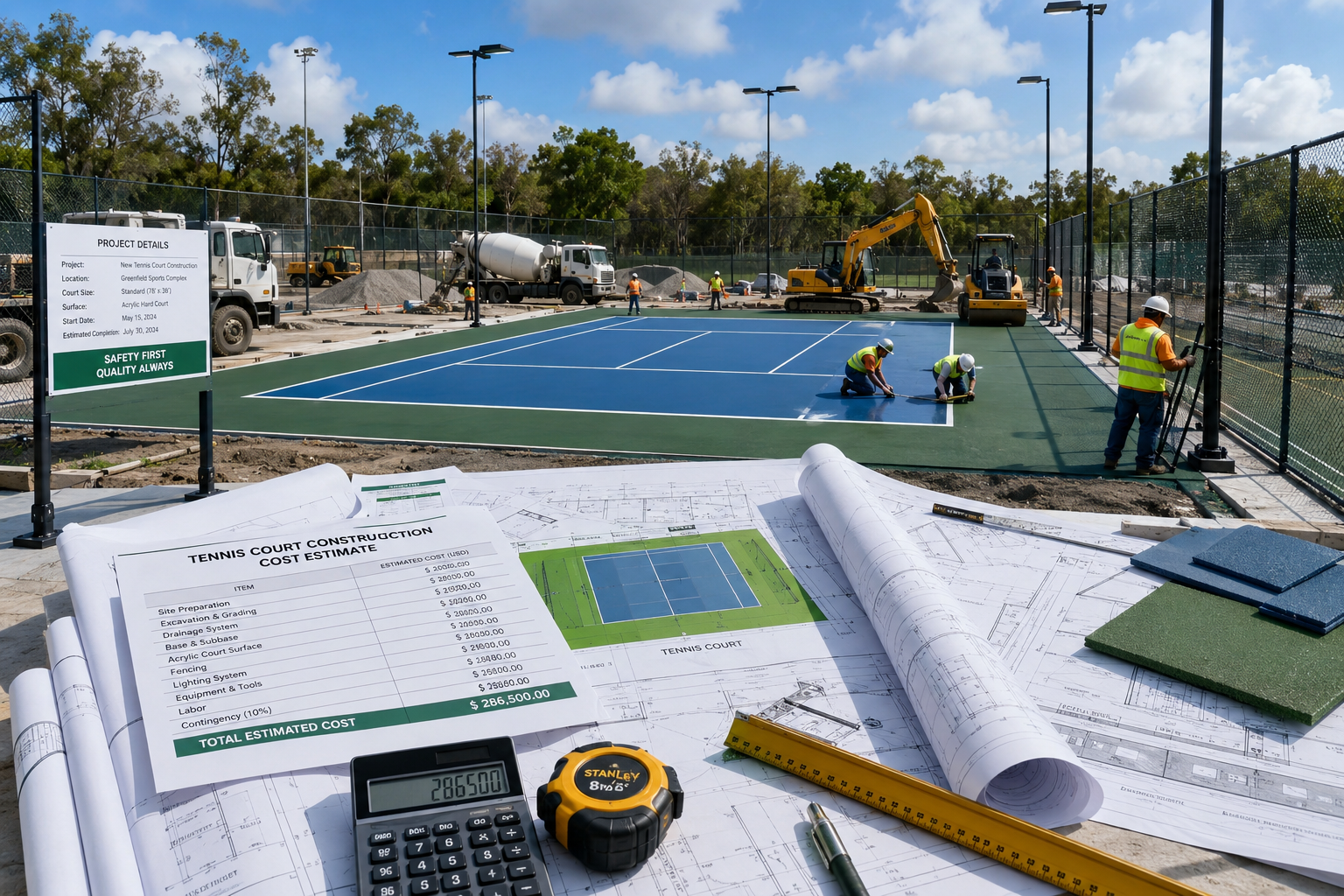
What Determines the Cost of New Tennis Court Construction?
There is no single construction price applicable to every tennis court. The final project investment is determined by the existing site, selected construction system, surface specification, accessories, and installation requirements. Evaluating these factors before construction helps create a more accurate project budget.
1. Site Location and Ground Conditions
The condition of the proposed construction site can significantly affect the overall cost. Uneven land, rocky soil, weak subgrade, existing structures, poor soil bearing capacity, groundwater, and difficult site access may require additional excavation, filling, compaction, stabilization, or drainage work.
A relatively level site with suitable soil conditions generally requires less preliminary earthwork, while challenging sites may need additional civil engineering before the tennis court foundation can be constructed.
2. Site Preparation and Earthwork
Site preparation typically includes clearing, excavation, grading, filling, compaction, and preparation of the formation level. The quantity of earthwork depends on existing ground levels and the desired finished court elevation.
Proper preparation is essential because settlement or inadequate compaction beneath the court can contribute to cracking, surface irregularities, and drainage problems in the future.
3. Foundation and Base Construction
The foundation is one of the most important components of a tennis court. Depending on the design and site requirements, an engineered asphalt base or reinforced concrete foundation may be used.
The base system must provide structural stability, suitable drainage, dimensional accuracy, and a smooth platform for the sports surface. Foundation specifications can therefore have a substantial influence on the total construction budget.
4. Drainage System
Effective drainage is particularly important for outdoor tennis courts. Surface water must be directed away from the playing area to prevent standing water and protect the foundation and sports surface.
Depending on the site, drainage may include appropriate court slopes, perimeter drains, catch basins, underground drainage pipes, filter layers, and connections to an existing stormwater system.
5. Tennis Court Surface Selection
The playing surface has a direct effect on both initial construction costs and ongoing maintenance requirements. Common options include acrylic hard courts, cushioned acrylic systems, synthetic surfaces, clay courts, artificial grass, and other specialized sports flooring systems.
For many outdoor facilities, acrylic systems are selected because they can provide durable performance, consistent traction, weather resistance, and relatively straightforward maintenance when correctly installed.
6. Fencing and Gates
Perimeter fencing helps contain tennis balls and provides security around the playing area. Fence height, mesh specification, posts, gates, finishes, and the total perimeter length can influence the overall project cost.
7. Sports Lighting
LED sports lighting can extend the usable hours of a tennis facility and improve visibility during evening play. Lighting costs depend on the number and type of fixtures, pole height, electrical infrastructure, foundation requirements, controls, and illumination requirements.
8. Tennis Equipment and Accessories
The project may include tennis posts, nets, center straps, umpire chairs, player benches, scoreboards, protective padding, seating, equipment storage, and other accessories. The selected equipment specifications influence the final project investment.
9. Customization and Additional Facilities
Additional features such as multiple courts, practice walls, spectator seating, player shelters, landscaping, walkways, clubhouse areas, branding, and integrated sports facilities require additional planning and construction work.
Major Components Included in Tennis Court Construction Cost
A complete tennis court project may contain several construction and installation components. The actual scope varies according to site requirements and the specifications selected by the client.
| Construction Component | Typical Cost Influence | Importance |
|---|---|---|
| Site Survey and Planning | Low to Moderate | Essential |
| Excavation and Earthwork | Moderate to High | Essential |
| Subgrade Preparation | Moderate | Critical |
| Aggregate Base | Moderate | Critical |
| Concrete or Asphalt Foundation | High | Critical |
| Drainage System | Moderate to High | Critical |
| Sports Surface | Moderate to High | Critical |
| Court Line Marking | Low | Required |
| Perimeter Fencing | Moderate | Recommended |
| LED Sports Lighting | Moderate to High | Optional |
| Tennis Equipment | Low to Moderate | Required |
| Landscaping and Additional Amenities | Project Specific | Optional |
Tennis Court Surface Options and Their Cost Impact
Choosing the right tennis court surface requires consideration of playing characteristics, climate, maintenance requirements, expected usage, and available budget. Different surface systems have different installation and maintenance requirements.
| Surface Type | Playing Characteristics | Maintenance Level | Relative Investment |
|---|---|---|---|
| Acrylic Hard Court | Consistent and versatile | Low to Moderate | Moderate |
| Cushioned Acrylic Court | Comfort-oriented playing system | Low to Moderate | Moderate to High |
| Synthetic Tennis Surface | Surface-specific performance | Low to Moderate | Moderate to High |
| Clay Court | Slower playing characteristics | High | Moderate |
| Artificial Grass Court | Surface-dependent performance | Moderate | Moderate to High |
| Natural Grass Court | Fast playing characteristics | Very High | High |
The most suitable surface should be selected according to the intended use rather than construction price alone. A professional assessment can help determine the appropriate combination of surface performance, maintenance requirements, durability, and lifecycle cost.
Materials Used for New Tennis Court Construction
High-quality materials are essential for developing a stable and durable tennis court. Each construction layer contributes to structural performance, drainage, surface quality, and long-term maintenance requirements.
Compacted Subgrade
A properly prepared and compacted subgrade provides the structural foundation for the court. Where required, soil stabilization can be carried out to improve ground performance.
Crushed Stone Aggregate
Engineered aggregate layers provide structural support and help create an effective drainage path beneath the playing surface.
Concrete or Asphalt Foundation
A properly engineered concrete or asphalt base provides a stable platform for the selected tennis court surfacing system.
Acrylic Sports Coatings
Acrylic sports coatings provide the finished playing surface and can be selected for suitable traction, color, durability, weather resistance, and playing characteristics.
Line Marking Materials
Specialized sports line marking materials are used to create accurate and clearly visible tennis court markings.
Drainage Components
Drainage pipes, channels, catch basins, filter materials, and related components help direct rainwater away from the court structure.
Standard Tennis Court Dimensions and Planning Requirements
Correct dimensions and adequate surrounding space are essential when planning a new tennis court. In addition to the playing area, designers must consider run-off space, fencing, access pathways, lighting positions, spectator areas, and maintenance access.
| Planning Element | Typical Requirement |
|---|---|
| Tennis Court Length | 23.77 metres |
| Doubles Court Width | 10.97 metres |
| Singles Court Width | 8.23 metres |
| Net Height at Centre | Approximately 0.914 metres |
| Net Height at Posts | Approximately 1.07 metres |
Additional clearance around the court should be incorporated according to the intended level of play, site layout, fencing design, spectator requirements, and applicable standards.
How to Plan a New Tennis Court Construction Project
Effective planning can help control construction costs while improving the long-term performance of the facility. A professional assessment should be completed before finalizing the design and construction scope.
Site Survey and Feasibility Assessment
The site should be evaluated for topography, soil conditions, drainage patterns, accessibility, existing utilities, available space, and surrounding structures.
Court Orientation
Outdoor tennis courts are commonly planned along a generally north-south orientation where site conditions allow. Orientation should be evaluated alongside local site constraints and the expected hours of use.
Drainage Planning
Drainage should be incorporated into the civil design rather than treated as an afterthought. Proper grading and drainage infrastructure help reduce water-related problems and support long-term surface performance.
Lighting and Electrical Planning
If evening play is required, lighting foundations, electrical conduits, control systems, and service access should be planned before foundation and paving work is completed.
Future Expansion
For sports academies, schools, clubs, and residential developments, it can be beneficial to consider future additional courts, spectator facilities, storage, landscaping, and other amenities during the initial site planning stage.
Step-by-Step New Tennis Court Construction Process
Step 1 – Consultation and Requirement Assessment
The project begins by understanding the intended use, number of courts, preferred surface, site availability, accessories, lighting requirements, and overall project objectives.
Step 2 – Site Inspection and Survey
Engineers assess the site conditions, levels, soil characteristics, drainage, access, utilities, and construction constraints.
Step 3 – Design and Cost Planning
Based on the site assessment, the construction methodology, surface system, drainage strategy, accessories, and project scope are finalized.
Step 4 – Excavation and Subgrade Preparation
The site is cleared and excavated where required. The formation level is graded and compacted to create a stable base for subsequent construction layers.
Step 5 – Aggregate Base Installation
Selected aggregate materials are placed in engineered layers and compacted to provide structural stability and appropriate drainage characteristics.
Step 6 – Foundation Construction
An engineered concrete or asphalt foundation is installed according to the project design. Surface levels and tolerances are checked before sports surfacing begins.
Step 7 – Sports Surface Installation
The selected tennis court surface system is installed over the prepared foundation. Acrylic systems may include multiple coating layers, texture treatment, color coats, and finishing applications.
Step 8 – Line Marking
Accurate tennis court lines are applied after the playing surface has been prepared and cured according to the selected system requirements.
Step 9 – Fencing, Lighting and Equipment
Perimeter fencing, gates, tennis posts, nets, lighting systems, seating, and other specified accessories are installed.
Step 10 – Quality Inspection and Handover
The completed facility is inspected for dimensions, surface quality, drainage, line accuracy, equipment installation, finishing quality, and overall workmanship before handover.
Benefits of Professionally Constructed Tennis Courts
Structural Durability
Proper subgrade preparation, foundation construction, drainage, and sports surfacing help create a durable facility capable of supporting regular use.
Consistent Playing Surface
Accurate grading, leveling, and professional surface installation contribute to consistent playing characteristics across the court.
Improved Drainage Performance
A properly designed drainage system helps remove rainwater efficiently and reduces the risk of water accumulation.
Player Safety
Appropriate traction, surface condition, equipment installation, and maintenance contribute to a safer playing environment.
Lower Lifecycle Maintenance
Correct construction can reduce premature surface deterioration and unnecessary repair requirements.
Professional Appearance
Quality surfacing, accurate line markings, fencing, lighting, and accessories create a well-finished sports facility.
Where Can New Tennis Courts Be Constructed?
Tennis court construction can be planned for a wide variety of recreational, educational, institutional, residential, and commercial environments.
- Schools and educational institutions
- Colleges and universities
- Professional sports academies
- Sports clubs
- Residential townships
- Housing societies
- Hotels and resorts
- Corporate campuses
- Private villas and farmhouses
- Community recreation facilities
- Municipal and government sports facilities
- Fitness and recreation centers
- Multi-sports complexes
Maintenance Requirements for a New Tennis Court
Regular maintenance helps preserve the appearance, safety, drainage performance, and playing quality of a tennis court. A preventive maintenance program can also help identify minor problems before they require major repairs.
Clean the Playing Surface Regularly
Leaves, dust, sand, and other debris should be removed regularly to maintain surface cleanliness and traction.
Inspect Drainage Systems
Drainage channels, outlets, and surrounding areas should be inspected periodically to ensure that rainwater can flow freely.
Repair Cracks and Surface Damage
Small cracks, coating damage, and worn areas should be evaluated and repaired promptly to prevent deterioration from spreading.
Maintain Fencing and Equipment
Fencing, gates, tennis posts, nets, lighting systems, benches, and other equipment should be inspected periodically.
Renew Sports Coatings When Required
Depending on usage, weather exposure, and surface condition, acrylic coatings may require periodic resurfacing or recoating to restore appearance and playing characteristics.
How to Optimize the Cost of New Tennis Court Construction
Cost optimization should focus on achieving the required performance and durability rather than simply selecting the lowest initial construction price.
- Conduct a professional site survey before finalizing the design.
- Select the surface according to expected usage and maintenance capability.
- Invest in appropriate drainage to reduce potential water-related repairs.
- Use suitable-quality materials for the foundation and sports surface.
- Plan lighting, fencing, utilities, and accessories during the initial design stage.
- Consider future expansion if multiple courts may be required later.
- Follow a preventive maintenance program after completion.
- Work with an experienced turnkey tennis court construction company to coordinate the complete project.
Why Choose Sports Facility India for Tennis Court Construction?
Sports Facility India provides end-to-end tennis court construction solutions for educational institutions, residential developments, sports academies, clubs, hotels, corporate facilities, government projects, and private properties across India.
Our turnkey approach can cover site assessment, planning, civil construction, foundation preparation, drainage, sports surfacing, line marking, fencing, lighting, tennis equipment, quality inspection, and final project handover.
Every project is planned according to the available site, intended usage, selected surface system, performance requirements, and project scope. This approach allows clients to develop a tennis facility that balances construction requirements, durability, maintenance considerations, aesthetics, and long-term usability.
Frequently Asked Questions About Tennis Court Construction Cost
What is the cost of new tennis court construction?
The cost varies according to site conditions, court surface, foundation system, drainage, fencing, lighting, accessories, labor, transportation, and project complexity. A site inspection and detailed project scope are recommended before preparing a final quotation.
What factors have the biggest effect on tennis court construction cost?
Site preparation, foundation construction, drainage, sports surface selection, fencing, lighting, and the overall project size are among the major factors affecting the total construction investment.
Which surface can be used for a new tennis court?
Depending on the project, tennis courts can be constructed with acrylic hard court systems, cushioned acrylic surfaces, synthetic systems, clay, artificial grass, or other suitable sports surfaces.
How long does it take to build a new tennis court?
The construction schedule depends on site preparation, weather, foundation requirements, drainage work, surface system, availability of materials, and project complexity. Multiple-court projects generally require more time than a single-court installation.
Can a tennis court include LED lighting?
Yes. LED sports lighting can be incorporated into the project, with lighting poles, foundations, electrical conduits, fixtures, controls, and related infrastructure planned according to the facility requirements.
Can tennis courts be customized?
Yes. Courts can be customized with different surface systems and colors, fencing configurations, lighting, player seating, landscaping, practice walls, branding, and other facility features.
Why is drainage important for tennis court construction?
Proper drainage helps prevent standing water, protects the foundation and playing surface, reduces moisture-related deterioration, and supports reliable court usability following rainfall.
Does Sports Facility India provide turnkey tennis court construction?
Yes. Sports Facility India provides turnkey tennis court construction services covering planning, site preparation, foundation work, drainage, sports surfacing, line marking, fencing, lighting, equipment installation, quality inspection, and project handover.
Get a Detailed Tennis Court Construction Plan
Planning a new tennis court for a school, university, sports academy, residential community, hotel, club, corporate campus, private property, or government facility? Sports Facility India can help evaluate your requirements and develop a construction plan based on the site, surface selection, drainage, foundation, fencing, lighting, and other project requirements.
Request a Tennis Court Project Consultation