
What Are the Official Doubles Badminton Court Dimensions?
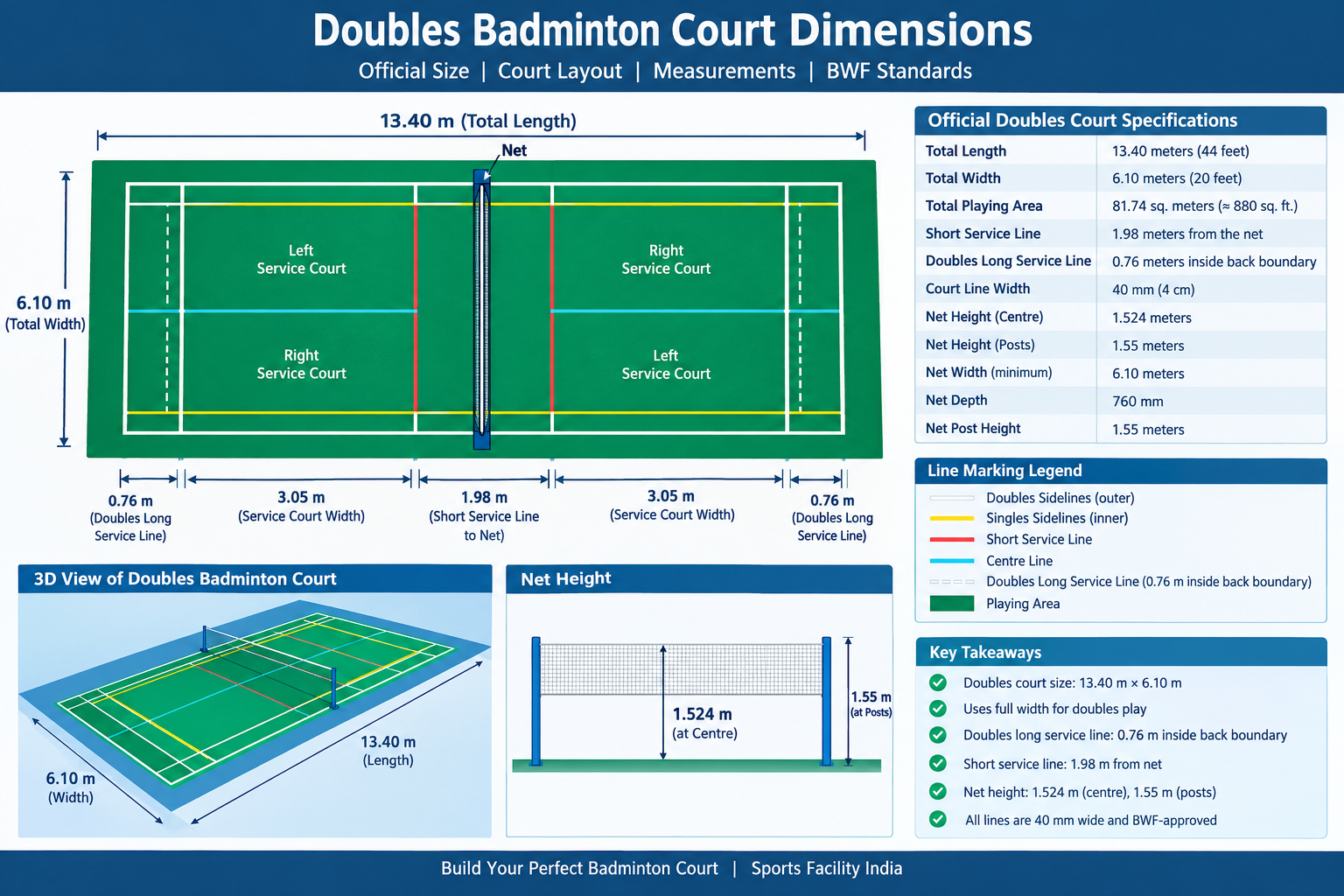
The official doubles badminton court is rectangular, with a total playing length of 13.40 metres and a width of 6.10 metres. Unlike singles matches, doubles games use the full court width, allowing two players on each side to cover a wider playing area.
The same outer court dimensions are used for both singles and doubles matches. However, the boundary lines and service areas differ depending on the playing format.
| Badminton Court Specification | Official Measurement |
|---|---|
| Total Court Length | 13.40 metres (44 feet) |
| Total Doubles Court Width | 6.10 metres (20 feet) |
| Total Playing Area | 81.74 square metres (approximately 880 sq. ft.) |
| Short Service Line Distance | 1.98 metres from the net |
| Doubles Long Service Line | 0.76 metres inside the back boundary |
| Court Line Width | 40 mm (4 cm) |
| Net Height at Centre | 1.524 metres |
| Net Height at Posts | 1.55 metres |
These measurements represent the regulation playing area. Additional space must be considered around the court for player movement, spectator access, maintenance, and safe installation.
Why Are Accurate Doubles Badminton Court Dimensions Important?
Accurate badminton court measurements are essential for maintaining consistent playing conditions. Even minor errors in court width, length, or service line positioning can affect gameplay and create problems during competitive matches.
Following the correct BWF doubles court dimensions provides several important benefits:
- Standardised playing conditions: Ensures that the court follows recognised badminton playing standards.
- Correct gameplay boundaries: Provides the required width and length for doubles matches.
- Accurate service areas: Maintains the correct positioning of short service lines, doubles long service lines, and centre lines.
- Better player movement: Supports coordinated movement between doubles partners during rallies.
- Improved playing experience: Creates consistent conditions for professional matches, coaching, training, and recreational badminton.
- Reliable court construction: Helps contractors plan flooring, markings, net installation, and surrounding clearance accurately.
Badminton Doubles Court Layout and Line Markings
A standard badminton doubles court contains several important boundary and service markings. Each line has a specific purpose in determining whether a shot or serve is inside or outside the permitted playing area.
1. Doubles Sidelines
The outer sidelines define the full playing width of the doubles court. The distance between these two sidelines is 6.10 metres. These lines are used during doubles rallies and services.
2. Back Boundary Lines
The back boundary lines mark the rear limits of the playing court. The distance between the two back boundary lines is 13.40 metres. During doubles rallies, these outer lines define the rear playing area.
3. Short Service Lines
The short service line is positioned 1.98 metres from the net on each side of the court. During service, the shuttle must travel beyond this line to land legally in the opponent's service court.
4. Doubles Long Service Lines
The doubles long service line is located 0.76 metres inside the back boundary line. This marking limits the rear boundary of the doubles service area.
5. Centre Lines
The centre line divides each side of the court into left and right service courts. It extends from the short service line towards the doubles long service line.
6. Singles Sidelines
Singles sidelines are positioned inside the doubles sidelines. They create a narrower playing area measuring 5.18 metres in width. Both singles and doubles markings can be provided on the same court.
All official badminton court lines are 40 mm wide and should be clearly distinguishable from the playing surface.
Doubles Badminton Service Court Dimensions
The doubles service area has a different shape from the regular playing area. It is wider and shorter, with its boundaries defined by the doubles sidelines, short service line, centre line, and doubles long service line.
The main measurements used to establish the doubles service area are:
- Service court width: 3.05 metres.
- Distance from net to short service line: 1.98 metres.
- Doubles long service line: 0.76 metres inside the back boundary.
- Service court division: Centre line separates the left and right service courts.
During doubles service, the shuttle must land within the diagonally opposite service court. The doubles long service line prevents the shuttle from landing too far towards the rear boundary.
Correct service area marking is particularly important when constructing professional badminton courts because inaccurate line positioning can affect service decisions and match fairness.
Standard Badminton Net Height and Specifications for Doubles
The badminton net separates the two playing sides and must be installed at the correct height to maintain regulation playing conditions. The net dimensions remain the same for singles and doubles matches.
| Net Specification | Standard Measurement |
|---|---|
| Net Height at Centre | 1.524 metres |
| Net Height at Posts | 1.55 metres |
| Minimum Net Width | 6.10 metres |
| Net Depth | 760 mm |
| Net Post Height | 1.55 metres |
The net posts are positioned on the doubles sidelines, irrespective of whether the court is being used for singles or doubles play. The net should be properly tensioned, with no gaps between its ends and the posts.
Singles vs Doubles Badminton Court Dimensions
One of the main differences between singles and doubles badminton is the playing width and service area. Both formats use the same overall court length, but doubles players use a wider playing area.
| Specification | Singles Court | Doubles Court |
|---|---|---|
| Total Length | 13.40 m | 13.40 m |
| Total Width | 5.18 m | 6.10 m |
| Playing Area | 69.41 sq. m | 81.74 sq. m |
| Side Boundaries | Inner sidelines | Outer sidelines |
| Long Service Boundary | Back boundary line | 0.76 m inside back boundary |
| Short Service Line | 1.98 m from net | 1.98 m from net |
| Net Height at Centre | 1.524 m | 1.524 m |
The main difference is that singles badminton uses the inner sidelines and the back boundary for its service length. Doubles badminton uses the outer sidelines and a separate long service line positioned 0.76 metres inside the back boundary.
How to Construct a Professional Doubles Badminton Court
Building a regulation badminton court requires more than measuring the playing area. Proper site preparation, flooring selection, drainage planning, line marking, and equipment installation are equally important for long-term performance.
1. Site Selection and Space Planning
Start by evaluating the available land or indoor facility. Consider the complete court dimensions along with additional clearance for player movement, walkways, spectators, and maintenance. Ceiling height and lighting arrangements should also be evaluated for indoor badminton facilities.
2. Foundation and Base Preparation
Prepare a stable, level foundation suitable for the selected badminton flooring system. The base should provide adequate structural support and prevent surface irregularities that could affect player movement.
3. Select Suitable Badminton Flooring
Choose a sports flooring system designed for badminton activities. Common options include synthetic PVC sports flooring and professionally finished wooden sports flooring. The selection should consider grip, shock absorption, durability, maintenance, and the intended level of play.
4. Accurate Court Line Marking
Mark the doubles sidelines, singles sidelines, back boundaries, short service lines, centre lines, and doubles long service lines according to the official measurements. Maintain the required 40 mm line width for clear visibility and accurate gameplay.
5. Net and Equipment Installation
Install suitable net posts on the doubles sidelines and maintain the standard net heights of 1.524 metres at the centre and 1.55 metres at the posts. Ensure that the net is properly tensioned and securely installed.
6. Lighting and Safety Arrangements
For indoor badminton courts, provide suitable lighting that minimises glare and uneven illumination. Also consider adequate ceiling clearance, ventilation, access routes, and unobstructed space around the playing area.
7. Final Inspection and Measurement
Before opening the facility, verify the court length, width, service markings, net height, flooring condition, and overall installation quality. A final inspection helps identify measurement errors and construction defects.
Best Flooring Options for Doubles Badminton Courts
Flooring plays an important role in badminton performance, particularly during fast rallies, sudden direction changes, jumping, and landing. The selected surface should provide suitable traction, comfort, and consistent playing conditions.
Synthetic PVC Badminton Flooring
PVC sports flooring is widely used in indoor badminton facilities. It offers a specialised playing surface designed for grip, player comfort, and consistent performance. It is suitable for academies, schools, clubs, and sports complexes.
Wooden Badminton Flooring
Wooden sports flooring is another option for professional indoor badminton facilities. A properly engineered sports floor can provide suitable shock absorption and playing characteristics when installed and maintained correctly.
Synthetic Sports Surfaces
Certain synthetic sports flooring systems can also be used for badminton, depending on their technical specifications and suitability for the intended level of play. The surface should provide consistent grip and safe player movement.
The best flooring option depends on the facility type, construction budget, expected usage, and maintenance requirements.
How Much Total Space Is Required for a Doubles Badminton Court?
The official doubles badminton playing area measures 13.40 metres × 6.10 metres, giving a total area of approximately 81.74 square metres.
However, the actual facility should provide additional space outside the court boundaries. This clearance allows players to move safely, retrieve shots, and avoid obstacles during fast-paced rallies.
The required surrounding clearance and ceiling height depend on the facility layout, intended playing level, applicable competition requirements, and available space. Professional tournament venues may require more extensive clearance than recreational or training facilities.
Therefore, it is advisable to finalise the complete site layout before starting foundation work or installing badminton flooring.
Frequently Asked Questions About Doubles Badminton Court Dimensions
1. What are the official doubles badminton court dimensions?
The official doubles badminton court measures 13.40 metres in length and 6.10 metres in width, according to BWF court specifications.
2. What is the doubles badminton court size in feet?
A standard doubles badminton court measures approximately 44 feet in length and 20 feet in width.
3. What is the total area of a doubles badminton court?
The total playing area is approximately 81.74 square metres, equivalent to around 880 square feet.
4. What is the official badminton net height for doubles?
The net measures 1.524 metres at the centre and 1.55 metres at the posts. These heights apply to both singles and doubles matches.
5. Where is the doubles long service line located?
The doubles long service line is positioned 0.76 metres inside the back boundary line. It determines the rear limit of the doubles service court.
6. What is the distance of the short service line from the net?
The short service line is positioned 1.98 metres from the net on each side of the badminton court.
7. What is the difference between singles and doubles badminton court sizes?
Both formats use a court length of 13.40 metres. However, singles uses a width of 5.18 metres, while doubles uses the full width of 6.10 metres.
8. What is the standard badminton court line width?
According to BWF court specifications, all standard badminton court lines must be 40 mm wide.
9. Which flooring is best for a professional doubles badminton court?
Synthetic PVC sports flooring and professionally engineered wooden sports flooring are common options for indoor badminton facilities. The final selection should depend on performance requirements, budget, durability, and maintenance.
10. Do you provide professional doubles badminton court construction?
Yes. Sports Facility India provides badminton court construction solutions, including site planning, measurement, flooring installation, line marking, and sports equipment installation for suitable indoor and outdoor projects.
Looking for Professional Doubles Badminton Court Construction?
Planning a badminton court for a school, sports academy, residential complex, club, or professional sports facility? Sports Facility India provides complete badminton court construction solutions with accurate measurements, quality sports flooring, professional line marking, and suitable equipment installation.
Our team can help you plan a badminton facility that meets your space requirements and intended playing standards. From initial site evaluation to final installation, we focus on quality, functionality, and long-term usability.
Visit Sports Facility India to explore our sports infrastructure solutions.
Request a Free Quote