
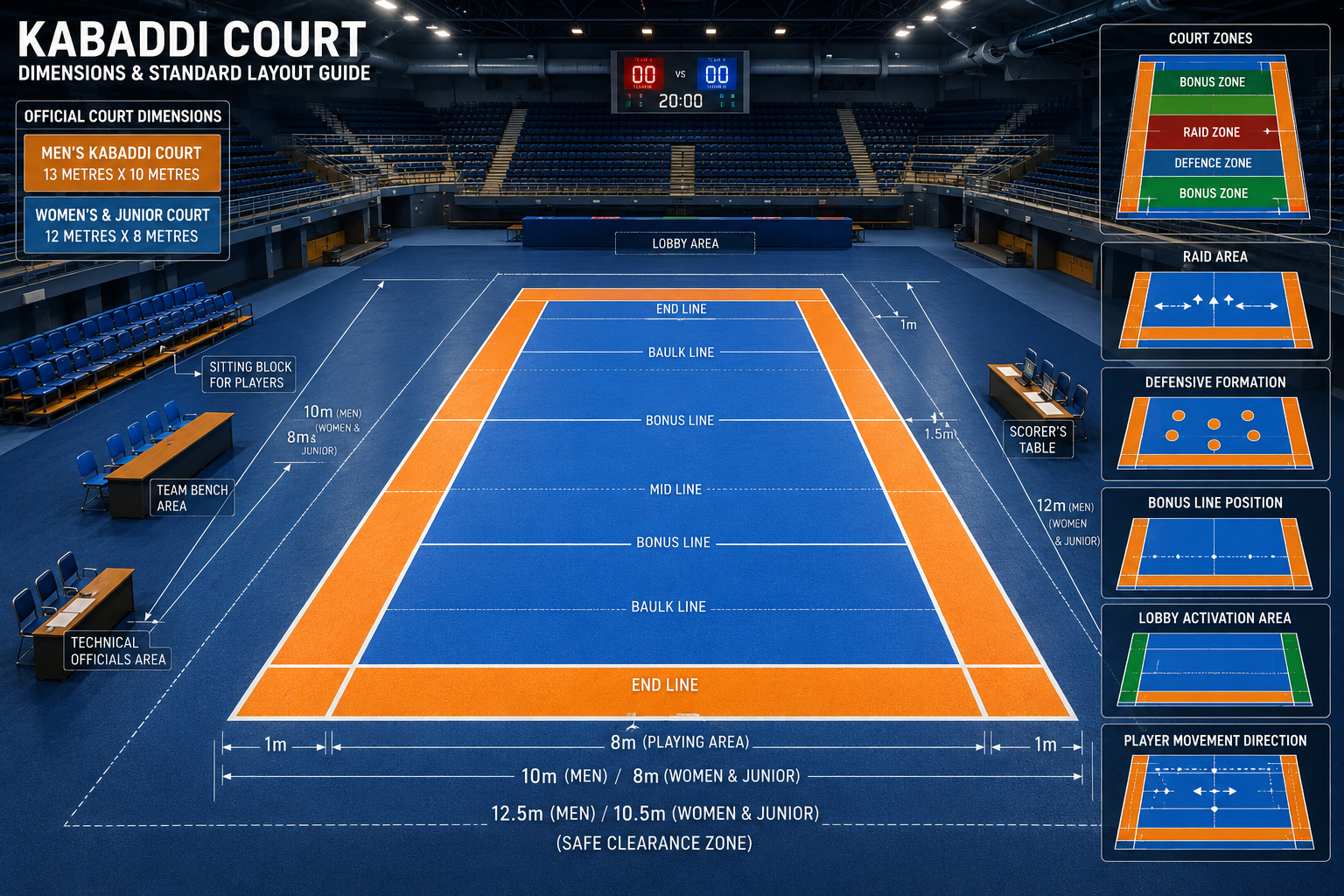
Standard Kabaddi Court Dimensions
Kabaddi court dimensions vary according to the competition category. The commonly used standard playing-area measurements for senior men and senior women are different. The court should be measured carefully before construction and marking to ensure that the playing area follows the applicable competition regulations.
| Kabaddi Court Category | Length | Width | Playing Area |
|---|---|---|---|
| Senior Men | 13 metres | 10 metres | 130 sq. metres |
| Senior Women | 12 metres | 8 metres | 96 sq. metres |
| Junior Boys | As per applicable rules | As per applicable rules | Category-specific |
| Junior Girls | As per applicable rules | As per applicable rules | Category-specific |
Note: Junior, youth and other competition categories may have different playing-area requirements. Always confirm the latest regulations of the relevant Kabaddi federation or tournament authority before finalizing court construction.
Men's Kabaddi Court Size and Measurements
The commonly used standard playing area for a senior men's Kabaddi court measures 13 metres in length and 10 metres in width. The rectangular playing area is divided into two equal halves by the centre line, with each team defending one half of the court.
The internal court layout includes baulk lines, bonus lines where applicable, end lines, boundaries and lobby areas. Each marking has a specific role in gameplay and should be positioned according to the applicable rules.
- Length: 13 metres
- Width: 10 metres
- Total playing area: 130 square metres
- Shape: Rectangular
- Division: Two equal halves
Women's Kabaddi Court Size and Measurements
The commonly used playing-area dimensions for a senior women's Kabaddi court are 12 metres in length and 8 metres in width. As with the men's court, the playing area is divided into two halves by the centre line.
Accurate measurements are important when preparing the base, installing the playing surface and marking the court. The internal lines should be established according to the competition category and applicable Kabaddi rules.
- Length: 12 metres
- Width: 8 metres
- Total playing area: 96 square metres
- Shape: Rectangular
- Division: Two equal halves
Kabaddi Court Layout and Important Markings
A proper Kabaddi court layout includes several internal markings that define the playing zones and help regulate gameplay. These markings must be measured from the correct reference points and should remain clearly visible throughout the court's use.
1. Centre Line
The centre line divides the rectangular Kabaddi court into two equal halves. It separates the playing areas of the two teams and serves as an important reference point during raids and defensive play.
2. Baulk Lines
Baulk lines are transverse markings located within each half of the court. They play an important role in raid-related rules and should be positioned according to the applicable competition specifications.
3. Bonus Lines
Bonus lines are marked in relation to the baulk lines. They define the bonus area used under applicable Kabaddi playing rules. Their position and use should follow the relevant competition regulations.
4. End Lines
End lines mark the two shorter ends of the rectangular playing area. They establish the limits of the court along its length.
5. Boundary Lines
Boundary lines define the outer limits of the playing area. Clear and accurate boundary markings are essential for identifying the court limits during matches and training.
6. Lobby Areas
Lobby areas are marked along the sides of the court. Their relationship with the main playing area is important during gameplay and should be marked according to the applicable rules.
Different Types of Kabaddi Courts
Kabaddi courts can be developed using different surface systems depending on the playing environment, competition requirements, facility type and available budget. The main types include traditional outdoor courts, synthetic courts, mat-based courts and indoor sports facilities.
1. Traditional Soil Kabaddi Court
Traditional Kabaddi is often played on prepared soil or mud surfaces. These courts are suitable for community sports grounds, schools, recreational facilities and selected outdoor competitions. Proper ground preparation, compaction, levelling and regular maintenance are important for maintaining suitable playing conditions.
2. Synthetic Kabaddi Court
Synthetic surfaces can provide a more consistent playing environment for training centres, sports academies and institutional facilities. The selected system should be evaluated for grip, cushioning, durability and suitability for Kabaddi activities.
3. Kabaddi Mat Court
Dedicated Kabaddi mats are commonly used in organized indoor training and competition environments. Mat systems are designed to provide a consistent playing surface and cushioning when the correct product is selected and installed according to its specifications.
4. Indoor Kabaddi Court
Indoor Kabaddi courts are constructed inside sports halls, school buildings, colleges and multipurpose sports facilities. Their planning should consider the playing surface, lighting, ventilation, ceiling clearance, safety space and supporting facilities.
Kabaddi Court Flooring Options
Selecting the right flooring is an important part of Kabaddi court construction. The surface should be suitable for the intended level of play and provide appropriate traction, cushioning and stability. Flooring selection depends on indoor or outdoor installation, frequency of use, maintenance requirements and project budget.
| Flooring Type | Typical Application | Key Considerations |
|---|---|---|
| Kabaddi Mat | Indoor training and competitions | Cushioning, grip, stability and maintenance |
| PVC Sports Flooring | Indoor sports halls | Resilience, traction and cleaning requirements |
| PU Sports Flooring | Suitable indoor sports facilities | Surface finish, durability and system specifications |
| Synthetic Flooring | Training and recreational facilities | Consistency, grip and intended application |
| Prepared Soil or Mud | Traditional outdoor Kabaddi | Ground preparation, levelling and drainage |
Indoor vs Outdoor Kabaddi Court Dimensions and Planning
The playing-area dimensions should follow the applicable competition category regardless of whether the Kabaddi court is indoors or outdoors. However, the overall facility requirements can differ depending on the installation environment.
| Feature | Indoor Kabaddi Court | Outdoor Kabaddi Court |
|---|---|---|
| Weather Exposure | Protected from direct outdoor weather | Exposed to weather conditions |
| Flooring | Kabaddi mats, PVC, PU or suitable indoor systems | Prepared soil or suitable outdoor surfaces |
| Drainage | Building and floor-system requirements | Important for rainwater management |
| Lighting | Indoor lighting system required | Natural or suitable artificial lighting |
| Maintenance | Flooring and indoor facility maintenance | Surface, drainage and weather-related maintenance |
How Much Space Is Required for a Kabaddi Court?
The official playing-area dimensions are not the same as the total land requirement for a complete Kabaddi facility. Additional space should be planned around the court for player safety, movement, team benches, officials, spectators and access.
When planning a new Kabaddi court, consider the following supporting areas:
- Safety clearance around the playing area.
- Player entry and exit access.
- Team benches and substitute seating.
- Officials' and support staff areas.
- Spectator seating, where required.
- Lighting and equipment zones.
- Drainage and surrounding infrastructure for outdoor facilities.
The final site size should be determined by the playing category, event requirements, facility design and applicable safety guidelines.
Kabaddi Court Measurement and Construction Process
Accurate measurement is the foundation of a properly constructed Kabaddi court. The construction process should follow a planned sequence to ensure that the playing area, flooring and markings are completed according to the project requirements.
- Site Inspection: Assess the available land, ground conditions, access and drainage requirements.
- Dimension Planning: Finalize the court length and width according to the applicable competition category.
- Layout Preparation: Establish the centre line, baulk lines, bonus lines, end lines and other required markings.
- Ground Preparation: Carry out levelling, excavation and compaction according to the selected surface system.
- Base Construction: Prepare the required foundation or sub-base for the selected flooring.
- Flooring Installation: Install the selected Kabaddi mat, synthetic flooring or prepared soil surface.
- Final Court Marking: Measure and apply the required playing lines accurately.
- Quality Inspection: Check court dimensions, surface condition, marking visibility and overall finish.
Important Factors to Consider When Measuring a Kabaddi Court
Before starting court construction, several technical and practical factors should be considered to avoid layout errors and future modifications.
- Competition category and applicable Kabaddi rules.
- Correct length and width of the playing area.
- Accurate positioning of all internal court markings.
- Safety clearance around the playing area.
- Indoor or outdoor installation conditions.
- Suitable sports flooring and base specifications.
- Ground levelling and drainage requirements.
- Lighting and visibility for players and officials.
- Player seating and spectator arrangements.
- Maintenance and future resurfacing requirements.
Why Accurate Kabaddi Court Dimensions Matter
Correct Kabaddi court measurements help create a consistent and properly defined playing environment. Accurate dimensions and internal markings are important for training, competition planning and the overall usability of the sports facility.
- Defines the correct playing area for each team.
- Supports accurate positioning of court markings.
- Helps maintain consistency between training and competition courts.
- Provides a structured playing environment.
- Supports tournament and institutional sports planning.
- Helps allocate suitable safety clearance.
- Reduces measurement and construction errors.
- Improves the overall functionality of the sports facility.
Kabaddi Court Construction Cost
The cost of constructing a Kabaddi court depends on the playing-area size, selected flooring, site condition and additional facility requirements. A traditional soil court may involve different construction work from a fully equipped indoor court with a dedicated mat or synthetic sports flooring.
| Cost Factor | Project Consideration |
|---|---|
| Court Dimensions | Determines the main playing-area material requirement. |
| Ground Preparation | Excavation, levelling and compaction may affect the budget. |
| Flooring Material | Mat, PVC, PU, synthetic and soil surfaces have different specifications. |
| Drainage | Outdoor projects may require dedicated water-management arrangements. |
| Court Marking | Measurement and finishing work are included in the project scope. |
| Additional Facilities | Lighting, fencing, seating and roofing can increase the overall project cost. |
For an accurate quotation, the site area, court category, flooring preference and construction requirements should be assessed before finalizing the project budget.
Kabaddi Court Maintenance Guidelines
Regular maintenance helps preserve the condition and usability of a Kabaddi court. The maintenance requirements depend on the installed flooring system, usage frequency and indoor or outdoor environment.
- Keep the court free from dust, mud and unwanted debris.
- Inspect the surface for uneven areas or visible damage.
- Check court markings regularly for fading or wear.
- Maintain drainage channels around outdoor courts.
- Clean indoor flooring using recommended maintenance methods.
- Repair damaged surfaces when necessary.
- Follow the flooring manufacturer's maintenance instructions.
Kabaddi Court Construction and Flooring Solutions by Sports-Facility
Sports-Facility provides sports court construction and flooring solutions for educational institutions, sports academies, clubs, stadiums, residential communities and recreational facilities across India.
Our project solutions can include Kabaddi court measurement, layout planning, ground preparation, flooring selection, sports surface installation and court marking. The construction approach is planned according to the playing category, site conditions, intended usage and project specifications.
Whether you are developing a traditional outdoor Kabaddi ground or an indoor sports facility, proper measurement and surface selection are important for creating a functional playing environment.
Explore our sports flooring and court construction services for more information about sports infrastructure solutions.
Frequently Asked Questions About Kabaddi Court Dimensions
1. What are the standard Kabaddi court dimensions?
The commonly used senior men's Kabaddi court measures 13 metres × 10 metres, while the senior women's court measures 12 metres × 8 metres. Other categories may have different dimensions according to competition regulations.
2. What is the length and width of a men's Kabaddi court?
The commonly used senior men's Kabaddi court is 13 metres long and 10 metres wide, providing a playing area of 130 square metres.
3. What is the size of a women's Kabaddi court?
The commonly used senior women's Kabaddi court measures 12 metres in length and 8 metres in width, providing a playing area of 96 square metres.
4. What is the total area of a standard men's Kabaddi court?
A standard senior men's playing area measures 13 metres × 10 metres, which equals 130 square metres.
5. What are the main markings on a Kabaddi court?
Important markings include the centre line, baulk lines, bonus lines where applicable, end lines, boundary lines and lobby areas. Their positioning should follow the applicable competition rules.
6. How much additional space is required around a Kabaddi court?
Additional space is required for player safety, movement, team benches, officials, access and spectators. The total site requirement depends on the facility design and event requirements.
7. Which flooring is suitable for a Kabaddi court?
Suitable options may include dedicated Kabaddi mats, PVC or PU sports flooring, synthetic surfaces and prepared soil. The choice depends on the indoor or outdoor environment and intended level of play.
8. Can Kabaddi courts be constructed indoors and outdoors?
Yes. Kabaddi courts can be developed in indoor sports halls and outdoor playgrounds. Flooring, drainage, lighting and surrounding facilities should be planned according to the installation environment.
9. What is the cost of constructing a Kabaddi court?
Construction cost depends on court dimensions, flooring material, ground preparation, foundation work, drainage and additional facilities. A site assessment is recommended for an accurate estimate.
10. Why are accurate Kabaddi court measurements important?
Accurate measurements help establish the correct playing area, position internal markings, maintain consistency with competition requirements and reduce construction errors.
11. Can an existing Kabaddi court be renovated?
Yes. Existing courts can be assessed for surface condition, dimensions, drainage and markings. Renovation may include repairs, resurfacing, new flooring or complete reconstruction depending on the site condition.
12. Who provides Kabaddi court construction and flooring solutions in India?
Sports-Facility provides sports court construction and flooring solutions for schools, colleges, sports academies, clubs and other facilities. Contact the team to discuss your Kabaddi court project requirements.
Plan Your Kabaddi Court with the Correct Dimensions
Planning the correct Kabaddi court size and measurements is an important step in developing a reliable sports facility. From the overall playing area and internal markings to flooring, ground preparation and safety clearance, every component should be considered during the design and construction process.
Sports-Facility offers Kabaddi court construction, measurement, layout planning and flooring solutions for schools, colleges, sports academies, clubs and sports complexes across India. Get in touch with our team to discuss your project requirements and plan a suitable Kabaddi playing area.