
What Is a Professional Box Cricket Layout?
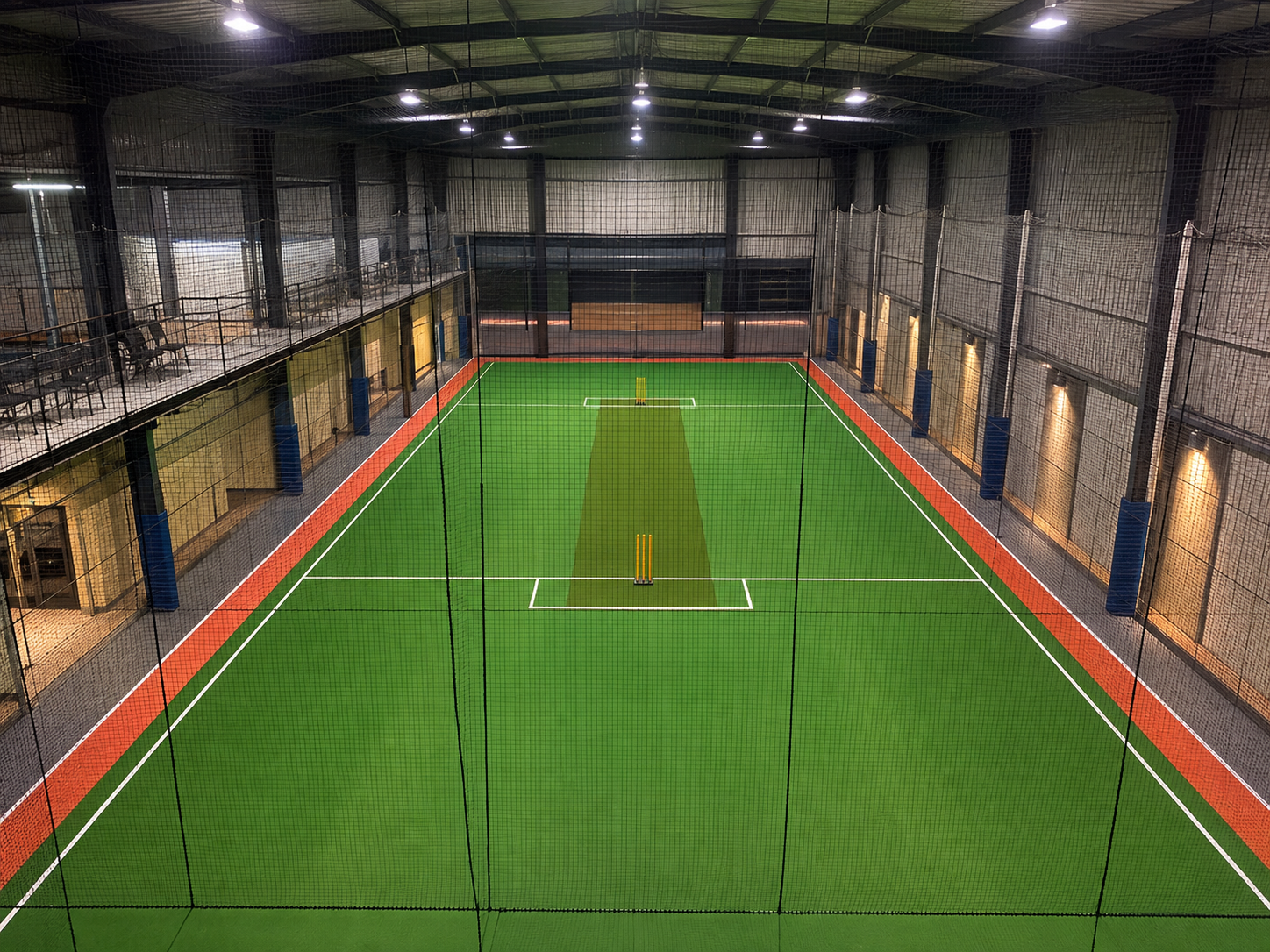
A box cricket layout is the planned arrangement of the playing court, pitch, wickets, protective netting and surrounding safety areas within an enclosed or semi-enclosed sports facility. Unlike a conventional open cricket ground, box cricket uses a compact playing environment where boundaries are generally defined by nets, walls or protective structures.
A professional layout focuses on efficient space utilization while maintaining appropriate player movement, visibility and safety. The position of the pitch, wickets, entry points, netting and other facility components should be considered before construction begins.
Why Professional Box Cricket Layout Planning Is Important
Proper planning is an important part of creating a functional box cricket facility. A poorly arranged court can restrict player movement, create unnecessary obstructions or make maintenance more difficult.
A carefully developed box cricket court layout helps organize the playing area and supporting zones while making better use of the available floor space.
- Efficient utilization of available space
- Clearly defined playing and pitch areas
- Better player movement and circulation
- Suitable placement of protective netting
- Improved safety around boundaries and corners
- Convenient access and maintenance
- Better positioning of lighting fixtures
- Professional appearance of the facility
- Suitable planning for regular commercial usage
Typical Professional Box Cricket Layout
The exact dimensions of a box cricket facility can vary according to the available site and the operating requirements of the venue. A typical compact layout may include a rectangular playing zone, central pitch, wicket areas, protective side and overhead netting, entry access and safety clearance.
Playing Area
The main rectangular zone provides the space required for batting, bowling, fielding and player movement.
Pitch Area
The pitch is positioned within the playing zone and can be developed using a suitable cricket surface according to the facility design.
Wicket Zones
Dedicated wicket areas should be positioned accurately and designed to withstand repeated ball impact and player movement.
Safety Zones
Adequate clearance should be considered around the playing area, entrances, corners and other potential contact points.
Professional Box Cricket Court Dimensions
There is no single universal box cricket court size for every recreational or commercial facility. The dimensions should be determined according to the available site, number of players, playing format and facility design.
For compact indoor facilities, the following dimensions may be used as a planning reference, subject to site-specific design:
| Layout Element | Indicative Dimension / Requirement | Planning Consideration |
|---|---|---|
| Overall Court Length | Approximately 12–16 metres | Depends on facility size and playing format |
| Overall Court Width | Approximately 6–8 metres | Should allow comfortable player movement |
| Pitch Area | Approximately 6 m × 0.9 m | Can vary according to the selected playing system |
| Boundary Protection | Protective netting / enclosure | Designed according to court and facility requirements |
| Safety Clearance | Site-specific | Should be planned around entrances, walls and corners |
These figures are indicative planning values rather than a universal competition standard. The final box cricket layout should be developed after measuring the actual site and confirming the intended playing format.
Box Cricket Layout Diagram
A basic layout can visually divide the facility into the main playing court, pitch, wicket areas, boundary netting and surrounding safety zones. The following conceptual diagram illustrates the arrangement; actual dimensions should be adapted to the project site.
Illustrative box cricket court layout — proportions are indicative.
Pitch Planning in a Box Cricket Layout
The pitch is one of the most important components of an indoor box cricket court. It should be positioned centrally and aligned with the wicket zones so that players have adequate space for batting and bowling.
Depending on the project requirements, the pitch can use a suitable synthetic cricket surface designed for regular practice and recreational play. The pitch base should be stable, level and properly integrated with the surrounding sports flooring.
- Accurate pitch positioning
- Level and stable base preparation
- Suitable cricket surface
- Clear wicket positioning
- Consistent playing conditions
- Proper transition between pitch and surrounding floor
Protective Netting and Enclosure Layout
Protective netting is a defining feature of most box cricket facilities. It helps contain cricket balls within the playing environment and separates the playing area from surrounding spaces.
Side netting, rear netting and overhead protection can be incorporated depending on the facility design. Netting support structures should be planned carefully so they do not unnecessarily interfere with player movement or the playing area.
- Side boundary netting
- Rear protective netting
- Overhead netting where required
- Secure support structures
- Safe entry and exit arrangements
- Proper tension and installation
Flooring for Professional Box Cricket Courts
Flooring selection should be based on the type of box cricket facility, expected traffic, player movement and maintenance requirements. A professional sports surface should provide suitable traction and a consistent playing environment.
PU Sports Flooring
PU systems can provide a seamless sports surface and may be considered for indoor facilities requiring a clean, professional finish.
EPDM Sports Flooring
EPDM-based surfaces may be used in selected sports applications where resilience, comfort and impact management are important considerations.
PVC Sports Flooring
PVC sports flooring can be considered for indoor multi-purpose facilities where a resilient and easy-to-maintain surface is required.
Artificial Cricket Turf
Synthetic cricket turf can be incorporated into the pitch or selected playing zones to create a dedicated cricket playing surface.
Lighting Layout for Indoor Box Cricket
Lighting plays an important role in an indoor cricket facility because players need clear visibility of the ball during batting, bowling and fielding. Lighting should be planned to provide consistent illumination while reducing glare and distracting shadows.
- Uniform illumination across the playing area
- Low-glare sports lighting
- Appropriate fixture positioning
- Reduced shadows where practical
- Suitable lighting around the pitch
- Efficient LED sports lighting options
Final lighting specifications should be selected according to the building design, ceiling height, playing level and applicable facility requirements.
Ceiling Height and Indoor Box Cricket Planning
Ceiling clearance should be considered carefully when designing an indoor box cricket facility. Players require sufficient overhead space for normal ball flight and movement.
The required clearance depends on the playing format, facility dimensions, lighting system, netting arrangement and building structure. Lighting, ducts, beams and other overhead services should be coordinated during the design stage.
Safety Considerations in Box Cricket Court Layout
Player safety should be incorporated into the layout from the beginning rather than added after construction. The design should identify areas where players may come into contact with walls, posts, netting supports or other structures.
- Provide suitable clearance around the playing zone.
- Use appropriate protective padding where required.
- Secure netting and structural supports properly.
- Avoid unnecessary obstacles around the court.
- Use suitable anti-slip sports surfaces.
- Keep entrances and circulation areas clearly defined.
- Inspect flooring and enclosure components regularly.
Professional Box Cricket Layout and Construction Process
- Site Measurement: Measure the available length, width and height and identify existing structural elements.
- Requirement Assessment: Determine the playing format, expected users, number of players, flooring requirements and supporting facilities.
- Layout Design: Position the court, pitch, wickets, entrances, safety zones and netting.
- Base Preparation: Prepare and level the existing floor or construct the required base according to the selected flooring system.
- Flooring Installation: Install the selected sports flooring and dedicated cricket pitch surface.
- Netting Structure: Install side, rear and overhead netting with suitable support structures.
- Lighting Installation: Complete sports lighting and electrical work according to the facility design.
- Marking and Equipment: Complete pitch markings, wicket positioning and required sports equipment.
- Final Inspection: Check flooring, markings, netting, lighting, access and overall safety before opening the facility.
Where Professional Box Cricket Layouts Can Be Used
A professionally planned box cricket court can be developed in a wide range of recreational and commercial environments.
- Indoor box cricket arenas
- Cricket academies
- Sports clubs
- Schools and colleges
- Universities
- Gyms and fitness centres
- Residential societies
- Hotels and resorts
- Corporate recreation facilities
- Multi-purpose sports centres
- Commercial sports complexes
- Community recreation centres
Custom Box Cricket Court Layout Design
Every site has different dimensions and structural conditions. A custom box cricket court layout can therefore be developed according to the available space and project objectives.
Custom planning may include court dimensions, pitch placement, netting height, flooring selection, lighting arrangement, player entry points, spectator areas, equipment storage and supporting amenities.
For commercial facilities, the layout can also be planned to support efficient player circulation and convenient access for maintenance and facility operations.
Indoor vs Outdoor Box Cricket Layout
| Feature | Indoor Box Cricket | Outdoor / Semi-Outdoor Box Cricket |
|---|---|---|
| Weather Exposure | Minimal | Higher |
| Lighting | Integrated indoor lighting | Natural and/or sports lighting |
| Drainage | Building drainage considerations | Important for rainwater management |
| Netting | Side and overhead enclosure as required | Weather-resistant enclosure recommended |
| Flooring | Indoor sports flooring options | Outdoor-rated sports surfaces |
Maintenance of a Professional Box Cricket Court
Regular maintenance helps preserve the performance, appearance and usability of the box cricket facility.
- Clean the sports flooring regularly.
- Remove dust and debris from the playing area.
- Inspect the pitch surface for wear.
- Check netting for damage or loose sections.
- Inspect structural supports periodically.
- Check lighting fixtures and electrical systems.
- Inspect wicket areas and sports equipment.
- Repair damaged components promptly.
Frequently Asked Questions About Professional Box Cricket Layout
Q1. What is a professional box cricket layout?
A professional box cricket layout is a planned arrangement of the playing area, pitch, wickets, protective netting, safety zones, entrances, flooring and other supporting elements within an enclosed or semi-enclosed facility.
Q2. What is the ideal size of a box cricket court?
Box cricket dimensions vary according to the playing format and available site. A compact indoor facility may use approximately 12–16 metres in length and 6–8 metres in width, but the final dimensions should be determined through site-specific planning.
Q3. What flooring is suitable for box cricket?
Flooring depends on the facility design and intended usage. PU, PVC, EPDM-based sports surfaces and synthetic cricket turf can be considered for different areas of a box cricket facility.
Q4. Is protective netting required for box cricket?
Protective netting is commonly used to enclose the playing area and help contain the ball. Side, rear and overhead netting can be selected according to the facility layout.
Q5. Can a box cricket court be constructed inside an existing hall?
Yes. An existing hall can potentially be converted into a box cricket facility after checking its floor area, ceiling clearance, structural conditions, access, lighting and other requirements.
Q6. Can the box cricket layout be customized?
Yes. Court dimensions, pitch placement, flooring, netting, lighting, entrances, safety areas and supporting facilities can be planned according to the available space and intended use.
Q7. What should be considered when planning an indoor box cricket court?
Important considerations include available floor area, ceiling clearance, pitch position, player movement, protective netting, flooring, lighting, access and safety zones.
Q8. Do box cricket courts require special lighting?
Indoor facilities require suitable sports lighting that provides adequate visibility while minimizing glare and distracting shadows. The final lighting arrangement depends on the building and facility design.
Q9. Do you provide complete box cricket layout and construction services?
Professional services can include site assessment, layout planning, civil and flooring work, pitch development, netting, lighting, court finishing and installation of relevant sports equipment.
Plan Your Professional Box Cricket Layout
Looking to develop an indoor box cricket arena, training facility or commercial sports centre? Sports Facility India provides complete sports facility solutions covering layout planning, flooring, pitch development, protective netting, lighting and installation.
Share your available space and project requirements to develop a box cricket layout designed around your facility.
Request a Free Quote