
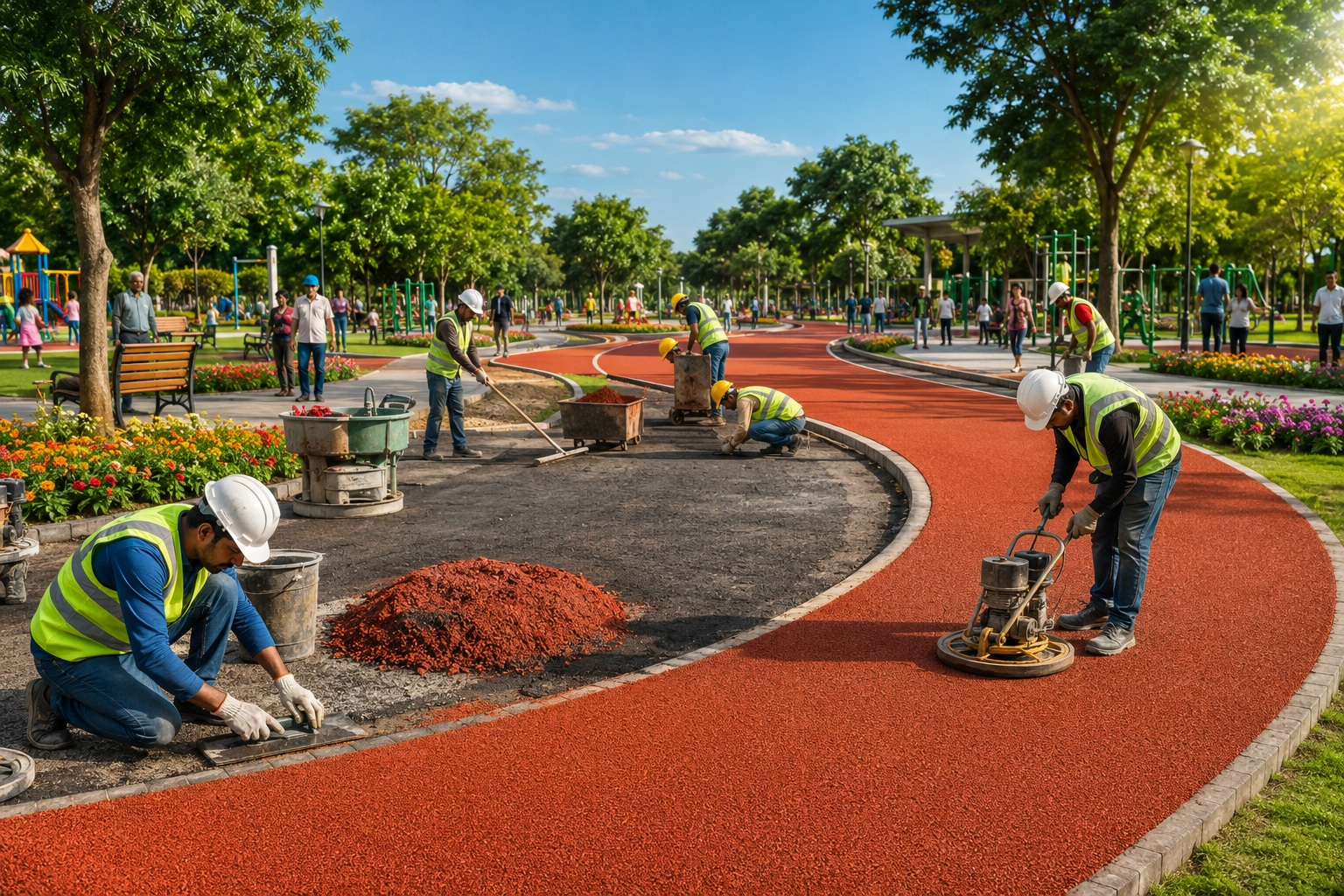
Professional Rubber Jogging Track Installation Services
Rubber Jogging Track Installation is an effective flooring solution for developing comfortable, durable and visually appealing walking and running pathways in parks, schools, residential societies, sports complexes, fitness centres and recreational spaces. These specialized rubber surfaces are designed to support regular pedestrian activities while providing a resilient and textured finish suitable for outdoor environments.
Sports-Facility offers professional rubber jogging track construction and installation services across India. Our solutions include EPDM rubber flooring, SBR cushion systems, polyurethane-bound surfaces, foundation preparation, drainage planning, track layout development and customized finishing. Each project is planned according to site conditions, available space, intended usage, technical specifications and budget.
A professionally installed jogging track can enhance the functionality of recreational infrastructure by creating a dedicated space for morning walks, jogging, fitness routines, endurance exercises and everyday outdoor activities. Different colours, track patterns, borders and distance markings can also be incorporated to complement the surrounding landscape and project design.
What Is Rubber Jogging Track Installation?
Rubber jogging track installation is the process of constructing a dedicated walking or running pathway using engineered rubber surfacing materials over a properly prepared foundation. The flooring system generally combines rubber granules, polyurethane binder and a suitable base structure to create a continuous, resilient and textured surface.
A common construction method uses an SBR rubber cushion layer beneath an EPDM wearing surface. SBR provides the resilient base layer, while coloured EPDM granules create the finished surface. The layers are bonded using compatible polyurethane binders to form an integrated flooring system.
Depending on the project, jogging tracks may also be developed using other suitable rubber surfacing configurations. The final system is selected after considering the substrate, drainage, environmental exposure, expected pedestrian traffic, required thickness and project performance specifications.
Why Is Rubber Jogging Track Flooring Important?
Walking and jogging pathways are important components of modern recreational and fitness infrastructure. A suitable flooring system helps provide a clearly defined activity area while improving the overall usability and appearance of parks, campuses, residential developments and sports facilities.
Rubber jogging track flooring offers a resilient alternative to conventional hard pathways. Its textured surface, customizable appearance and layered construction make it suitable for many recreational applications. Correct foundation preparation and drainage design are equally important for achieving dependable long-term performance.
- Creates a dedicated surface for walking, jogging and recreational running.
- Provides a resilient and comfortable walking surface.
- Offers a textured finish for surface grip.
- Supports regular pedestrian movement.
- Available in different colours and design combinations.
- Suitable for a variety of indoor and outdoor applications.
- Can be integrated into landscaped recreational environments.
- Requires manageable routine cleaning and maintenance.
Key Features of EPDM Rubber Jogging Track Flooring
EPDM jogging track flooring combines rubber granules and polyurethane binder to create an attractive and functional wearing surface. The characteristics of the completed flooring depend on the material specifications, installation process, base preparation and selected system design.
- EPDM rubber wearing surface
- Optional SBR rubber cushion layer
- Textured and resilient finish
- UV-stable colour options
- Outdoor weather suitability
- Custom colour combinations
- Polyurethane-bound construction
- Continuous surface appearance
- Project-specific thickness options
- Decorative borders and patterns
- Distance and directional markings
- Professional edge finishing
Benefits of Rubber Jogging Track Installation
Installing a suitable rubber jogging track can improve the functionality and appearance of recreational areas. The combination of appropriate rubber materials, correct surface preparation and professional installation helps create a practical pathway for everyday fitness activities.
| Benefit | Description |
|---|---|
| Surface Comfort | Provides a resilient surface for walking and jogging activities. |
| Surface Grip | Textured rubber finishes can provide traction during regular movement. |
| Durability | Suitable material selection and correct installation support regular recreational use. |
| Outdoor Performance | Appropriately specified EPDM materials can be used in outdoor environments. |
| Visual Appearance | Different colours, patterns and borders can enhance landscape design. |
| Design Flexibility | Track layouts can be customized to suit available space and project requirements. |
| Maintenance | Routine cleaning and drainage maintenance help preserve the flooring. |
Types of Rubber Jogging Track Flooring Systems
Different rubber jogging track systems are available depending on the project location, surface requirements, construction method and budget. The most suitable configuration should be selected after evaluating the site and intended application.
1. EPDM Rubber Jogging Track
EPDM (Ethylene Propylene Diene Monomer) rubber is commonly used as the visible wearing layer of jogging tracks. EPDM granules are mixed with a suitable polyurethane binder and applied over the prepared surface to create a continuous, textured and decorative finish.
EPDM is available in multiple colours, making it suitable for public parks, school campuses, residential pathways, fitness areas and landscaped recreational spaces.
2. SBR Rubber Cushion Jogging Track
SBR (Styrene Butadiene Rubber) granules are frequently used to construct the resilient base layer beneath an EPDM wearing surface. The granules are combined with polyurethane binder and installed to the specified thickness.
The SBR layer forms part of a multi-layer rubber flooring system and is selected according to the required cushioning characteristics and project specifications.
3. Sandwich Rubber Jogging Track System
A sandwich rubber jogging track uses multiple construction layers to create an integrated sports and recreational surface. A typical configuration includes a prepared base, SBR rubber cushion layer and EPDM wearing surface.
The layer composition, thickness and binder requirements are determined according to the application and technical specifications.
4. Poured-in-Place Rubber Jogging Track
Poured-in-place rubber flooring is installed directly over a suitably prepared substrate. Rubber granules and polyurethane binder are mixed and applied on-site to form a continuous surface.
This installation method allows different colours, decorative borders, curves and design combinations to be incorporated into the track layout.
Rubber Jogging Track Construction Layers
The performance of a rubber jogging track depends on the quality of its foundation and the compatibility of the flooring layers. A typical outdoor project may include the following construction components. The exact arrangement can vary depending on the existing ground and engineering design.
| Construction Layer | Purpose |
|---|---|
| Prepared Subgrade | Provides the underlying ground foundation. |
| Compacted Granular Sub-base | Provides support and helps distribute loads. |
| Concrete or Asphalt Base | Creates a stable and suitable platform for rubber surfacing. |
| Compatible Primer | Promotes adhesion where required by the flooring system. |
| SBR Rubber Cushion Layer | Forms the resilient base layer in a multi-layer system. |
| EPDM Wearing Layer | Provides the finished textured and coloured surface. |
| Edge and Marking Finish | Completes the track detailing and visual appearance. |
Step-by-Step Rubber Jogging Track Installation Process
Professional rubber jogging track construction involves several stages, including site evaluation, layout planning, civil foundation work, material preparation, rubber application and final inspection. Each stage must be completed carefully to achieve a consistent finish and reliable surface performance.
Step 1: Site Inspection and Measurement
The installation process begins with a detailed site inspection. The project team evaluates the available area, ground conditions, existing surface, slope, drainage, access and intended use of the jogging track.
- Site dimensions and available space
- Existing ground and substrate condition
- Surface levels and slope
- Rainwater drainage arrangements
- Entry, exit and access requirements
Step 2: Track Layout and Design Planning
The track layout is developed according to the project requirements and available space. Straight sections, curves, track width, walking routes, entry points, borders and distance indicators can be incorporated into the design.
Step 3: Excavation and Ground Preparation
Existing vegetation, loose material and unsuitable soil are removed where necessary. The ground is then graded, leveled and compacted according to the foundation design. Additional soil stabilization or correction work may be required depending on site conditions.
Step 4: Sub-base Development
A suitable granular sub-base is installed over the prepared subgrade. The aggregate material is spread, leveled and compacted to create a stable foundation for the next construction layer.
Step 5: Concrete or Asphalt Base Construction
Depending on the project design, a concrete or asphalt base may be constructed over the compacted sub-base. The completed base is checked for surface regularity, slope, drainage, cracks and other defects before the rubber flooring work begins.
Step 6: Surface Cleaning and Primer Application
The base is cleaned and prepared before applying a compatible primer, where specified by the selected flooring system. Substrate moisture and environmental conditions should comply with the material manufacturer's application requirements.
Step 7: SBR Rubber Cushion Layer Installation
SBR rubber granules are mixed with the specified polyurethane binder and spread over the prepared base. The material is leveled and compacted or finished as required to achieve the specified thickness and consistent surface.
Step 8: EPDM Rubber Wearing Surface Installation
Coloured EPDM granules are mixed with a compatible polyurethane binder and applied over the prepared cushion layer or designated substrate. The mixture is distributed and finished carefully to achieve the specified thickness, texture, colour and surface appearance.
Step 9: Borders, Markings and Edge Finishing
After the surface has cured according to the manufacturer's instructions, finishing work is completed. This may include decorative borders, distance markings, directional arrows, logos, colour patterns and edge detailing.
Step 10: Final Quality Inspection and Handover
The completed jogging track is inspected for dimensions, thickness, surface consistency, colour uniformity, finishing, adhesion and drainage performance. Any identified defects are addressed before the project is handed over.
| Inspection Point | Quality Assessment |
|---|---|
| Track Dimensions | Verification against approved layout. |
| Surface Thickness | Measurement according to project specifications. |
| Surface Finish | Inspection of texture, joints and workmanship. |
| Colour Uniformity | Visual assessment of colour consistency. |
| Drainage | Inspection of slope and water discharge arrangements. |
| Bonding | Adhesion checks where specified. |
Technical Specifications of Rubber Jogging Track Flooring
Rubber jogging track specifications are finalized according to the intended use, site conditions, selected material system and project requirements. The following table provides an indicative configuration for a multi-layer rubber jogging track and should not be treated as a universal specification.
| Technical Parameter | Indicative Configuration |
|---|---|
| Total Rubber Surface Thickness | Approximately 10 mm – 15 mm |
| EPDM Wearing Layer | Approximately 3 mm – 5 mm |
| SBR Cushion Layer | Approximately 7 mm – 10 mm |
| Binder | Compatible polyurethane binder |
| Surface Finish | Textured rubber finish |
| Colour | Standard and customized EPDM colours |
| Base | Suitable prepared concrete or asphalt substrate |
| Drainage | Designed according to the foundation and site conditions |
The final thickness, material grades, binder quantity, curing requirements and construction details should be confirmed in the approved technical specification and manufacturer's installation guidelines.
EPDM Rubber Jogging Track Colours and Designs
One of the advantages of EPDM rubber jogging track flooring is the availability of different colour combinations. The track can be designed to complement the surrounding landscape, institutional branding, architectural style and recreational environment.
- Brick Red EPDM
- Terracotta EPDM
- Green EPDM
- Blue EPDM
- Grey EPDM
- Black EPDM
- Orange EPDM
- Yellow EPDM
- Two-tone colour combinations
- Custom borders and decorative patterns
Final colour selection can be made using available material samples before installation.
Applications of Rubber Jogging Track Installation
Rubber jogging track flooring is suitable for a wide range of public, private, educational, commercial and recreational developments. The design can be customized according to the available area, expected pedestrian movement and landscape requirements.
Parks and Public Spaces
- Public parks
- City gardens
- Community parks
- Botanical gardens
- Lakefront pathways
Educational and Sports Facilities
- Schools
- Colleges
- Universities
- Sports academies
- Fitness centres
Residential and Commercial Projects
- Residential societies
- Townships
- Hotels and resorts
- Corporate campuses
- Healthcare facilities
Rubber Jogging Track Installation for Parks and Gardens
Public parks and landscaped gardens require practical pathways that support daily recreational activities while complementing the surrounding environment. EPDM rubber jogging tracks can be developed around gardens, open spaces, community areas and public recreation zones.
Track designs may include coloured surfaces, curved layouts, decorative borders, distance markers and directional graphics. Proper slope planning and drainage arrangements are important considerations for outdoor park installations.
Rubber Jogging Tracks for Schools and Universities
Schools, colleges and universities can incorporate rubber jogging tracks into their campus fitness and recreational facilities. These dedicated pathways can be used for walking, jogging, warm-up exercises, physical education activities and general student fitness programs.
Depending on campus requirements, track layouts can be developed around playgrounds, sports grounds, landscaped areas and open recreational spaces.
- Primary and secondary schools
- Colleges and universities
- Sports training institutes
- Physical education facilities
- School fitness and recreation zones
Rubber Jogging Track Flooring for Residential Societies and Townships
Residential communities increasingly include walking and fitness amenities as part of their recreational infrastructure. A rubber jogging track can provide residents with a designated area for morning walks, evening jogging and everyday outdoor exercise.
These tracks can be installed around landscaped gardens, clubhouse areas, community parks and other common spaces. Colour combinations, curved layouts and decorative borders can be selected to complement the overall residential development.
Rubber Jogging Tracks for Sports Complexes and Fitness Centres
Sports complexes, athletic academies and fitness centres can use rubber jogging tracks for warm-up activities, conditioning exercises, recreational running and general fitness programs.
The flooring system should be selected according to the intended level of use, required surface characteristics, available area and applicable sports facility specifications. Where competitive athletics or certified running-track performance is required, a dedicated athletics track system should be specified instead of assuming that a general-purpose jogging track is suitable.
Industries and Projects We Serve
| Sector | Application |
|---|---|
| Educational Institutions | Campus jogging and fitness pathways. |
| Government Departments | Public parks and recreational infrastructure. |
| Residential Developers | Community walking and jogging tracks. |
| Sports Infrastructure | Fitness and recreational running areas. |
| Hotels and Resorts | Guest wellness and outdoor fitness facilities. |
| Healthcare Facilities | Walking and recreational pathways. |
| Corporate Campuses | Employee wellness and fitness zones. |
| Municipal Projects | Community walking and jogging infrastructure. |
Why Choose EPDM Rubber for Jogging Track Flooring?
EPDM rubber is widely used as a wearing material for outdoor recreational flooring because it is available in multiple colours and is suitable for exposure to outdoor conditions when correctly specified. Its combination with an appropriate polyurethane binder and compatible base system creates a practical surface for walking and jogging applications.
- Available in a wide range of colours.
- Suitable for appropriately designed outdoor flooring systems.
- Offers good colour stability when the correct grade is selected.
- Can be combined with SBR cushion layers.
- Supports seamless and customized surface designs.
- Suitable for recreational and pedestrian applications.
- Allows decorative borders and patterns.
Rubber Jogging Track Installation Cost in India
The Rubber Jogging Track Installation Cost in India depends on several technical and site-related factors. The total project price may vary according to the flooring system, material quality, surface thickness, construction area, foundation requirements and installation complexity.
Projects with an existing suitable concrete or asphalt base may require a different scope of work compared with new installations involving excavation, sub-base construction, drainage and civil foundation development. Therefore, a site-specific assessment is recommended before preparing a final quotation.
Sports-Facility can assess the project requirements and recommend an appropriate rubber jogging track system based on the available space, expected usage, design preferences and budget.
Factors Affecting Rubber Jogging Track Installation Price
The following factors are commonly considered when estimating the cost of a rubber jogging track project.
- Total project area
- Existing ground condition
- Concrete or asphalt base availability
- EPDM material grade
- SBR cushion layer thickness
- Total flooring thickness
- Polyurethane binder specifications
- Track width and overall layout
- Drainage and slope requirements
- Excavation and civil work
- Site accessibility
- Custom colours and patterns
- Distance markings and graphics
- Project location and transportation
Customized Rubber Jogging Track Design Options
Every recreational project has different space, design and functional requirements. Rubber jogging track flooring can be customized to match the landscape plan, institutional identity and overall appearance of the facility.
- Single-colour and multi-colour track surfaces
- Two-tone EPDM designs
- Decorative track borders
- Curved and circular track layouts
- Distance and directional markings
- Institutional and corporate logos
- Custom graphics and patterns
- Landscape-integrated designs
- Entry and exit detailing
- Customized track dimensions
Rubber Jogging Track Maintenance and Care
Regular maintenance helps preserve the appearance and usability of rubber jogging track flooring. A simple maintenance schedule can help prevent debris accumulation, maintain drainage and identify surface issues at an early stage.
- Sweep leaves, dust and loose debris from the track regularly.
- Clean the surface using suitable methods recommended for the installed flooring system.
- Keep nearby drains and water outlets free from blockages.
- Inspect track edges and transitions periodically.
- Avoid dragging heavy machinery or sharp objects across the rubber surface.
- Repair damaged or detached areas using compatible materials.
- Arrange periodic professional inspections for large facilities.
Common Mistakes to Avoid During Rubber Jogging Track Construction
Poor planning or unsuitable installation practices can affect the quality and service life of a rubber jogging track. The following issues should be avoided during project execution.
- Ignoring soil and ground conditions.
- Inadequate slope and drainage planning.
- Installing rubber surfacing over an unsuitable substrate.
- Using incompatible polyurethane binders.
- Incorrect rubber layer thickness.
- Insufficient surface cleaning and preparation.
- Ignoring moisture and weather conditions during installation.
- Not allowing the specified curing time.
- Using inconsistent rubber granule quality.
- Neglecting final inspection and maintenance.
How to Choose the Best Rubber Jogging Track Installation Company
Selecting a capable contractor is an important part of any jogging track construction project. The installation company should understand rubber flooring systems, foundation requirements, material compatibility, drainage arrangements and application procedures.
| Selection Criteria | What to Evaluate |
|---|---|
| Project Experience | Previous experience with rubber jogging tracks and recreational flooring. |
| Material Specifications | EPDM and SBR quality, binder compatibility and technical documentation. |
| Installation Team | Knowledge of surface preparation, mixing and application methods. |
| Construction Planning | Understanding of foundations, levels and drainage. |
| Project Portfolio | Relevant completed projects and verifiable references. |
| Quality Control | Inspection procedures and compliance with agreed specifications. |
| After-Sales Support | Maintenance guidance and support for future requirements. |
Why Choose Sports-Facility for Rubber Jogging Track Installation?
Sports-Facility provides rubber jogging track installation solutions for parks, educational institutions, residential developments, sports facilities, commercial campuses and public recreational projects across India.
We focus on understanding project requirements, selecting suitable rubber flooring systems and coordinating the different stages of construction. From initial consultation and site assessment to surface application and finishing, our services are planned around the technical and functional needs of each project.
- Project-specific flooring solutions
- EPDM and SBR flooring options
- Customized track layouts
- Site assessment and planning
- Professional installation
- Quality inspection
- Turnkey project coordination
- Pan-India project enquiries
- Maintenance guidance
Complete Rubber Jogging Track Construction and Installation Services
Our project scope can be customized to include different stages of jogging track development, depending on the existing site condition and client requirements.
Site Development and Civil Work
- Site inspection and consultation
- Ground survey and measurement
- Jogging track layout planning
- Drainage and slope planning
- Excavation and ground preparation
- Soil compaction
- Granular sub-base construction
- Concrete and asphalt base preparation
Rubber Flooring and Finishing
- Surface preparation and primer
- SBR cushion layer installation
- EPDM rubber flooring installation
- Polyurethane binder application
- Custom colour combinations
- Track borders and markings
- Final quality inspection
- Maintenance recommendations
Frequently Asked Questions About Rubber Jogging Track Installation
Featured Snippet: What Is Rubber Jogging Track Installation?
Rubber jogging track installation is the construction of a walking or running pathway using rubber flooring materials such as EPDM and SBR over a properly prepared foundation. The system may include a compacted sub-base, concrete or asphalt base, SBR cushion layer, polyurethane binder and EPDM wearing surface. It is commonly used in parks, schools, residential communities, sports facilities and recreational areas.
Voice Search: How Is a Rubber Jogging Track Installed?
A rubber jogging track is installed by inspecting the site, preparing and compacting the foundation, constructing the required base, preparing the surface, applying compatible primer where required, installing the SBR cushion layer and applying the EPDM wearing surface. The final stages include curing, edge finishing, markings and quality inspection.
Conclusion: Reliable Rubber Jogging Track Construction Solutions
A professionally planned Rubber Jogging Track Installation project can improve the functionality of parks, educational campuses, residential communities, sports facilities and public recreational spaces. The right combination of foundation preparation, suitable rubber materials, polyurethane bonding, drainage planning and skilled installation helps create a practical and attractive surface for walking and jogging.
Whether you are developing a new public park pathway, school jogging track, residential fitness route, sports academy facility or corporate wellness area, Sports-Facility can help plan a rubber jogging track solution according to your project requirements.
Request a Rubber Jogging Track Installation Quotation
Planning to construct a rubber jogging track for a park, school, residential society, university, sports complex, fitness centre or commercial development? Contact Sports-Facility to discuss your project requirements.
Our team can assist with site assessment, track layout planning, EPDM and SBR flooring selection, foundation requirements, installation planning and customized finishing.
Share your project location, approximate track dimensions, existing base condition and preferred flooring requirements to receive a project-specific proposal.
Sports-Facility – Rubber Jogging Track Installation and EPDM Flooring Solutions Across India.