
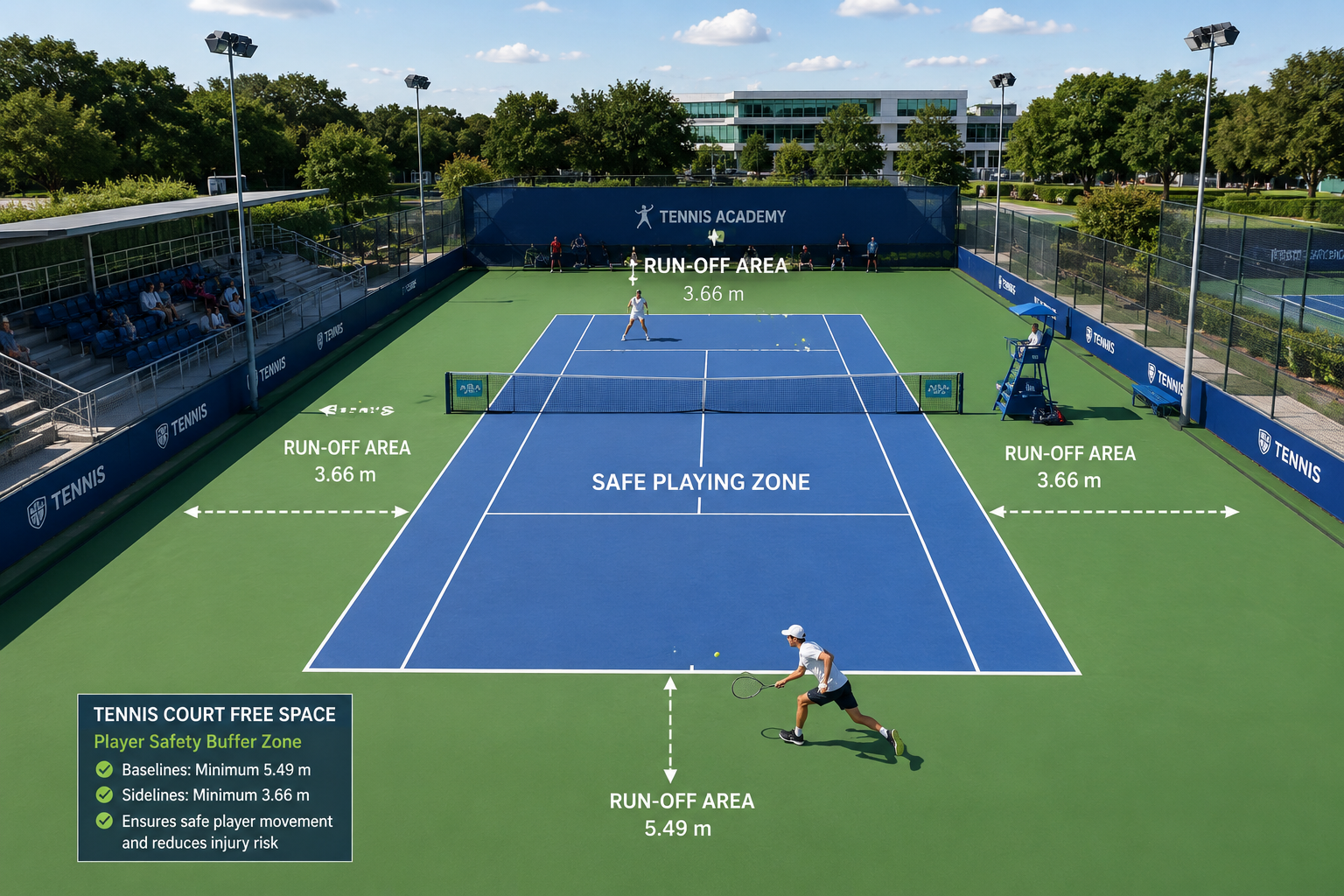
Run off area for tennis court


Modern tennis court construction requires carefully planned run-off areas to ensure player safety, smooth movement, and compliance with professional standards. The run-off area, also known as the free zone, refers to the extra open space surrounding the playing surface beyond the baselines and sidelines. This additional clearance is essential in both indoor and outdoor tennis facilities because players frequently move outside the marked court boundaries while chasing deep returns, wide-angle shots, and fast volleys during intense rallies. A properly designed tennis court run-off area improves overall playability by allowing unrestricted movement without the risk of collisions with fencing, walls, poles, seating areas, or other obstacles. Whether the court is intended for recreational use, coaching academies, residential communities, schools, clubs, or tournament-level competition, sufficient free space significantly enhances the playing experience and minimizes injury risks. According to international tennis court recommendations, the standard court dimensions measure 78 ft (23.77 m) in length and 36 ft (10.97 m) in width for doubles play. However, the total playing area must include additional safety zones around the court. Professional tennis facilities generally provide approximately 18–21 ft (5.5–6.4 m) of space behind each baseline and 10–12 ft (3–3.6 m) along both sidelines. With these clearances included, the overall recommended court area becomes approximately 120 ft × 60 ft (36.5 m × 18.3 m). Adequate run-off zones contribute to safer gameplay, improved athlete performance, and better court functionality. They also provide space for umpire chairs, coaching access, ball collection, player benches, lighting poles, and spectator arrangements without interfering with active play. In high-performance tennis environments, well-planned free zones are considered a critical component of court design, ensuring comfort, safety, and professional-level playing conditions for athletes of all skill levels.

Have a Query ?


Tennis Court Run-Off Area | Standard Court Layout & Marking
Run oof area for tennis court

Run-Off Area for Tennis Courts

The run-off area for a tennis court is one of the most important factors in ensuring player safety, smooth movement, and professional gameplay. A properly planned run-off zone provides additional free space around the playing area, allowing players to move freely during fast rallies, wide shots, and baseline recovery without the risk of colliding with fences, walls, poles, or spectators.

Whether for professional tournaments, schools, sports academies, residential communities, or recreational facilities, adequate tennis court run-off space improves overall court functionality and enhances the playing experience. Proper clearance around the court also supports maintenance access, equipment placement, and compliance with international tennis standards.

Why Tennis Court Run-Off Areas Are Important

Player Safety

Run-off zones reduce the chances of injuries by providing safe stopping distance around the court during high-speed movements and sudden directional changes.

Improved Gameplay

Adequate free space allows players to chase wide balls comfortably, improving match quality and overall court usability.

Professional Standards

Proper run-off dimensions help courts comply with ITF and tournament standards for professional and competitive tennis.

Better Court Planning

Well-designed run-off areas provide space for fencing, lighting poles, seating, umpire chairs, and maintenance access.

Standard Tennis Court Run-Off Dimensions

Court Type Baseline Run-Off Side Run-Off Recommended Use
Professional / International Court 6.4 m (21 ft) 3.66 m (12 ft) Tournaments & professional play
Indoor Tennis Court 7 m (23 ft) 4 m (13 ft) Indoor sports complexes
School / Recreational Court 3–5 m (10–16 ft) 2–3 m (6–10 ft) Training & recreational use

Indoor Tennis Court Run-Off Requirements

Indoor tennis courts generally require larger run-off clearances to accommodate lighting systems, roof structures, ventilation systems, and wall safety zones. Proper ceiling height is equally important for uninterrupted gameplay.

  • Minimum baseline clearance: 7 m (23 ft)
  • Minimum side clearance: 4 m (13 ft)
  • Recommended ceiling height: 9–12 m (30–40 ft)
  • Ensure adequate lighting and obstacle-free movement areas

Key Factors When Planning Tennis Court Run-Off Areas

  • Usage Type: Determine whether the court is intended for recreational, training, or tournament purposes.
  • Safety Clearance: Leave enough free space around all sides to prevent player collisions.
  • Fencing Placement: Fences should be installed beyond the minimum run-off zone for safe movement.
  • Lighting Position: Lighting poles should never obstruct player movement or visibility.
  • Drainage & Surface Slope: Proper drainage prevents water accumulation near court edges.
  • Future Expansion: Additional perimeter space helps accommodate seating, pathways, or multiple courts later.

Benefits of Proper Tennis Court Run-Off Space

Enhanced Player Movement

Players can move naturally and confidently without restriction during competitive rallies.

Reduced Injury Risk

Safe clearance zones minimize the risk of impact injuries caused by walls or fencing.

Professional Appearance

Spacious layouts improve the overall aesthetics and functionality of tennis facilities.

Long-Term Durability

Additional space around the court helps reduce edge wear and simplifies maintenance activities.

Frequently Asked Questions (FAQs)

What is the standard run-off area for a tennis court?

Standard professional tennis courts typically require 6.4 m baseline clearance and 3.66 m side clearance.

Why is run-off space important in tennis?

Run-off areas improve player safety, allow unrestricted movement, and help maintain professional playing conditions.

Can recreational tennis courts have smaller run-off areas?

Yes, recreational or school courts can use reduced clearances depending on available space and usage requirements.

Do indoor tennis courts need additional clearance?

Yes, indoor courts require larger side and overhead clearance for safe gameplay and equipment installation.

Does the run-off area affect tournament approval?

Yes, official tournaments require courts to meet minimum ITF run-off and safety standards.

Need Expert Tennis Court Planning?

Get professional guidance for tennis court layout, run-off area dimensions, fencing, lighting, and complete sports infrastructure planning.

Contact Our Experts

tennis court run-off area
tennis court clearance dimensions
tennis court safety zone
baseline run-off tennis court
side clearance tennis court
indoor tennis court dimensions
ITF tennis court standards

Leading tennis court cinstruction

Our Expertise in Tennis Court Run-Off Area Planning
We have successfully designed and planned multiple full-size and recreational tennis courts across India, serving schools, clubs, sports complexes, and private facilities.


Why Clients Choose Us for Tennis Court Layout & Run-Off Area Design

1. Nationwide service coverage across India.
2. Expert guidance on full-size court dimensions and run-off area requirements.
3. Custom layout solutions tailored for player safety and competitive standards.
4. Optimized court perimeter and clearance areas to meet ITF regulations.

We’ve successfully executed tennis court layouts for schools, clubs, training academies, and recreational facilities. Every project reflects our commitment to precision, safety, and international standards.

Investing in a professionally planned tennis court layout with adequate run-off areas ensures player safety, proper movement, and compliance with competitive standards. With www.sports-facility.in, you get more than just a court design—you get a trusted partner dedicated to quality, safety, and reliability.

Whether you are planning a school playground, sports club, or private tennis facility, we provide tennis court layout solutions that meet international standards. Choose sports-facility.in, the trusted tennis court planning company, to build high-quality, safe, and regulation-compliant courts.

Frequently Asked Questions

What types of sports facilities do you specialize in?

We specialize in a wide range of sports facilities including basketball courts, tennis courts, badminton courts, pickleball courts, running tracks, and multi-sport complexes.

Do you provide maintenance services for existing facilities?

Yes, we offer comprehensive maintenance services to ensure your sports facilities remain in top condition. This includes regular inspections, repairs, and resurfacing as needed.

Can you customize the design of the sports facility?

Absolutely! We work closely with our clients to create custom designs that meet their specific needs and preferences, ensuring the facility is tailored to the intended use.

What materials do you use for construction?

We use high-quality materials that are durable and suitable for the specific sport. This includes synthetic surfaces, wooden flooring, and specialized coatings for optimal performance.

Badminton Court Flooring, Sports Flooring, Acyrllic Flooring Services, Sports Flooring Services, Sports Court, Rubber Flooring, Basketball Equipmen, tennis court flooring, basketball court flooring, badminton court flooring, volleyball court flooring, pickleball court flooring, skating rink flooring, walking track flooring, multi‑purpose court flooring, cycle track flooring