
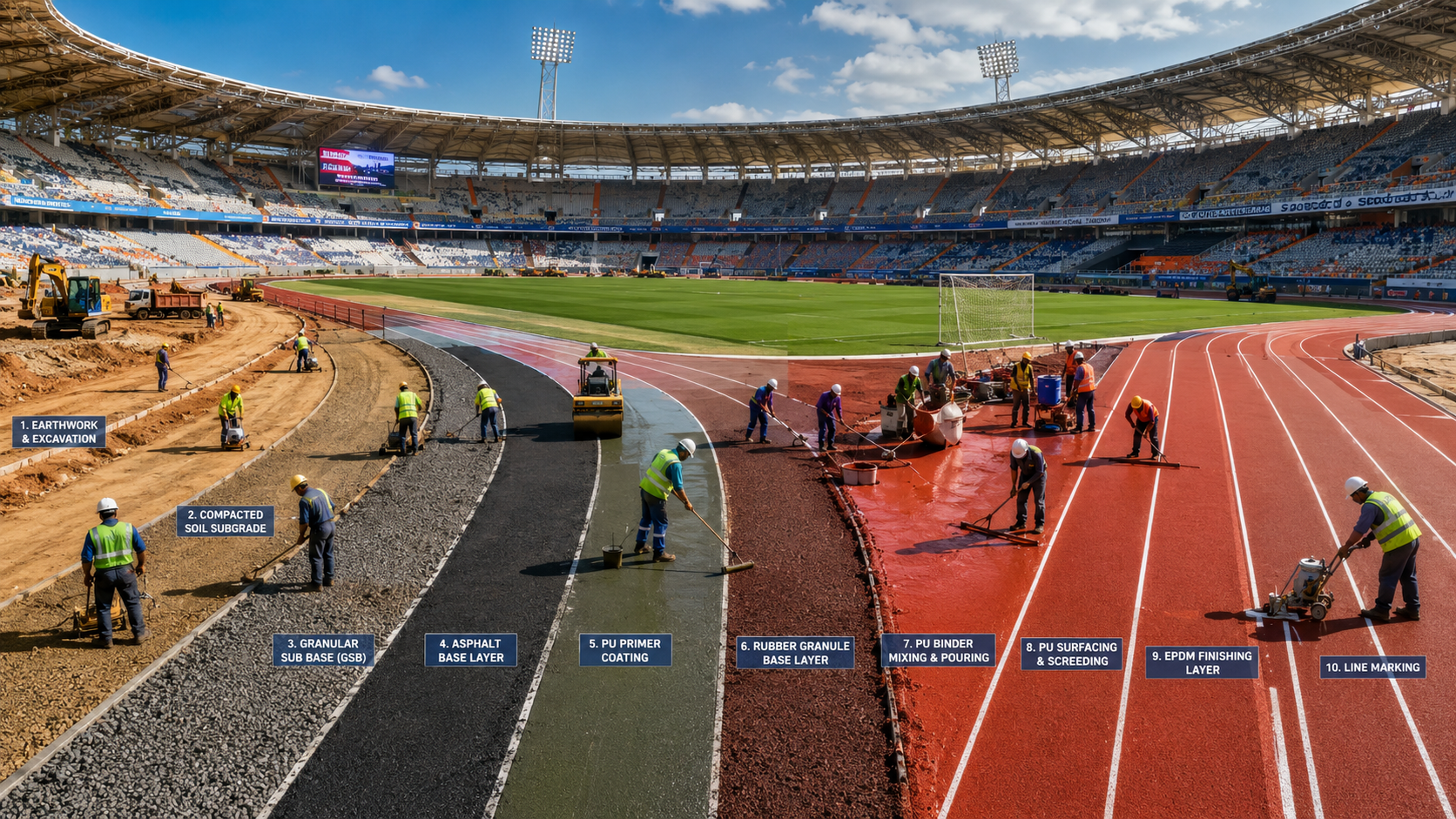
What Is Running Track Construction?
Running track construction is the systematic process of creating a dedicated athletic running surface over a properly engineered foundation. It generally includes site investigation, excavation, grading, compaction, drainage, sub-base preparation, engineered base construction, synthetic surfacing and accurate lane marking.
The objective is to create a level and durable sports surface that can withstand repeated running, sprinting and training activity. The complete track system must be designed so that the foundation, drainage and synthetic surface work together effectively.
Professional planning is particularly important for outdoor tracks because soil conditions, rainfall, temperature variations and water management can influence the long-term performance of the facility.
Why Professional Running Track Construction Matters
An athletic running track is more than a synthetic surface placed over the ground. Its performance depends on the quality of the foundation, drainage, base preparation, surfacing materials and installation workmanship.
An uneven or poorly compacted base can affect surface consistency, while inadequate drainage may create long-term problems. Professional construction therefore focuses on accurate levels, proper compaction, suitable materials and controlled installation.
- Stable and properly prepared foundation
- Effective water management
- Consistent synthetic surface
- Suitable traction and resilience
- Professional lane configuration
- Durable sports infrastructure
- Better long-term maintenance planning
Types of Synthetic Running Track Flooring in India
Different athletic facilities require different surface characteristics. Common synthetic running track systems include polyurethane, EPDM-based systems and prefabricated rubber surfaces.
1. Polyurethane Running Track
Polyurethane running tracks are widely considered for performance-oriented athletic facilities. Depending on the system design, polyurethane surfacing can provide resilience, traction and a durable synthetic finish for regular athletic activity.
- Resilient athletic surface
- Suitable traction characteristics
- Durable synthetic construction
- Suitable for intensive training environments
- Available in different system specifications
- Can be designed around applicable competition requirements
2. EPDM Sandwich Running Track
An EPDM sandwich running track combines resilient rubber granules with polyurethane layers. The resulting system can provide a comfortable and durable surface for schools, universities, sports academies and training facilities.
- EPDM rubber granule surface
- Polyurethane-based construction
- Resilient surface characteristics
- Suitable for regular athletic training
- Multiple colour possibilities
- Practical maintenance requirements
3. Prefabricated Athletic Track
Prefabricated running tracks use factory-manufactured synthetic rubber surfaces installed over a prepared base. Controlled manufacturing can help maintain consistent product characteristics and thickness.
- Factory-manufactured surface
- Consistent material characteristics
- Professional athletic application
- Resilient surface construction
- Suitable for specialised facilities
Running Track Flooring Systems Compared
| Track System | Common Application | Main Characteristics | Installation |
|---|---|---|---|
| Polyurethane | Stadiums and advanced athletic facilities | Resilience and durable synthetic surface | Site-applied system |
| EPDM Sandwich | Schools, academies and training facilities | Cushioning and durability | Multi-layer installation |
| Prefabricated Track | Professional sports facilities | Factory-controlled surface | Sheet installation |
Running Track Construction Process in India
A professional running track construction company in India follows a systematic process to establish the foundation and synthetic surface. The exact construction sequence depends on the selected track system and site conditions.
Step 1: Site Survey and Measurement
The project begins with an assessment of the available site, proposed track dimensions, access, surrounding infrastructure, existing ground conditions and intended facility usage.
Step 2: Soil Investigation
Ground and soil conditions are evaluated to understand the site's bearing characteristics, drainage behaviour and preparation requirements. This information helps determine suitable foundation and compaction procedures.
Step 3: Excavation and Grading
Existing ground is excavated and graded according to the project design. Correct levels are established to create a suitable foundation for the track structure.
Step 4: Drainage Construction
Drainage is an important component of an outdoor running track. Drainage channels and other water-management elements are planned to help control rainwater and reduce standing water.
Step 5: Sub-Base Preparation
Suitable granular materials are placed and compacted to create a stable structural foundation. Proper compaction and level control are important at this stage.
Step 6: Engineered Base Construction
Depending on the selected system, an asphalt or other engineered base may be constructed over the prepared sub-base. The finished base should provide the required stability and smoothness for synthetic surfacing.
Step 7: Synthetic Surface Installation
The selected polyurethane, EPDM or prefabricated running track surface is installed according to the system manufacturer's specifications. Surface layers are applied or installed to achieve the intended performance characteristics.
Step 8: Lane Marking
After the synthetic surface is ready, track lanes and other required markings are measured and applied accurately according to the intended facility layout.
Step 9: Quality Inspection
The completed track is inspected for surface finish, levels, joints, markings, drainage performance and overall workmanship before handover.
Running Track Construction Layers
A synthetic athletic track normally consists of several construction layers. The exact composition depends on the selected flooring system, site conditions and project specification.
| Layer | Purpose |
|---|---|
| Prepared Ground | Provides the underlying site foundation. |
| Compacted Sub-Base | Provides structural support and stability. |
| Engineered Base | Creates a stable and level platform for synthetic surfacing. |
| Resilient Synthetic Layers | Provide the required surface characteristics. |
| EPDM Wearing Layer | Provides the final athletic surface in applicable systems. |
| Lane Markings | Defines running lanes and required track layouts. |
World Athletics Requirements for Running Tracks
Athletic facilities intended for formal competition should consider the applicable technical requirements published by World Athletics. These requirements can cover track geometry, lane configuration, markings, surface characteristics and other aspects of competition facilities.
A conventional outdoor athletics track is commonly designed around a 400-metre oval configuration. However, the exact layout, number of lanes, dimensions and facility components depend on the project and intended level of competition.
Projects requiring formal certification should be planned, constructed and tested according to the applicable regulations and certification procedures rather than relying solely on generic dimensions.
Running Track Construction for Different Facilities
Synthetic running tracks can be developed for educational, professional, recreational and institutional sports facilities. The flooring specification can be adjusted according to the expected level of usage.
Schools and Educational Institutions
Schools can use running tracks for physical education, athletics training, sports days and inter-school competitions. Flooring selection can focus on durability, comfort, safety and practical maintenance.
Colleges and Universities
Colleges and universities may require dedicated athletics facilities for regular student training, competitions and sports programmes. A suitable synthetic track can support frequent use when correctly designed and maintained.
Sports Academies
Athletic academies require surfaces that can handle repeated training sessions. Resilience, traction, consistency and long-term durability are important considerations when selecting the track system.
Stadiums and Sports Complexes
Stadium projects require detailed coordination between the running track, field area, spectator facilities, drainage, access and other infrastructure. Track geometry and surfacing should be integrated into the overall stadium design.
Government Sports Projects
Government sports infrastructure projects can benefit from professionally planned running tracks developed according to project specifications, expected usage and applicable technical requirements.
Private Sports Facilities
Private clubs, fitness centres and multipurpose sports complexes can install synthetic athletic tracks for structured training, fitness programmes and recreational running.
Benefits of Synthetic Running Track Construction
- Provides a dedicated athletic training surface
- Offers resilient underfoot characteristics
- Supports suitable traction for running activity
- Can provide impact-management characteristics
- Designed for repeated athletic use
- Provides a professional sports facility appearance
- Suitable for schools and professional sports complexes
- Can be adapted to different project requirements
- Supports organised athletics training
- Allows professional lane marking and track layouts
Running Track Construction Cost in India
The running track construction cost in India varies significantly depending on the size, design, site conditions and selected synthetic flooring system. A standard price cannot be applied to every project.
Major factors that influence the overall project cost include:
- Total track area
- Number of running lanes
- Site preparation and excavation
- Soil and ground conditions
- Drainage requirements
- Granular sub-base construction
- Asphalt or engineered base
- Polyurethane or EPDM flooring specification
- Track thickness and construction system
- Lane marking and finishing
- Site accessibility
- Transportation and logistics
- Testing or project-specific technical requirements
For an accurate synthetic running track price, a site assessment should be completed before finalising the construction specification.
Synthetic Running Track Maintenance
Regular maintenance helps preserve the appearance and performance of a synthetic athletic track. The exact maintenance programme depends on the flooring system, traffic levels and environmental conditions.
Routine Maintenance
- Remove leaves, dust and loose debris.
- Keep the surface clean.
- Remove spills and contaminants promptly.
- Keep drainage channels clear.
- Monitor heavily used areas.
Periodic Inspection
- Inspect the synthetic surface.
- Check joints and transitions.
- Inspect lane markings.
- Look for surface damage or wear.
- Check drainage performance.
- Arrange compatible repairs where required.
Running Track Construction for Indian Climate Conditions
India has diverse climatic conditions ranging from high summer temperatures and heavy monsoon rainfall to colder northern regions. Running track construction should therefore take local environmental conditions into consideration.
Drainage is particularly important in areas with heavy seasonal rainfall. In hot regions, the selected synthetic surface and construction materials should be suitable for the expected temperature range and environmental exposure.
Site-specific engineering, appropriate materials and correct installation practices are important for creating a durable athletic facility across different regions of India.
How to Choose the Best Running Track Construction Company in India
Selecting an experienced running track contractor in India is important because athletic track construction combines civil engineering and specialised sports surfacing.
Before choosing a contractor, consider:
- Experience in synthetic athletic track projects
- Understanding of track construction layers
- Experience with polyurethane and EPDM systems
- Knowledge of drainage and sub-base construction
- Quality of installation materials
- Project planning and supervision
- Track measurement and lane-marking capability
- Quality-control procedures
- Maintenance and after-installation support
Running Track Construction Services by Sports Facility
Sports Facility provides complete athletic track construction solutions for educational institutions, sports academies, stadiums, clubs and other sports infrastructure projects.
Our project approach can cover the complete construction cycle, from initial consultation and site assessment through foundation preparation, synthetic surfacing, lane marking, finishing and handover.
Our Running Track Services Include
- Running track site inspection
- Athletic track design consultation
- Ground and subfloor assessment
- Excavation and grading coordination
- Drainage planning
- Sub-base preparation
- Engineered base construction
- Polyurethane running track installation
- EPDM running track installation
- Prefabricated athletic track installation
- Lane marking
- Track renovation and resurfacing
- Final inspection
- Maintenance guidance
Our Running Track Construction Project Workflow
| Stage | Project Activity |
|---|---|
| 1 | Initial requirement discussion |
| 2 | Site survey and measurements |
| 3 | Ground and soil assessment |
| 4 | Track system selection |
| 5 | Excavation and grading |
| 6 | Drainage and sub-base construction |
| 7 | Engineered base preparation |
| 8 | Synthetic track surfacing |
| 9 | Lane marking and finishing |
| 10 | Final inspection and project handover |
Frequently Asked Questions About Running Track Construction in India
What is running track construction?
Running track construction is the process of developing an athletic running facility through site preparation, excavation, drainage, sub-base construction, engineered base work, synthetic surfacing and lane marking.
Which flooring is best for a running track in India?
Polyurethane, EPDM-based and prefabricated synthetic track systems can be considered. The appropriate flooring depends on the intended use, performance requirements, site conditions, budget and maintenance programme.
How much does running track construction cost in India?
Cost depends on track dimensions, number of lanes, ground preparation, drainage, base construction, synthetic flooring specification, markings, site accessibility and project location. A site-specific quotation is recommended.
What are the main types of synthetic running tracks?
Common systems include polyurethane running tracks, EPDM sandwich tracks and prefabricated synthetic rubber tracks. Each system has different construction characteristics and should be selected according to project requirements.
Can synthetic running tracks be constructed for schools?
Yes. Synthetic running tracks can be developed for schools, colleges, universities and sports academies. The track specification can be adapted according to available space and expected usage.
Why is drainage important for running track construction?
Drainage helps manage rainwater and reduce prolonged water accumulation. Proper water management is particularly important for outdoor athletic tracks exposed to heavy rainfall.
How long does running track construction take?
Construction time depends on the project area, site preparation, drainage, weather, foundation requirements and selected synthetic flooring system. A detailed schedule can be prepared after site assessment.
Can an existing running track be renovated?
In many cases, existing athletic tracks can be repaired, resurfaced or renovated depending on the condition of the existing foundation and synthetic surface. A technical site inspection is recommended before deciding the renovation method.
Are polyurethane running tracks suitable for professional facilities?
Polyurethane systems can be considered for professional and performance-oriented athletic facilities. The final specification should be selected according to the required performance level and applicable competition requirements.
Do you provide complete running track construction services?
Yes. Sports Facility provides complete running track project support including consultation, site assessment, foundation preparation, drainage coordination, synthetic surfacing, lane marking, finishing and maintenance guidance.
What Is the Best Running Track Flooring in India?
The best running track flooring depends on the facility, usage level, climate, subfloor and performance requirements. Polyurethane, EPDM sandwich and prefabricated synthetic track systems are commonly considered for different athletic facilities. A professional site assessment helps determine the appropriate construction and flooring specification.
Running Track Construction in India – Quick Answer
Running Track Construction in India is the complete development of an athletic running facility, including ground preparation, drainage, sub-base construction, engineered base work, synthetic polyurethane or EPDM surfacing, lane marking and final finishing. Professional construction helps create a stable, resilient and durable surface for athletic training and sports activities.
Related SEO Keywords for Running Track Construction
running track construction in India, synthetic running track construction, athletic track construction India, running track flooring India, synthetic athletic track, polyurethane running track, EPDM running track, prefabricated running track, running track contractor India, running track installation, athletic track flooring, synthetic sports flooring India, running track construction company, running track manufacturer India, stadium running track construction, school running track construction, university athletic track, sports academy running track, professional running track flooring, running track resurfacing, running track renovation, athletics track construction, synthetic running track price, running track construction cost in India.
Plan Your Running Track Construction Project with Sports Facility
Planning a new athletic track for a school, sports academy, university, stadium or private sports complex? Sports Facility provides professional running track construction in India with project solutions tailored to the site and intended application.
From site inspection and ground preparation to drainage, base construction, synthetic surfacing, lane marking and final inspection, our team can support the complete athletic track development process.
Contact Sports Facility to discuss your track dimensions, number of lanes, site location, flooring preference, expected usage and project requirements.
Request a Running Track QuoteFinal Thoughts on Running Track Construction in India
Running Track Construction in India requires careful planning, suitable civil engineering, effective drainage, quality materials and specialised synthetic surfacing. Every stage, from soil preparation to final lane marking, contributes to the performance and service life of the completed athletic facility.
Polyurethane, EPDM sandwich and prefabricated systems offer different characteristics for schools, universities, sports academies, stadiums and professional athletic facilities. The correct system should be selected according to the project's intended usage, site conditions, performance requirements and budget.
With proper site assessment, engineered construction, professional synthetic flooring installation, accurate track marking and regular maintenance, a running track can provide a reliable environment for athletics training, physical education, recreation and competition.