
Why Running Track Construction Specifications Matter
Accurate running track construction specifications are important for achieving a stable, safe, and consistent athletic surface. A synthetic track is not simply a colored top coating; its performance depends on the complete construction system beneath the surface.
Proper specifications help coordinate the subgrade, drainage, sub-base, structural base, synthetic surface, slope, joints, edge details, and markings. Correct planning can reduce problems such as standing water, cracking, uneven surfaces, premature wear, poor traction, and inconsistent running conditions.
- Improves overall track stability and surface consistency
- Supports effective rainwater management
- Helps provide suitable traction and player comfort
- Reduces the risk of uneven or damaged playing surfaces
- Provides a clear construction framework for contractors
- Supports project-specific athletic facility requirements
- Helps maintain accurate lane geometry and markings
Running Track Construction – Technical Specification Overview
Site & Subgrade Specifications
The site should be surveyed and evaluated before construction begins. Ground conditions, existing levels, soil characteristics, access, drainage requirements, and available space should be assessed.
- Site survey and dimensional verification
- Subgrade assessment and preparation
- Removal of unsuitable material where required
- Proper compaction and level control
Drainage Specifications
Drainage is a critical component of outdoor running track construction, particularly in regions exposed to seasonal or heavy rainfall.
- Appropriate surface falls
- Perimeter drainage provisions
- Connection to suitable stormwater outlets
- Prevention of prolonged water accumulation
Base Construction Specifications
The structural base provides support for the synthetic track system. Depending on the project, the base may incorporate engineered granular layers, asphalt, concrete, or other approved construction assemblies.
- Compacted sub-base
- Stable structural base
- Controlled levels and gradients
- Suitable surface preparation before coating
Synthetic Surface Specifications
The synthetic surface is selected according to the required performance, usage level, climate, maintenance expectations, and project budget.
- Polyurethane systems
- EPDM rubber systems
- Sandwich synthetic systems
- Prefabricated rubber systems
Running Track Surface Systems and Specifications
Different synthetic running track systems provide different combinations of resilience, traction, comfort, durability, installation characteristics, and maintenance requirements. The appropriate system should be selected after evaluating the project's intended use and technical requirements.
1. Full Polyurethane Running Track
A full polyurethane athletic track uses polyurethane-based materials throughout the relevant surface system. It is commonly considered for high-performance facilities where consistent surface characteristics and professional finishing are priorities.
- Seamless synthetic surface construction
- Resilient and elastic playing characteristics
- Suitable for demanding athletic environments
- Designed for consistent traction and running comfort
- Requires professionally prepared base and installation
2. EPDM Sandwich Running Track
An EPDM sandwich running track combines resilient rubber layers with a polyurethane-based binder and EPDM wearing surface. The layered construction is designed to provide a balance of resilience, comfort, traction, and durability.
- Elastic rubber shock-absorbing layer
- Polyurethane binder system
- EPDM granule wearing surface
- Suitable for training and institutional facilities
- Available in project-specific thicknesses and specifications
3. EPDM Synthetic Running Track
EPDM-based systems use colored rubber granules within a synthetic binder system. These surfaces can be selected for schools, sports academies, recreational facilities, and other outdoor athletic applications.
- EPDM rubber surface finish
- Good traction characteristics
- Flexible surface construction
- Available in multiple surface colors
- Suitable for outdoor sports environments
4. Prefabricated Rubber Running Track
Prefabricated running tracks are manufactured under controlled conditions and installed over a suitably prepared base. They can provide consistent material properties and are considered for projects requiring a factory-produced synthetic track system.
- Factory-manufactured rubber surface
- Consistent material composition
- Professional installation over prepared base
- Suitable for selected athletic and competition facilities
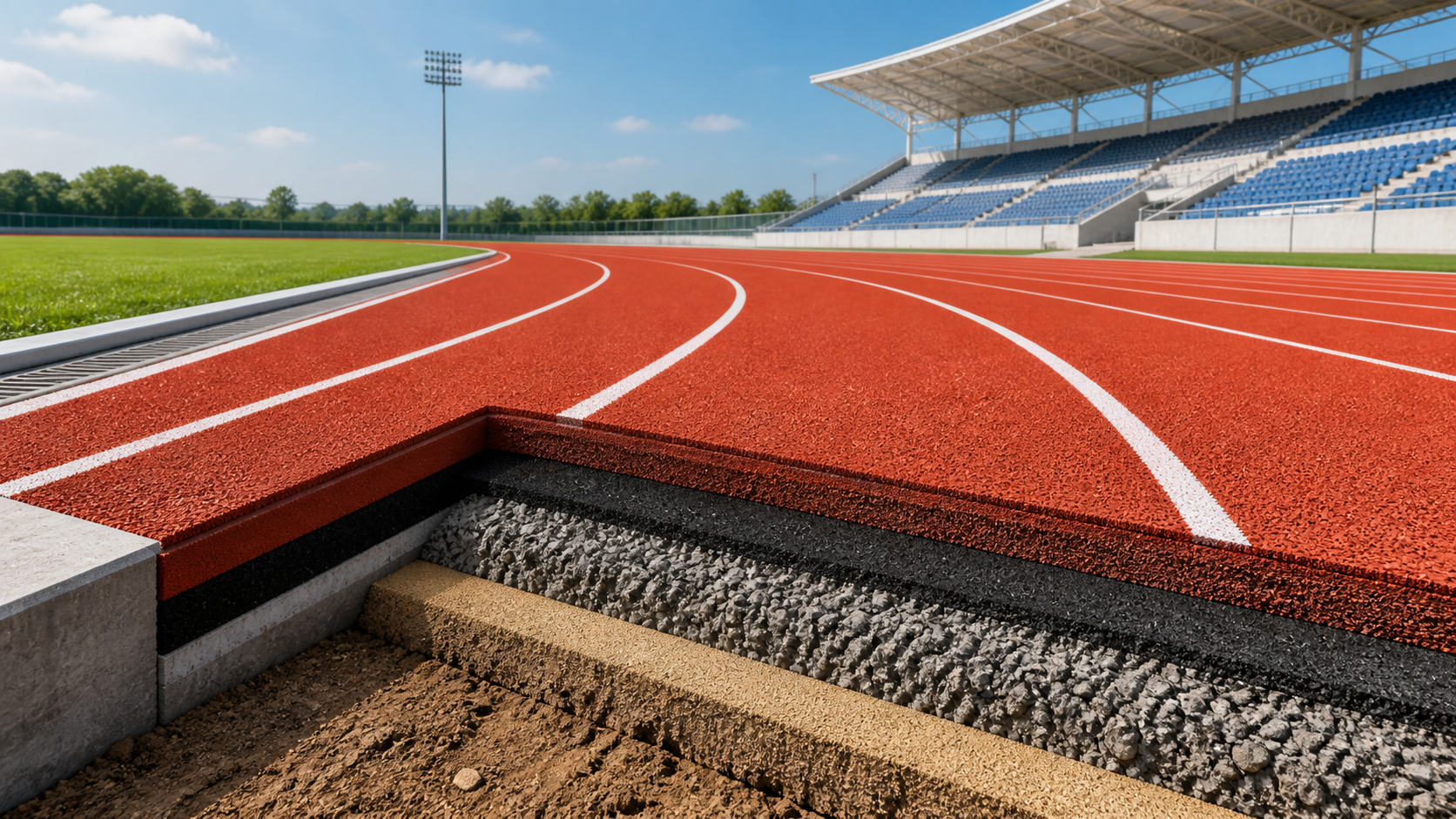
Running Track Construction Layer Specifications
A synthetic running track generally consists of multiple construction layers. Exact materials and thicknesses should be established through project design, engineering requirements, site conditions, and the selected synthetic surface system.
| Construction Layer | Typical Material / System | Primary Function |
|---|---|---|
| Playing Surface | PU / EPDM / Prefabricated Rubber | Traction, resilience, athlete comfort and surface protection |
| Elastic Layer | Rubber granules with polyurethane binder | Shock absorption and surface resilience |
| Base Preparation Layer | Suitable leveling or regulating material | Provides a uniform surface for synthetic installation |
| Structural Base | Dense asphalt or engineered concrete system | Structural stability and load distribution |
| Sub-Base | Compacted granular material | Load distribution, stability and ground preparation |
| Drainage | Perimeter drains and stormwater system | Removal of rainwater and protection against water accumulation |
| Prepared Subgrade | Compacted and engineered natural ground | Foundation for the complete track structure |
Standard Running Track Dimensions and Technical Specifications
A conventional outdoor athletics track is generally planned around a 400-metre oval configuration. However, the final geometry should be established from the approved design and the requirements applicable to the intended facility.
- Track Configuration: Typically an oval athletics track
- Standard Track Length: 400 m for a conventional outdoor competition track
- Track Lanes: Number and arrangement based on project design
- Lane Width: Determined according to the applicable athletics requirements
- Lane Markings: Precise and clearly visible athletic track markings
- Track Geometry: Accurate straights, curves, radii and lane measurements
- Surface Levels: Controlled during base and synthetic installation
- Drainage: Designed to suit site conditions and stormwater requirements
For competition-level facilities, dimensional and performance requirements should be verified against the latest applicable World Athletics technical requirements and the project's certification objectives.
Running Track Construction Process and Specifications
1. Site Survey and Measurement
Construction begins with detailed site measurement and assessment. Available land, existing levels, access, utilities, drainage conditions, and proposed track geometry are reviewed.
2. Soil and Subgrade Assessment
The subgrade is evaluated to determine its suitability for supporting the proposed track structure. Weak or unsuitable areas may require treatment, replacement, stabilization, or additional engineering measures.
3. Excavation and Ground Preparation
The site is excavated and graded according to the approved levels. Proper compaction is essential to create a stable foundation for the subsequent layers.
4. Drainage Installation
Drainage channels, perimeter systems, outlets, and related stormwater provisions are installed according to the site's rainfall pattern, surrounding ground levels, and drainage strategy.
5. Sub-Base Preparation
Engineered granular material is placed and compacted in controlled layers. The objective is to create a stable and uniform foundation beneath the structural base.
6. Structural Base Construction
The structural base may consist of asphalt or another approved construction system. Proper compaction, levels, smoothness, joints, and curing or setting requirements are checked before synthetic surfacing begins.
7. Surface Preparation
The base is inspected for cracks, contamination, uneven areas, moisture-related problems, and other conditions that could affect the synthetic surface installation.
8. Synthetic Track Installation
The selected polyurethane, EPDM, sandwich, or prefabricated rubber system is installed according to the manufacturer's technical requirements and project specifications.
9. Lane and Event Markings
After the surface has been completed and approved, lane lines and relevant athletic event markings are accurately positioned using the approved track geometry.
10. Final Quality Inspection
The completed track should be inspected for surface consistency, line accuracy, drainage performance, visible defects, finishing quality, and compliance with the project's specified requirements.
Running Track Drainage Specifications
Effective drainage is one of the most important components of running track construction specifications. Outdoor tracks are exposed to rain, humidity, seasonal weather, and surface runoff. Poor drainage can contribute to water accumulation, deterioration of the base, algae growth, surface contamination, and premature damage.
- Provide suitable surface gradients as defined by the project design.
- Install perimeter drainage where required.
- Ensure drainage outlets have sufficient discharge capacity.
- Prevent surrounding landscape water from flowing onto the track.
- Coordinate track levels with adjacent areas.
- Test drainage performance before final project handover.
Drainage specifications should be designed according to local rainfall, soil conditions, site levels, stormwater infrastructure, and applicable engineering requirements rather than applying one fixed slope to every project.
Running Track Specifications for Indian Climate Conditions
Running tracks installed in India may experience high temperatures, monsoon rainfall, humidity, UV exposure, dust, and seasonal temperature variation. Therefore, material selection and base construction should consider the local environment.
Outdoor synthetic surfaces should be selected for their suitability to the project's climate and usage conditions. Proper drainage, moisture management, surface preparation, UV-stable materials, and professional installation are important considerations for long-term performance.
- UV-resistant synthetic materials
- Weather-suitable polyurethane and EPDM systems
- Effective rainwater drainage
- Properly compacted foundation layers
- Moisture-controlled base preparation
- Suitable maintenance planning
Running Track Base Construction Specifications
The quality of the base has a direct effect on the performance of the synthetic running track. Even premium surface materials may develop problems if the underlying foundation is unstable, poorly compacted, uneven, or affected by excessive moisture.
Subgrade
The natural ground should be prepared and compacted according to the geotechnical and civil design requirements.
Granular Sub-Base
A suitable granular layer can provide load distribution and support drainage and structural stability when correctly designed and compacted.
Asphalt or Concrete Base
Depending on the selected system, a properly engineered asphalt or concrete base may be used beneath the synthetic surface. Surface regularity and structural integrity should be checked before installation.
Surface Preparation
The base must be suitably clean, stable, dry where required, and free from conditions that could compromise adhesion or surface performance.
Quality Control for Running Track Construction
Specification-based construction requires quality checks at different stages rather than inspecting only the completed surface.
- Verify site dimensions and track geometry.
- Check subgrade preparation and compaction.
- Inspect drainage channels and discharge points.
- Verify structural base levels and surface regularity.
- Check synthetic material quality and batch information.
- Follow manufacturer's installation requirements.
- Inspect surface texture and consistency.
- Verify lane and event markings.
- Check final drainage performance.
- Document project specifications and completion details.
How to Choose the Right Running Track Construction Specifications
The best specification is not necessarily the same for every project. Track design should be developed around the facility's intended use and site conditions.
Consider the Intended Usage
A school training track may have different requirements from a professional athletics stadium or high-performance academy.
Consider Climate and Weather
Rainfall, temperature, UV exposure, humidity, and local environmental conditions should influence drainage and material selection.
Consider Surface Performance
Training and competition facilities may require different levels of resilience, traction, shock absorption, and surface consistency.
Consider Maintenance
Cleaning, periodic inspection, drainage maintenance, line marking upkeep, and surface repairs should be considered during the specification stage.
Consider Applicable Standards
If the facility is intended for regulated competition, the design should be reviewed against the latest applicable athletics standards and certification requirements.
Where Running Track Construction Specifications Are Used
Professionally specified athletic tracks can be developed for a wide range of sports and institutional facilities.
- Schools and educational campuses
- Colleges and universities
- Sports academies
- Athletics training centres
- Stadiums and sports complexes
- Government sports facilities
- Military and institutional campuses
- Residential and recreational developments
- Corporate sports facilities
- Community parks and fitness facilities
Running Track Maintenance Specifications
Regular maintenance helps preserve the appearance, traction, drainage performance, and usability of a synthetic running track. Maintenance requirements vary according to the surface system, traffic, weather, and facility usage.
- Routine sweeping and cleaning
- Removal of leaves, dirt and debris
- Inspection of drainage channels
- Monitoring of surface wear
- Inspection of joints and edges
- Repair of localized surface damage
- Periodic inspection of lane markings
- Professional assessment when significant deterioration occurs
Running Track Construction Standards
Athletic track projects should be designed according to their intended level of use. For competition facilities, the applicable World Athletics technical requirements should be considered during planning, including track geometry, dimensions, markings, surface characteristics, and other relevant facility requirements.
For schools, recreational facilities, and general training tracks, specifications can be developed according to the project's functional requirements, site conditions, safety considerations, budget, and expected usage.
Where certification or formal competition approval is required, the project should be reviewed by appropriately qualified professionals and against the latest applicable regulations.
Running Track Construction Specifications – FAQs
Q1: What are running track construction specifications?
A: Running track construction specifications define the requirements for site preparation, drainage, sub-base, structural base, synthetic surface, track geometry, lane markings, installation and quality control.
Q2: What materials are commonly used for synthetic running tracks?
A: Common systems include polyurethane, EPDM rubber, sandwich synthetic systems and prefabricated rubber surfaces. The appropriate option depends on the facility's use, performance requirements and project conditions.
Q3: What is the standard length of an outdoor running track?
A: A conventional outdoor athletics track is generally designed around a 400-metre oval configuration. Exact geometry and dimensions should follow the approved project design and applicable athletics requirements.
Q4: Why is drainage important in running track construction?
A: Proper drainage helps remove rainwater and reduces the possibility of prolonged water accumulation around or on the track. Drainage design should consider site levels, rainfall, soil conditions and stormwater infrastructure.
Q5: How thick is a synthetic running track?
A: There is no single thickness suitable for every synthetic track. Surface thickness varies according to the selected system, performance requirements, base construction and manufacturer's specification.
Q6: Which running track surface is best?
A: The most suitable surface depends on whether the track is intended for schools, training, recreational use or competition. Polyurethane and EPDM-based systems are commonly considered for synthetic athletic facilities.
Q7: Can running track specifications be customized?
A: Yes. Track specifications can be developed according to site dimensions, ground conditions, climate, drainage requirements, expected usage, surface system and applicable standards.
Q8: Do you provide turnkey running track construction?
A: Sports Facility India can provide project-focused running track construction services covering planning, civil preparation, drainage, base development, synthetic surfacing and track marking, subject to the project's scope and site requirements.
Get Running Track Construction Specifications for Your Project
Planning a school track, sports academy, stadium or institutional athletics facility? Get project-specific guidance for running track construction specifications, surface selection, drainage, base preparation and synthetic track installation.
Related Running Track Construction Services
- Running Track Construction in India
- Synthetic Running Track Construction
- Polyurethane Running Track Construction
- EPDM Running Track Flooring
- Athletic Track Construction
- School Running Track Construction
- Sports Academy Running Track Construction
- Running Track Flooring Contractors
- Running Track Installation Services
- Professional Athletic Track Construction