Why Choose Sports Facility India for Running Track Construction?
Constructing a reliable athletic track requires technical knowledge, suitable materials, accurate measurements, and professional installation. Selecting the right running track construction company is important for ensuring proper foundation stability, surface consistency, drainage performance, and long-term usability.
Sports Facility India offers customized sports flooring and athletic infrastructure solutions with attention to project planning, construction quality, and application-specific requirements.
Complete Turnkey Construction
We provide end-to-end running track construction solutions, covering site evaluation, design planning, civil construction, synthetic flooring, lane marking, finishing, and project handover.
Multiple Running Track Systems
We offer Full PU, EPDM Sandwich, EPDM jogging track, Spray Coat, and prefabricated synthetic track systems for different athletic and recreational applications.
Customized Track Design
Running track layouts are planned according to available land, track dimensions, lane requirements, curves, straight sections, and the intended purpose of the facility.
Quality Flooring Materials
We consider suitable polyurethane materials, EPDM granules, rubber cushioning layers, synthetic binders, and engineered base materials according to the selected specifications.
Professional Installation
Systematic installation practices help maintain surface thickness, smoothness, alignment, texture, and finishing quality throughout the running track.
Solutions for Different Facilities
Our running track construction solutions are suitable for educational campuses, sports complexes, stadiums, public parks, residential projects, and corporate fitness facilities.
Types of Synthetic Running Track Flooring Systems
Choosing the appropriate synthetic running track flooring system is one of the most important decisions during sports facility development. Different flooring systems offer different characteristics in terms of cushioning, resilience, traction, durability, maintenance, and installation requirements.
Sports Facility India provides multiple synthetic track options to accommodate professional athletic facilities, educational institutions, recreational jogging tracks, and general fitness applications.
1. Full PU Running Track
Full Polyurethane (PU) running tracks are designed for athletic facilities requiring a seamless, resilient, and performance-oriented synthetic surface. This system uses polyurethane-based materials to develop a durable athletic flooring structure with suitable shock absorption and traction characteristics.
Full PU running tracks are commonly considered for professional stadiums, sports academies, universities, athletic training centres, and competition-oriented sports facilities.
Features and Advantages
- Seamless polyurethane synthetic surface.
- Consistent surface texture and appearance.
- Suitable resilience and impact absorption.
- Reliable traction for athletic movements.
- Designed for regular and intensive sports activities.
- Suitable for professional athletic infrastructure.
- Weather-resistant material options.
- Long-term service potential with proper installation and maintenance.
2. EPDM Sandwich Running Track
EPDM Sandwich running tracks are multi-layer synthetic athletic surfaces combining rubber cushioning materials, polyurethane binders, and EPDM granules. The system is developed to provide a comfortable and resilient running surface for regular athletic training and recreational sports activities.
EPDM Sandwich systems are suitable for schools, colleges, universities, sports academies, institutional playgrounds, and outdoor athletic facilities where a cushioned synthetic surface is required.
Features and Advantages
- Multi-layer synthetic flooring construction.
- Comfortable and resilient athletic surface.
- Good impact absorption characteristics.
- Suitable traction for running and training.
- Available in different colour combinations.
- Suitable for educational and institutional facilities.
- Outdoor material options.
- Manageable routine maintenance requirements.
3. EPDM Jogging Track
EPDM jogging tracks are designed for walking, jogging, recreational fitness, and everyday exercise. These surfaces are manufactured using EPDM rubber granules and suitable polyurethane binders to create a comfortable and attractive synthetic pathway.
EPDM jogging track flooring is widely considered for public gardens, parks, residential societies, townships, resorts, fitness centres, corporate campuses, and community recreational areas.
Features and Advantages
- Comfortable rubber-based walking surface.
- Good slip resistance with suitable surface texture.
- UV-resistant EPDM material options.
- Available in multiple decorative colours.
- Suitable for outdoor walking and jogging pathways.
- Resilient and cushioned flooring characteristics.
- Easy routine cleaning and maintenance.
- Suitable for public and private recreational spaces.
4. Spray Coat Running Track
Spray Coat running track systems provide a practical synthetic surfacing option for schools, colleges, sports clubs, recreational facilities, and training grounds. These systems generally use a rubberized base layer with a polyurethane coating and textured rubber granules to create an athletic surface.
Spray Coat flooring can be considered for facilities requiring a functional synthetic running surface for regular physical education, athletic practice, and recreational activities.
Features and Advantages
- Textured synthetic athletic finish.
- Suitable traction characteristics.
- Practical flooring solution for regular training.
- Consistent surface appearance.
- Outdoor application options.
- Available in different colour finishes.
- Relatively straightforward routine maintenance.
5. Prefabricated Synthetic Running Track
Prefabricated running track systems are manufactured in controlled factory conditions and supplied in ready-to-install synthetic rubber sections or rolls. These surfaces are installed over a properly prepared base using the specified bonding and installation procedures.
Prefabricated synthetic tracks are suitable for professional athletic facilities, sports stadiums, universities, and projects where factory-controlled manufacturing, consistent thickness, and installation efficiency are important considerations.
Features and Advantages
- Factory-manufactured synthetic surface.
- Controlled material thickness.
- Consistent surface characteristics.
- Professional athletic track applications.
- Efficient installation process.
- Suitable durability when correctly installed.
- Uniform surface appearance.
- Routine cleaning and maintenance requirements.
Comparison of Different Running Track Flooring Systems
Every running track surface has specific characteristics and application requirements. The following comparison provides a general overview to help select a suitable synthetic flooring system for different sports and recreational facilities.
| Track Flooring System | Recommended Application | Surface Characteristics | Maintenance |
|---|---|---|---|
| Full PU | Professional Stadiums and Athletic Facilities | Seamless, resilient synthetic surface | Low to Moderate |
| EPDM Sandwich | Schools, Colleges and Sports Academies | Multi-layer cushioned surface | Low |
| EPDM Jogging Track | Parks, Gardens and Residential Projects | Comfortable rubberized surface | Low |
| Spray Coat | Schools and Recreational Facilities | Textured synthetic surface | Low |
| Prefabricated Track | Professional Athletic Facilities | Factory-manufactured rubber surface | Low |
How to Select the Best Running Track Flooring?
Selecting the right running track flooring depends on the intended application, athlete requirements, site conditions, expected footfall, project budget, and maintenance expectations. A suitable surface should be selected after evaluating the complete project rather than considering the flooring material alone.
- Purpose of the Track: Professional athletics, school sports, recreational jogging, endurance training, and general fitness may require different synthetic flooring specifications.
- Performance Requirements: Competition and high-intensity training facilities may require specialized surfaces with appropriate resilience, traction, and shock absorption.
- Site and Soil Conditions: Existing ground levels, soil stability, accessibility, slope, and drainage conditions must be evaluated before construction.
- Weather Conditions: Outdoor running tracks should use suitable materials that can withstand local temperature variations, UV exposure, moisture, and environmental conditions.
- Project Budget: Flooring selection, civil construction, drainage, track dimensions, material specifications, and additional infrastructure influence the overall project investment.
- Maintenance Requirements: Cleaning schedules, drainage maintenance, periodic inspections, repairs, and future resurfacing should be considered.
- Track Layout: Number of lanes, track length, curves, straight sections, event markings, and available land area influence the design and construction process.
Step-by-Step Running Track Construction Process
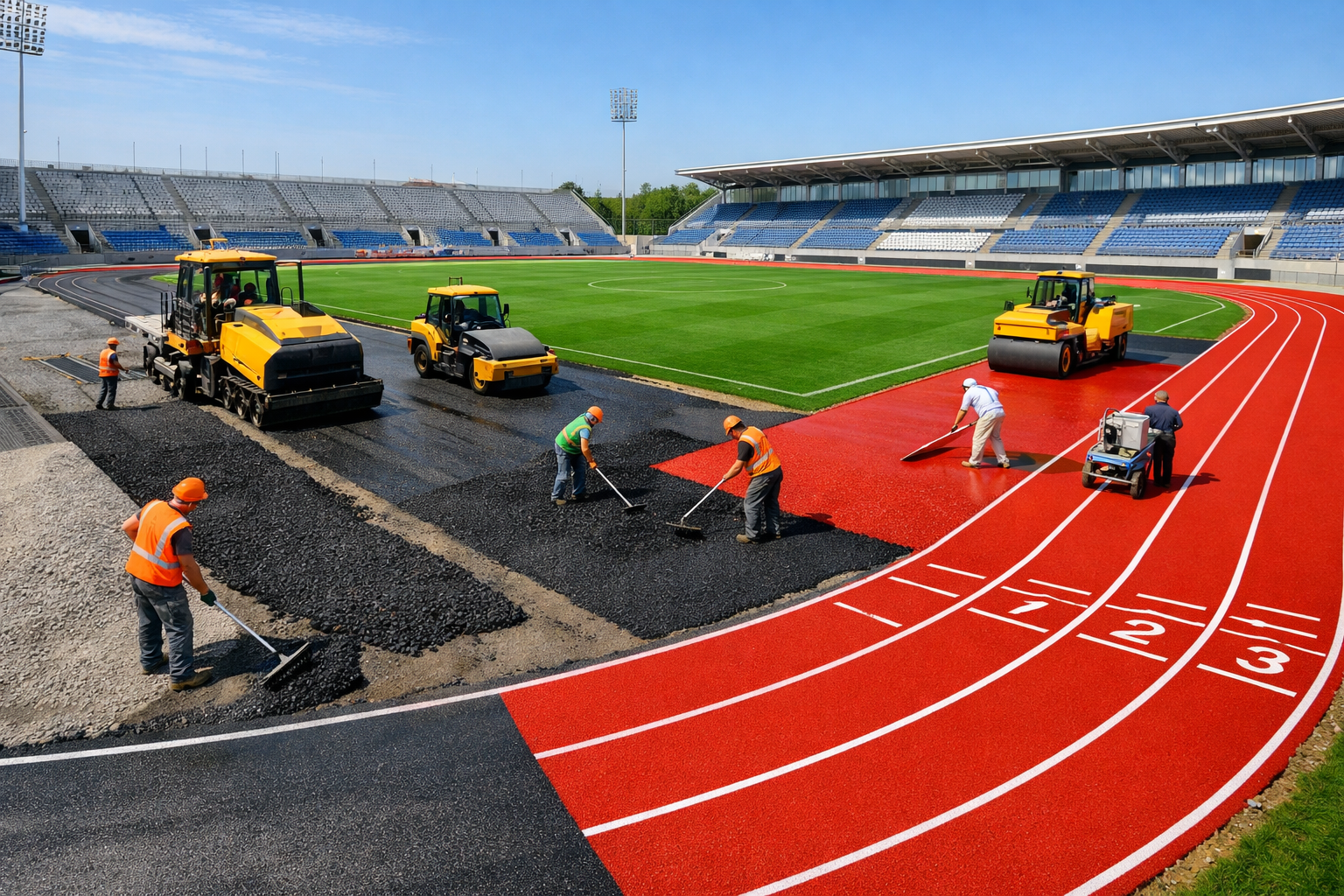
Professional running track construction involves multiple stages of civil engineering, foundation preparation, drainage development, synthetic flooring installation, and quality inspection. Every stage plays an important role in developing a stable and functional athletic facility.
Sports Facility India follows a systematic construction approach to help ensure proper site preparation, suitable foundation development, and accurate synthetic surface installation.
1. Site Inspection and Evaluation
The proposed site is inspected to evaluate available land, soil conditions, existing levels, accessibility, slope, drainage, and project requirements.
2. Track Design and Layout Planning
Track geometry, lane configuration, running distance, straight sections, curves, starting points, finishing areas, and additional athletic zones are planned.
3. Surveying and Leveling
Professional surveying establishes the required track dimensions, elevations, gradients, and surface levels to support proper construction.
4. Excavation and Ground Preparation
Vegetation, unsuitable soil, loose materials, and debris are removed. The ground is prepared, graded, and compacted according to the engineering requirements.
5. Drainage System Installation
Appropriate drainage channels, pipes, outlets, and water management arrangements are developed to help prevent water accumulation around the track.
6. Granular Sub-Base Construction
Selected aggregates are laid in specified layers and compacted to create a stable foundation for the subsequent base construction.
7. Asphalt or Concrete Base Development
An engineered asphalt or reinforced concrete base is constructed according to the approved specifications, required levels, structural strength, and drainage design.
8. Base Inspection and Preparation
The completed base is checked for smoothness, levels, cleanliness, surface defects, and suitability before applying the synthetic flooring system.
9. Synthetic Running Track Installation
The selected Full PU, EPDM Sandwich, Spray Coat, EPDM, or prefabricated synthetic flooring system is installed according to its technical specifications.
10. Surface Finishing
The final wearing or textured layer is completed to achieve the specified thickness, appearance, surface consistency, traction, and resilience.
11. Lane Marking and Line Painting
Lane boundaries, start and finish lines, relay zones, hurdle markings, and other required athletic markings are measured and applied accurately.
12. Quality Inspection and Project Handover
Final inspection includes surface quality, dimensions, lane alignment, drainage, finishing, and overall construction evaluation before project handover.
Applications of Synthetic Running Track Construction
Synthetic running tracks are used across educational, professional, recreational, residential, and institutional environments. Depending on the selected surface system and project requirements, running tracks can be designed for competitive athletics, student fitness, walking, jogging, and regular physical training.
Schools
Running tracks for physical education, student fitness, school sports competitions, athletics practice, and recreational activities.
Colleges and Universities
Athletic infrastructure for inter-college competitions, university sports programs, student training, and campus fitness facilities.
Sports Academies
Dedicated athletic training surfaces for sprinting, endurance running, athlete development, coaching, and regular practice.
Sports Stadiums
Synthetic athletic tracks for professional sports infrastructure, training facilities, competitions, and organized sporting events.
Public Parks and Gardens
EPDM jogging and walking tracks for community fitness, outdoor exercise, recreational activities, and public wellness.
Residential Communities
Rubberized jogging pathways and fitness tracks for housing societies, residential townships, apartments, and gated communities.
Corporate Campuses
Outdoor running and fitness facilities for employee wellness, recreational activities, and corporate fitness programs.
Government and Institutional Projects
Athletic infrastructure for government sports facilities, public institutions, police training centres, and other institutional developments.
Benefits of Professional Running Track Construction
A professionally designed and installed synthetic running track provides a dedicated space for athletics, training, jogging, and fitness activities. Suitable surface materials, a properly prepared foundation, and effective drainage can improve the usability, comfort, and durability of the sports facility.
Improved Athlete Comfort
Resilient synthetic flooring systems can provide a more comfortable running environment for sprinting, jogging, endurance training, and regular exercise.
Shock Absorption
Specially designed rubber and polyurethane layers can absorb a portion of running impact and provide suitable surface cushioning.
Consistent Traction
Appropriate surface textures help provide reliable grip for running movements, acceleration, and athletic training.
Outdoor Durability
Suitable UV-resistant and weather-resistant material options can help maintain surface performance under outdoor environmental conditions.
Easy Routine Maintenance
Synthetic tracks generally require regular cleaning, drainage maintenance, surface inspection, and timely repairs to maintain their condition.
Long-Term Usability
Proper foundation preparation, quality materials, professional installation, and preventive maintenance support long-term track performance.
Key Features of Our Running Track Construction Services
Our running track construction solutions are planned to accommodate different athletic requirements, site conditions, and project specifications.
- Complete synthetic running track construction solutions.
- Full PU polyurethane running track flooring.
- EPDM Sandwich synthetic athletic track systems.
- EPDM jogging and walking track installation.
- Spray Coat synthetic track flooring.
- Prefabricated synthetic running track installation.
- Rubberized shock-absorbing cushion layers.
- Resilient and high-traction surface options.
- UV-resistant and weather-resistant material options.
- Professional site surveying and layout planning.
- Ground preparation and precision leveling.
- Engineered granular sub-base construction.
- Asphalt and concrete base construction.
- Drainage and rainwater management solutions.
- Customized running track dimensions and lane layouts.
- Professional athletic lane and event markings.
- Quality inspection and project handover.
- Maintenance-oriented synthetic flooring solutions.
Industries and Facilities We Serve
Sports Facility India provides customized athletic track construction and synthetic sports flooring solutions for different sectors. Our services are planned around the functional requirements of educational institutions, sports organizations, public recreational facilities, residential developments, and commercial projects.
Educational Institutions
Running tracks for schools, colleges, universities, and international educational campuses.
Sports Academies
Synthetic athletic surfaces for coaching, professional training, and athlete development.
Professional Stadiums
Athletic track facilities for organized sports, competitions, tournaments, and training.
Government Sports Projects
Sports infrastructure for public athletic facilities and government institutions.
Residential Townships
Jogging tracks and recreational pathways for apartments, housing societies, and townships.
Public Parks and Gardens
Outdoor walking and jogging surfaces for public fitness and community recreation.
Corporate Campuses
Running and fitness infrastructure for employee wellness and outdoor recreational activities.
Police and Training Centres
Athletic surfaces for endurance running, physical conditioning, and fitness training.
Resorts and Hotels
Recreational jogging and walking tracks for hospitality, wellness, and leisure facilities.
Municipal and Community Facilities
Synthetic fitness pathways and athletic surfaces for community development projects.
Technical Specifications of Synthetic Running Tracks
Running track specifications are finalized according to the available site area, intended use, selected flooring system, engineering requirements, and applicable sports standards. The following options represent commonly considered configurations for running track projects.
| Technical Specification | Available Options and Details |
|---|---|
| Track Configuration | 200m, 300m, 400m and Customized Layouts |
| Surface Systems | Full PU, EPDM Sandwich, EPDM, Spray Coat and Prefabricated |
| Base Construction | Engineered Asphalt or Reinforced Concrete |
| Cushioning System | Rubber and Polyurethane Cushion Layers as Required |
| Surface Finish | Textured, Resilient and High-Traction Synthetic Finish |
| Material Options | Polyurethane, EPDM Granules, Rubber and Synthetic Binders |
| Weather Resistance | Suitable UV-Resistant and Weather-Resistant Systems |
| Lane Configuration | 4, 6, 8 and Customized Lane Layouts |
| Applications | Schools, Universities, Academies, Stadiums, Parks and Institutions |
| Maintenance | Cleaning, Drainage Maintenance, Inspections and Repairs |
Note: Actual dimensions, lane widths, surface thicknesses, material composition, and technical performance requirements should be finalized according to the applicable project specifications and relevant athletic standards.
Running Track Construction Cost in India
The running track construction cost in India depends on the overall project dimensions, selected synthetic flooring system, number of lanes, site conditions, civil construction requirements, drainage arrangements, and material specifications. Each project has different technical requirements, so the total construction cost is determined after evaluating the site and proposed track design.
For example, a recreational EPDM jogging track may have different construction requirements compared with a professional Full PU athletic track. Similarly, a new 400-meter running track involving excavation, drainage, sub-base construction, and asphalt development will require a different project budget from synthetic resurfacing over an existing suitable base.
Factors Affecting Running Track Construction Price
- Total running track length, width, and surface area.
- Number of lanes and track configuration.
- 200m, 300m, 400m, or customized track layout.
- Selected Full PU, EPDM, Sandwich, Spray Coat, or prefabricated flooring.
- Required synthetic surface thickness.
- Existing soil and ground conditions.
- Excavation, earthwork, and ground preparation.
- Granular sub-base and compaction requirements.
- Asphalt or reinforced concrete base construction.
- Drainage channels and rainwater management systems.
- Site accessibility and transportation requirements.
- Lane marking and athletic event markings.
- Additional fencing, lighting, landscaping, and sports infrastructure.
- Maintenance and future resurfacing requirements.
Get a Customized Running Track Construction Estimate
Sports Facility India evaluates the project requirements to prepare a suitable construction proposal for educational institutions, sports academies, stadiums, parks, residential communities, corporate campuses, and government projects.
Share your site dimensions, preferred flooring system, number of lanes, project location, and existing ground conditions to receive a project-specific running track construction estimate.
Synthetic Running Track Maintenance and Care
Regular maintenance is essential for preserving the appearance, surface texture, traction, and usability of a synthetic running track. A planned maintenance schedule also helps identify minor surface defects, drainage issues, and areas of excessive wear before they become major problems.
Different synthetic track systems may require different maintenance procedures depending on the materials, installation method, environmental exposure, and frequency of use.
- Remove dust, leaves, mud, and other debris regularly.
- Keep drainage channels, outlets, and surrounding areas clean.
- Inspect the synthetic surface for cracks, loose granules, or damaged sections.
- Avoid dragging heavy machinery or sharp objects across the track.
- Use cleaning products compatible with the installed flooring system.
- Repair damaged sections using suitable system-compatible materials.
- Maintain visible lane lines and athletic event markings.
- Prevent contamination from oils, chemicals, and other harmful substances.
- Arrange professional inspections when necessary.
- Follow the manufacturer's maintenance recommendations.
Frequently Asked Questions About Running Track Construction
1. What is running track construction?
Running track construction is the process of designing and developing an athletic running surface using appropriate civil engineering, foundation preparation, drainage, and synthetic flooring systems. It generally includes site inspection, excavation, leveling, sub-base construction, asphalt or concrete base development, synthetic surface installation, lane marking, and final inspection.
2. Which is the best running track construction company in India?
Sports Facility India provides customized running track construction solutions, including Full PU, EPDM Sandwich, EPDM jogging tracks, Spray Coat, and prefabricated synthetic surfaces. The company offers solutions for educational institutions, sports academies, stadiums, parks, residential developments, and other sports facilities.
3. Which material is used for synthetic running track construction?
Synthetic running tracks can be constructed using polyurethane (PU), EPDM rubber granules, SBR rubber, polyurethane binders, prefabricated rubber surfaces, and other specified synthetic materials. The exact material composition depends on the selected track system and project requirements.
4. Which running track flooring system is best?
The best running track flooring system depends on the purpose of the facility, athlete requirements, expected usage, budget, and site conditions. Full PU and prefabricated systems may be considered for professional athletic facilities, while EPDM Sandwich, Spray Coat, and EPDM jogging surfaces can be suitable for educational and recreational applications.
5. Do you construct 400-meter running tracks?
Running track projects can be planned in 200-meter, 300-meter, 400-meter, and customized configurations according to available land, required lane arrangements, design specifications, and intended application.
6. What is the construction process for a synthetic running track?
The construction process generally includes site inspection, track layout planning, surveying, excavation, ground compaction, drainage installation, granular sub-base construction, asphalt or concrete base preparation, synthetic flooring installation, finishing, lane marking, and quality inspection.
7. Are synthetic running tracks suitable for outdoor use?
Yes. Suitable synthetic running track systems can be installed in outdoor sports facilities. Proper drainage, appropriate material selection, UV resistance, base preparation, installation quality, and regular maintenance are important for outdoor performance.
8. How much does running track construction cost?
Running track construction costs depend on track dimensions, flooring type, surface thickness, number of lanes, civil work, drainage, foundation requirements, and site conditions. A customized estimate can be prepared after evaluating the project specifications.
9. How long does a synthetic running track last?
The service life of a synthetic running track depends on the flooring system, material quality, construction standards, climate, frequency of use, and maintenance practices. Proper installation and timely maintenance can help extend the useful life of the track.
10. Can you construct jogging tracks in residential societies and parks?
Yes. EPDM jogging track and rubberized walking pathway systems can be planned for residential societies, townships, gardens, public parks, resorts, and corporate campuses. The flooring design can be customized according to pathway dimensions, usage requirements, and site conditions.
11. Do you provide complete turnkey running track construction?
Turnkey running track construction can include site assessment, design planning, civil works, excavation, drainage, sub-base development, asphalt or concrete base construction, synthetic flooring installation, lane marking, finishing, and final handover.
12. What information is required for a running track construction quotation?
To prepare a project-specific quotation, details such as site dimensions, location, proposed track length, number of lanes, preferred flooring system, existing ground condition, and additional infrastructure requirements are helpful.