
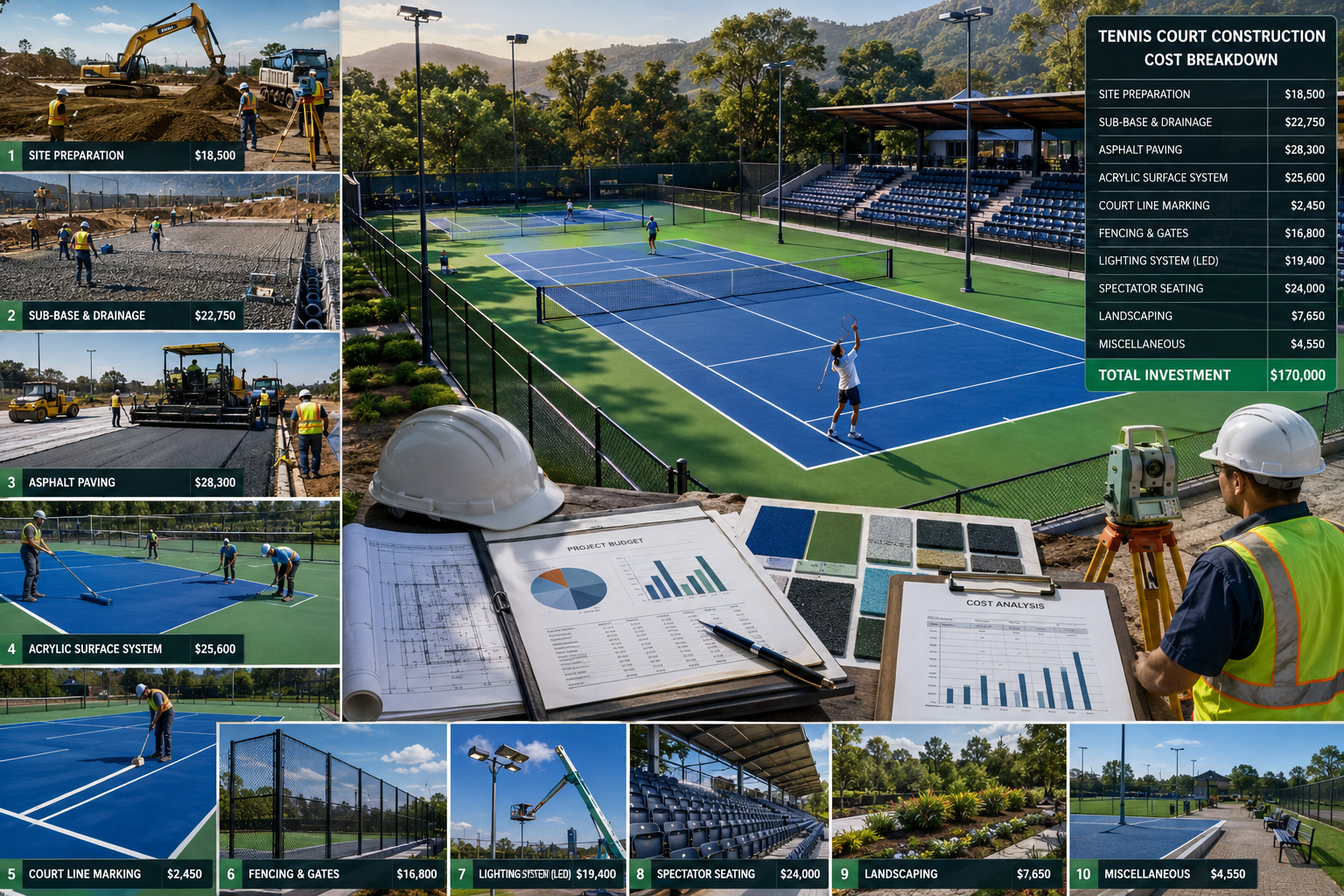
How Much Does Tennis Court Construction Cost?
There is no single construction price that applies to every tennis court project. The cost varies according to the type of playing surface, construction specifications, available land, soil conditions, and additional infrastructure requirements. A simple outdoor tennis court and a professionally developed tournament facility require different levels of investment.
For an accurate tennis court construction cost estimate, the following project components should be evaluated:
- Site location, soil conditions, and ground preparation.
- Standard tennis court dimensions and safety run-off space.
- Foundation design, base thickness, and construction materials.
- Selected tennis court flooring and surface specifications.
- Rainwater drainage and water management systems.
- Perimeter fencing, access gates, and protective netting.
- Sports lighting, electrical installation, and additional amenities.
- Tennis nets, posts, seating, and other court accessories.
- Labour, equipment, transportation, and local construction conditions.
The most reliable way to determine the total tennis court building cost is through a site inspection and detailed bill of quantities. A project-specific quotation helps identify material specifications, construction quantities, installation charges, optional facilities, and additional civil work before construction begins.
Tennis Court Surface Types and Their Construction Costs
Selecting the appropriate playing surface is one of the most important decisions when planning a tennis court. Different surfaces provide different playing characteristics, installation requirements, maintenance needs, and long-term costs.
The ideal tennis court flooring system depends on the intended level of play, project budget, frequency of usage, climatic conditions, and available maintenance facilities. Below are the major tennis court surface options and their cost considerations.
1. Acrylic Tennis Court Construction
Acrylic tennis court flooring is one of the most popular choices for schools, colleges, sports academies, residential communities, sports clubs, and outdoor recreational facilities. These courts generally use specialized acrylic sports coatings installed over a properly prepared concrete or asphalt base.
Acrylic hard courts provide a uniform playing surface, consistent ball response, attractive colour combinations, and customizable surface textures. They are suitable for recreational and competitive tennis facilities when designed and installed according to the required specifications.
Key Features:- Consistent ball response and playing characteristics.
- Multiple colour combinations and professional line marking.
- Suitable for outdoor recreational and competitive facilities.
- Relatively straightforward routine maintenance.
- Different surface texture and cushioning options.
Cost Considerations: Acrylic tennis court construction costs depend on base preparation, concrete or asphalt specifications, acrylic coating quality, cushioning layers, surface preparation, and installation requirements.
2. Clay Tennis Court Construction
Clay tennis courts offer a traditional playing experience and are commonly associated with slower ball movement, longer rallies, and specialized training environments. Their construction requires suitable court materials, carefully prepared foundations, effective drainage, and an appropriate surface maintenance system.
Key Features:- Traditional tennis playing experience.
- Slower ball movement and longer rallies.
- Suitable for specialized training facilities.
- Supports sliding movements associated with clay surfaces.
- Requires regular grooming and moisture management.
Cost Considerations: Clay court construction costs are influenced by material availability, foundation preparation, drainage, irrigation, surface installation, and recurring maintenance requirements.
3. Natural Grass Tennis Court Construction
Natural grass tennis courts provide a distinctive appearance and a fast playing surface. They are generally considered for premium sports clubs, private properties, and specialized tennis facilities where suitable turf maintenance infrastructure is available.
Key Features:- Natural playing surface with a premium appearance.
- Fast gameplay depending on turf conditions.
- Requires suitable soil and ground grading.
- Proper drainage and irrigation are essential.
- Needs regular mowing and specialist turf management.
Cost Considerations: Natural grass tennis court costs depend on turf establishment, soil preparation, irrigation, drainage, specialized maintenance, and local climatic conditions.
4. Artificial Grass Tennis Court Construction
Artificial grass tennis courts provide a synthetic turf alternative for selected recreational facilities, residential developments, private clubs, and sports complexes. The flooring system should be selected according to tennis-specific playing requirements, turf specifications, and drainage conditions.
Key Features:- Consistent visual appearance throughout the year.
- No routine mowing or natural turf cultivation.
- Different synthetic turf specifications available.
- Requires proper base preparation and installation.
- Maintenance depends on infill, pile, and usage conditions.
Cost Considerations: Artificial grass tennis court construction costs depend on turf quality, backing, infill materials, foundation preparation, drainage, and professional installation.
Important: The cheapest tennis court flooring option at the installation stage may not necessarily be the most economical over its entire service life. Always compare initial construction expenses, maintenance requirements, resurfacing costs, and expected usage before selecting a flooring system.
Tennis Court Flooring Cost Comparison
Different tennis court flooring systems involve different construction and maintenance expenses. The following comparison provides a general overview to help you understand the relative investment requirements of various playing surfaces.
| Tennis Court Surface | Typical Applications | Relative Initial Cost | Maintenance Requirements |
|---|---|---|---|
| Acrylic Hard Court | Schools, clubs, academies, and public courts | Generally Moderate | Cleaning, crack monitoring, and periodic resurfacing |
| Clay Tennis Court | Specialist clubs and training facilities | Project Dependent | Surface grooming, moisture control, and material replenishment |
| Natural Grass Court | Premium clubs and private facilities | Can Be High | Mowing, irrigation, turf repair, and specialist care |
| Artificial Grass Court | Recreational and private sports facilities | Depends on Turf Specification | Cleaning, infill management, and seam inspection |
These categories are indicative and do not represent fixed construction quotations. Actual costs depend on the selected products, installation specifications, site conditions, and project requirements. For an accurate comparison, obtain quotations based on identical court dimensions, foundation work, drainage, flooring scope, and accessories.
Major Factors Affecting Tennis Court Construction Cost in India
The total cost of constructing a tennis court is determined by several interconnected construction components. Understanding these factors helps property owners, educational institutions, sports academies, builders, and facility developers prepare realistic budgets.
1. Site Preparation and Earthwork
The existing condition of the proposed construction site directly affects the project budget. Uneven ground, unsuitable soil, excavation, filling, compaction, and soil stabilization can increase the amount of preliminary work required before the tennis court foundation is installed.
A professional site inspection helps identify ground-related challenges and determine the appropriate preparation method. Proper earthwork creates a stable foundation and reduces the possibility of future settlement and surface irregularities.
2. Foundation and Base Construction
A properly designed foundation is essential for tennis court durability and playing performance. Depending on the selected flooring system and site conditions, the base may be constructed using concrete or asphalt with appropriate thickness and structural specifications.
The quality of the base influences surface stability, drainage performance, and the overall lifespan of the sports flooring. Base construction expenses depend on material specifications, thickness, reinforcement where required, labour, and ground conditions.
3. Drainage and Water Management
Effective drainage is an important component of outdoor tennis court construction. Poor water management can cause waterlogging, surface deterioration, and interruptions to playing activities.
Drainage slopes, channels, collection points, and surrounding ground levels should be planned according to the project location and selected court construction system. The total drainage cost depends on site elevation, rainfall conditions, soil permeability, and drainage design.
4. Tennis Court Flooring Materials
The selected sports flooring system has a significant influence on the overall construction investment. Acrylic coatings, cushioning layers, synthetic turf, clay materials, and natural grass systems have different material and installation requirements.
The quality of materials, coating specifications, thickness, surface texture, and installation techniques should be evaluated before choosing a flooring system. Selecting suitable materials according to the intended level of play can help achieve the required surface performance.
5. Court Dimensions and Available Space
The dimensions of the proposed tennis court influence the quantity of construction materials, surface flooring, fencing, and other infrastructure required. A standard tennis court measures 23.77 metres in length, with a singles playing width of 8.23 metres and a doubles playing width of 10.97 metres.
Additional space is required beyond the playing lines for player movement, safety run-off areas, fencing, and access. Therefore, the total land development cost may be higher than the cost calculated using the playing area alone.
6. Fencing and Protective Enclosures
Perimeter fencing helps contain tennis balls and defines the playing area. Depending on the project requirements, the fencing system may include chain-link mesh, supporting posts, foundations, access gates, and protective netting.
The overall fencing cost depends on the court perimeter, fence height, material quality, post specifications, gate requirements, and installation work.
7. Sports Lighting and Electrical Installation
LED sports lighting can make tennis facilities usable during evening hours and improve the overall functionality of the court. Lighting requirements depend on the intended level of play, illumination uniformity, glare control, and electrical infrastructure.
The cost may include LED floodlights, lighting poles, pole foundations, electrical cables, control panels, and installation charges.
8. Tennis Nets, Posts, and Court Accessories
Additional accessories improve the functionality and usability of a tennis facility. These may include tennis nets, net posts, centre straps, seating arrangements, player shelters, scoreboards, and equipment storage facilities.
The final investment depends on the quality, quantity, and specifications of the accessories selected for the project.
9. Project Location, Transportation, and Labour
Tennis court construction expenses may vary between cities and regions due to differences in labour rates, equipment availability, material transportation, site accessibility, and local construction conditions.
Projects located in remote areas may require additional transportation and logistics arrangements. These factors should be considered while preparing the overall construction budget.
Standard Tennis Court Dimensions and Space Requirements
Before calculating the tennis court construction cost, it is important to finalize the court dimensions and available site area. Standard playing dimensions help ensure correct gameplay, while additional space is required for safe player movement and supporting infrastructure.
| Specification | Standard Measurement |
|---|---|
| Overall Court Length | 23.77 Metres (78 Feet) |
| Singles Court Width | 8.23 Metres (27 Feet) |
| Doubles Court Width | 10.97 Metres (36 Feet) |
| Net Height at Centre | 0.914 Metres (3 Feet) |
| Net Height at Posts | 1.07 Metres (3.5 Feet) |
These measurements describe the playing court and do not represent the total land area required for the facility. Additional space must be considered for run-off areas, fencing, walkways, access, seating, and other amenities. Professional and tournament facilities should follow the applicable governing-body design requirements.
Step-by-Step Tennis Court Construction Process
A systematic construction process helps control material usage, workmanship, project timelines, and overall quality. The exact construction sequence depends on the selected flooring system, site conditions, and project specifications.
-
Site Inspection and Project Planning
The first step involves evaluating the available land, soil conditions, site accessibility, court dimensions, drainage requirements, and intended usage.
-
Design and Cost Estimation
The court layout, flooring system, foundation specifications, drainage arrangements, fencing, and additional facilities are finalized to prepare a project-specific cost estimate.
-
Excavation and Ground Preparation
The site is prepared through excavation, removal of unsuitable materials, filling, grading, and compaction wherever required.
-
Drainage and Foundation Construction
The required drainage infrastructure is installed, followed by the construction of a suitable concrete or asphalt foundation according to the selected flooring system.
-
Tennis Court Surface Installation
The selected acrylic, clay, natural grass, or artificial grass surface is installed using the appropriate construction and application techniques.
-
Court Line Marking and Finishing
Accurate tennis court line markings are completed according to the required playing dimensions and applicable specifications.
-
Fencing, Lighting, and Accessories
Where included in the project, fencing, access gates, LED floodlights, tennis nets, posts, and other accessories are installed.
-
Quality Inspection and Project Handover
The completed facility is inspected for dimensions, surface finish, drainage, line marking, and other agreed project requirements before handover.
How to Plan Your Tennis Court Construction Budget
A well-prepared construction budget should cover every major project component instead of focusing only on the tennis court flooring price. Proper financial planning helps avoid unexpected expenses and ensures that all essential facilities are considered before construction begins.
Tennis Court Construction Budget Checklist
- Land preparation, excavation, and ground stabilization.
- Foundation materials and base construction.
- Drainage infrastructure and water management.
- Sports flooring materials and installation charges.
- Court surface finishing and line marking.
- Perimeter fencing and access gates.
- Lighting poles, LED floodlights, and electrical work.
- Tennis nets, posts, and additional accessories.
- Walkways, seating, landscaping, and access arrangements.
- Transportation, labour, machinery, and equipment charges.
- Applicable taxes and clearly identified additional expenses.
- Contingency allowance for unforeseen site conditions.
Tips for Reducing Tennis Court Construction Expenses
Reducing tennis court construction expenses does not mean compromising on essential construction quality. A well-planned project can help control the budget while maintaining appropriate playing conditions and long-term durability.
- Select a flooring system according to actual playing requirements.
- Evaluate soil and drainage conditions before beginning construction.
- Finalize court dimensions and layout before material procurement.
- Compare quotations using identical material specifications.
- Include essential infrastructure in the initial project plan.
- Choose suitable materials instead of focusing only on the lowest price.
- Plan regular maintenance to reduce avoidable repair expenses.
Request a detailed quotation that identifies the scope of work, materials, specifications, installation charges, exclusions, payment milestones, estimated completion time, and warranty conditions. This makes it easier to compare different tennis court construction companies.
Why Choose Sports Facility India for Tennis Court Construction?
Sports Facility India provides sports infrastructure and tennis court construction solutions for clients planning recreational, educational, and commercial sports facilities. Our approach focuses on understanding individual project requirements, evaluating site conditions, and identifying suitable construction and flooring options.
Whether you are developing a tennis court for a school, college, sports academy, residential township, private property, or commercial sports complex, project planning should consider the available space, intended playing level, construction specifications, and overall investment.
Our Key Service Advantages
- Project-Specific Planning: Construction recommendations based on site conditions, available space, and intended usage.
- Flooring Selection Guidance: Assistance in comparing suitable acrylic, clay, natural grass, and artificial grass court systems.
- Construction Coordination: Planning of ground preparation, foundation work, drainage, surface installation, and court accessories according to the agreed project scope.
- Budget Transparency: Project quotations that identify major construction components and optional facilities.
- Customized Solutions: Sports court development solutions for educational institutions, academies, clubs, residential communities, and private facilities.
- Project Enquiries Across India: Contact our team to discuss your construction location, site requirements, and service availability.
A professionally planned tennis court can provide a functional environment for recreational activities, sports training, and organized play. The right construction solution depends on your project objectives, available budget, and long-term facility requirements.
Applications of Tennis Court Construction Projects
Tennis courts are developed for different types of sports infrastructure projects. The construction budget and facility specifications vary depending on the intended users, frequency of play, and level of sports activities.
- Schools and Educational Institutions
- Colleges and Universities
- Professional Sports Academies
- Government Sports Facilities
- Sports Stadiums and Complexes
- Tennis Training Centres
- Residential Townships
- Housing Societies and Apartments
- Private Villas and Properties
- Hotels and Resorts
- Sports Clubs and Recreation Centres
- Commercial Sports Facilities
Tennis Court Construction Cost and Services Across India
Tennis court construction costs can vary across different Indian cities due to local labour rates, construction materials, transportation, site accessibility, soil conditions, and project specifications. A detailed location-based assessment is important for preparing an accurate construction budget.
Sports Facility India welcomes project enquiries from Delhi, Noida, Gurugram, Ghaziabad, Faridabad, Lucknow, Kanpur, Agra, Jaipur, Chandigarh, Ludhiana, Amritsar, Dehradun, Haridwar, Indore, Bhopal, Ahmedabad, Surat, Vadodara, Mumbai, Pune, Nagpur, Nashik, Hyderabad, Visakhapatnam, Vijayawada, Bengaluru, Mysuru, Chennai, Coimbatore, Kochi, Thiruvananthapuram, Bhubaneswar, Ranchi, Patna, Kolkata, Guwahati, Raipur, Jammu, Srinagar, Shimla, Goa, and other locations across India.
If you are planning a tennis court project in any of these locations, contact our team to discuss site conditions, construction specifications, flooring requirements, and project estimates.
Frequently Asked Questions About Tennis Court Construction Cost
Here are answers to common questions about tennis court construction expenses, flooring prices, site requirements, installation procedures, and maintenance costs in India.
1. How much does tennis court construction cost in India?
The cost of tennis court construction in India depends on court dimensions, site preparation, foundation work, drainage, selected flooring materials, fencing, sports lighting, and additional amenities. Flooring-only installation and complete turnkey construction involve different expenses. A site inspection and detailed project quotation are recommended for an accurate estimate.
2. Which tennis court surface is economical to construct?
Acrylic hard courts are often a cost-effective option for outdoor tennis facilities because they provide a consistent playing surface and relatively straightforward maintenance. However, the final cost depends on foundation specifications, acrylic coating quality, site conditions, and installation requirements.
3. What is included in tennis court construction?
Depending on the agreed project scope, tennis court construction may include site preparation, excavation, foundation work, drainage, sports flooring installation, line marking, fencing, access gates, tennis nets, net posts, and lighting. All inclusions should be confirmed in the contractor's quotation.
4. How much land is required for a tennis court?
The standard tennis playing area measures 23.77 metres in length and 8.23 metres in width for singles or 10.97 metres for doubles. Additional space is required for player movement, run-off areas, fencing, walkways, and safe access around the court.
5. Does the project location affect tennis court construction cost?
Yes. Local labour rates, soil conditions, material availability, transportation expenses, site accessibility, and regional weather conditions can affect the overall tennis court construction budget.
6. How long does it take to construct a tennis court?
The construction schedule depends on site preparation, excavation, foundation work, drainage installation, flooring selection, weather conditions, and curing requirements. The contractor should provide a realistic project timeline after evaluating the site and construction scope.
7. What is the maintenance cost of a tennis court?
Tennis court maintenance costs depend on the surface type, usage frequency, environmental exposure, and maintenance schedule. Acrylic courts may require periodic cleaning, crack repairs, and resurfacing, while clay and natural grass courts generally require more frequent surface-specific maintenance.
8. What is the cost of acrylic tennis court flooring?
The cost of acrylic tennis court flooring depends on the selected coating system, surface preparation, number of application layers, cushioning requirements, base condition, and project location. Flooring-only installation should be evaluated separately from complete tennis court construction.
9. Can I get a customized tennis court construction cost estimate?
Yes. You can contact Sports Facility India with your project location, available land dimensions, preferred flooring system, and additional facility requirements to discuss a customized tennis court construction estimate.
10. How can I reduce tennis court construction expenses?
You can manage construction expenses by evaluating site conditions before beginning work, selecting an appropriate flooring system, finalizing the court layout, comparing detailed contractor quotations, and planning essential infrastructure in advance. Avoid compromising on foundation quality, drainage, or material suitability simply to reduce initial expenses.