
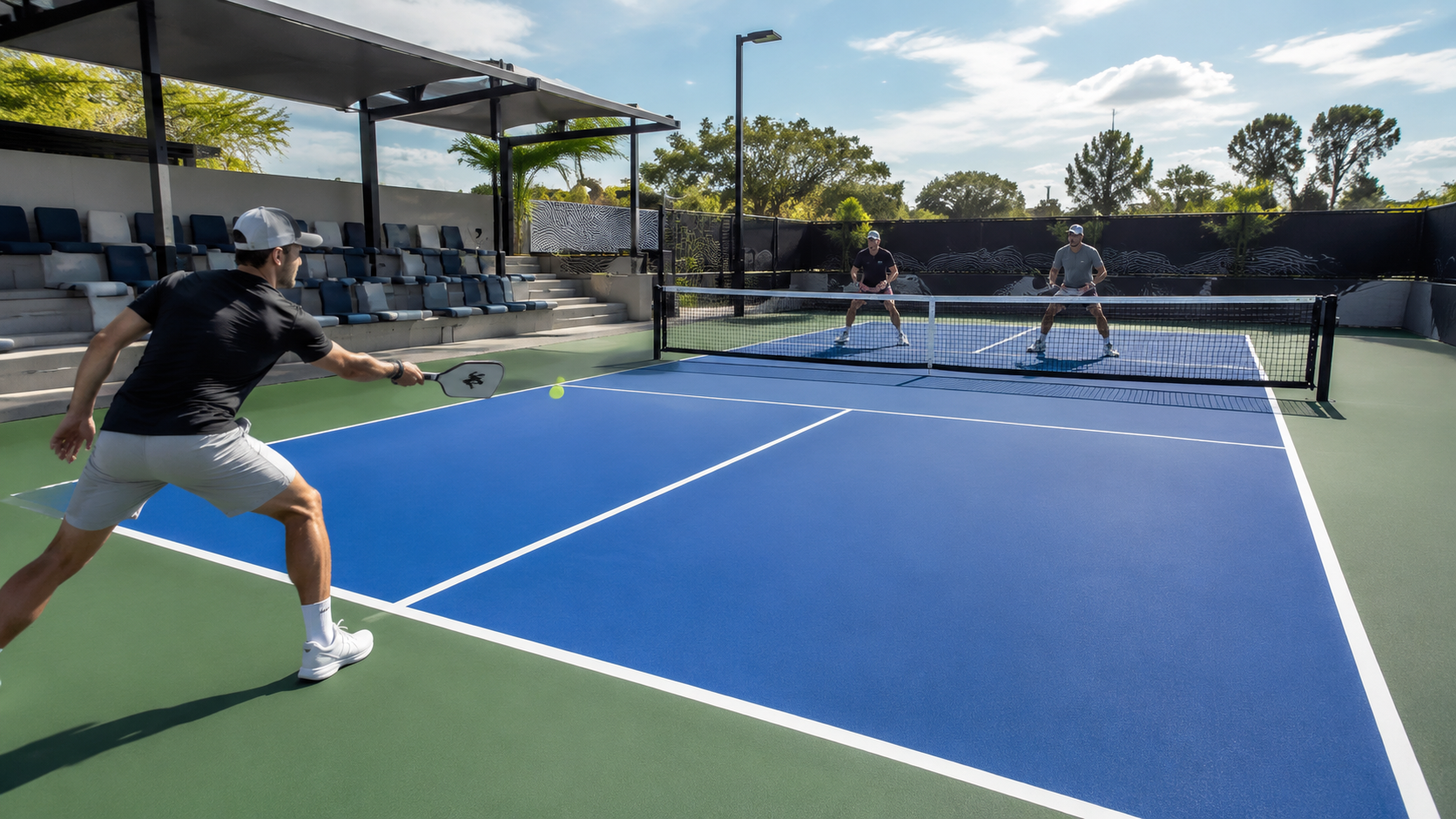
Professional Pickleball Court Flooring and Construction Services
Pickleball combines elements of tennis, badminton, and table tennis, using a solid paddle and a perforated plastic ball. As the sport becomes more popular in recreational and organized sports settings, schools, clubs, housing societies, and sports developers are exploring dedicated pickleball courts.
A well-designed court requires more than a painted playing area. The base must be stable and appropriately levelled, the surface should suit the playing environment, drainage must be addressed for outdoor installations, and the court markings must follow the selected layout.
Sports Facility India offers project-oriented guidance for pickleball court flooring, including surface selection, groundwork coordination, acrylic sports surface options, cushioned systems where appropriate, and court marking. Each proposal should be finalized according to the actual site conditions, material specifications, and project requirements.
Key Elements of a Well-Planned Pickleball Court
- Correct playing dimensions and sufficient surrounding clearance
- Stable, properly prepared court base
- Surface finish suited to the venue and intended use
- Consistent playing characteristics and appropriate traction
- Drainage and weather considerations for outdoor courts
- Clear, accurately positioned court markings
- Suitable lighting and access for the facility
- Practical cleaning and long-term maintenance planning
Why Professional Pickleball Court Construction Matters
Professional pickleball court construction helps coordinate the technical details that influence playing conditions and the long-term performance of the facility. An uneven base, unsuitable coating, poor drainage, or inaccurate markings can affect the court's usability and may lead to avoidable maintenance work.
A planned construction process begins with a site assessment and continues through base preparation, surface installation, line marking, and final inspection. The exact work depends on whether the project involves a new court, an existing concrete or asphalt surface, an indoor sports hall, or an outdoor recreation area.
Benefits of Professional Court Planning
- Accurate court layout and dimensions
- Better control over base preparation and surface finish
- Surface selection based on indoor or outdoor conditions
- Consideration of drainage and weather exposure
- Clear court markings for practice and organized play
- More predictable project scope and installation planning
- Maintenance recommendations suited to the selected system
Best Surface Options for Pickleball Courts
The best pickleball court flooring system depends on the venue, existing base, budget, player requirements, and expected usage. Acrylic sports surfacing is commonly used for outdoor courts, while suitable indoor sports surfaces and cushioned systems can be considered for particular facilities.
Acrylic Pickleball Court Flooring
Suitable for: Many outdoor courts and compatible indoor bases.
Acrylic sports surfacing is a popular choice for hard-court construction. When installed over a suitable base, the system provides a textured finish and allows contrasting colours and clear court lines.
- Available in multiple colour combinations
- Designed for sports court applications
- Can be applied over suitable prepared substrates
- Outdoor performance depends on the complete system and maintenance
Cushioned Sports Flooring
Suitable for: Selected training and high-use facilities.
Cushioned systems incorporate resilient layers beneath the playing surface. Their suitability depends on the product design and whether its playing characteristics meet the requirements of the intended pickleball facility.
- Resilient layers available in selected systems
- Can provide a different underfoot feel
- Options for selected sports facilities
- Requires compatible base and surface materials
Anti-Skid Sports Surface
Suitable for: Courts where the selected system is designed for the playing environment.
Surface texture is an important part of court design. The objective is to provide suitable traction while preserving the playing characteristics required for quick movement and controlled changes of direction.
- Texture selected for the intended application
- Requires suitable substrate preparation
- Indoor or outdoor suitability varies by product
- Routine inspection helps identify wear or surface issues
Multi-Layer Acrylic Court System
Suitable for: Dedicated recreational and competitive courts.
Multi-layer acrylic systems may combine surface preparation, resurfacing materials, texture coats, colour coats, and line marking. The layer arrangement depends on the selected product and substrate.
- Layered construction according to system specification
- Options for contrasting playing colours
- Can be used on compatible hard-court bases
- Requires appropriate curing and installation conditions
Existing Concrete or Asphalt Court
Suitable for: Renovation projects where the existing base is appropriate.
An existing concrete or asphalt area may be converted into a pickleball court if the base is stable and suitable. Cracks, uneven areas, moisture, and drainage must be assessed before surfacing work begins.
- Potential to reuse an existing hard-court base
- Repairs and levelling may be required
- Surface compatibility must be confirmed
- Drainage and slope require careful assessment
Indoor Sports Flooring
Suitable for: Sports halls and indoor recreational facilities.
Indoor courts can use an appropriate sports flooring system selected for the building, substrate, intended activity, and maintenance plan. The surface should be checked for pickleball suitability rather than chosen on the basis of general sports use alone.
- Options for compatible indoor venues
- Base and moisture conditions should be assessed
- Lighting and ceiling clearance need planning
- Product specifications guide cleaning and upkeep
Pickleball Court Flooring System Comparison
Compare systems by their intended application, installation requirements, playing characteristics, and maintenance needs. The lifespan of a court cannot be determined by surface category alone; it depends on the materials, base condition, usage, climate, and upkeep.
| System Type | Potential Application | Key Considerations | Maintenance |
|---|---|---|---|
| Acrylic sports surface | Many outdoor courts and compatible hard-court bases | Base condition, coating system, weather exposure, and texture | Regular cleaning and periodic surface inspection |
| Cushioned system | Selected training and sports facilities | Resilience, stability, product compatibility, and installation requirements | Follow product-specific cleaning and care guidance |
| Textured sports surface | Indoor or outdoor applications approved for the product | Traction, ball response, substrate, and wear | Inspect texture and surface condition regularly |
| Multi-layer acrylic system | Dedicated recreational and competitive courts | Layer build-up, curing conditions, finish, and line marking | Periodic inspection and suitable cleaning |
| Renovated concrete or asphalt base | Existing courts suitable for resurfacing | Cracks, slope, moisture, drainage, and repairs | Depends on the installed surface and existing base |
This comparison is a general planning guide, not a product performance guarantee. Request the selected manufacturer's specifications and maintenance recommendations before choosing a system.
Standard Pickleball Court Dimensions
The standard pickleball playing area measures 20 feet wide by 44 feet long for both singles and doubles. The court includes right and left service areas, a non-volley zone near the net, baselines, and sidelines. Additional space outside the marked court is necessary for player movement, safe access, and practical facility operation.
| Specification | Standard Measurement |
|---|---|
| Playing court length | 44 feet (13.41 metres) |
| Playing court width | 20 feet (6.10 metres) |
| Net height at the sidelines | 36 inches (approximately 91.4 cm) |
| Net height at the centre | 34 inches (approximately 86.4 cm) |
| Non-volley zone | Extends 7 feet (2.13 metres) from the net on each side |
| Recommended overall playing area | 30 feet × 60 feet (approximately 9.14 × 18.29 metres) as a planning guideline |
| Preferred additional playing space | 34 feet × 64 feet (approximately 10.36 × 19.51 metres) where space allows |
The 20 × 44-foot measurement refers to the marked playing court, not the full construction footprint. Site planning should account for run-off space, access, fencing, lighting, and any applicable governing-body or competition requirements. Confirm the current requirements before construction.
Pickleball Court Construction Process
A structured installation process helps ensure that the court layout, base, surface materials, and markings are coordinated. The steps below describe a typical project; the exact sequence varies depending on whether the court is new, being resurfaced, indoors, or outdoors.
- Site inspection and consultation: Assess available space, access, site conditions, intended use, and the project budget.
- Layout and design planning: Confirm court dimensions, surrounding clearances, net location, service areas, and the overall facility layout.
- Groundwork and base preparation: Carry out the required excavation, sub-base preparation, concrete work, asphalt work, or repairs according to the design.
- Level and drainage assessment: Check the base profile and provide appropriate drainage and slope for outdoor construction without compromising the playing surface requirements.
- Surface preparation: Repair defects and prepare the substrate according to the selected coating or flooring system.
- Primer and surface layers: Apply compatible primer, resurfacing, cushioning, or texture layers where required by the chosen product.
- Colour coating and finishing: Apply the specified surface coats and allow the system to cure according to the manufacturer's instructions.
- Court line marking: Mark baselines, sidelines, service areas, and the non-volley zone according to the approved court layout.
- Net and equipment installation: Install suitable net equipment and related accessories as included in the project scope.
- Final inspection and handover: Review the visible finish, line layout, equipment placement, and care requirements before the court is put into use.
Indoor vs Outdoor Pickleball Court Construction
Indoor and outdoor pickleball courts have different design considerations. Outdoor projects must account for weather, drainage, sunlight, and temperature changes. Indoor projects need a suitable building, a compatible substrate, sufficient clearance, lighting, and appropriate ventilation where relevant.
| Consideration | Indoor Pickleball Court | Outdoor Pickleball Court |
|---|---|---|
| Weather exposure | Protected from direct outdoor weather | Directly affected by local climate unless covered |
| Base requirements | Stable, level, and compatible with the flooring system | Stable base with appropriate drainage and outdoor detailing |
| Surface selection | Suitable indoor sports flooring or compatible court system | Weather-suitable acrylic or another approved outdoor system |
| Lighting | Indoor lighting design and glare control | Outdoor lighting design, where required |
| Maintenance considerations | Dust, indoor moisture, surface wear, and cleaning | Rain, leaves, dust, sunlight, drainage, and surface wear |
| Additional planning | Ceiling clearance, access, ventilation, and building use | Weather exposure, fencing, drainage, and surrounding clearance |
Features of a Well-Designed Pickleball Court
Consistent Playing Surface
A properly prepared and maintained surface helps provide consistent conditions across the playing area.
Suitable Traction
Surface texture should be selected for the intended playing environment and product specifications.
Accurate Court Markings
Clear lines help players identify the boundaries, service areas, and non-volley zone.
Weather-Aware Design
Outdoor court design should consider drainage, sun exposure, local climate, and compatible materials.
Colour Customization
Selected court systems allow different colour combinations while maintaining clear contrast between playing areas and lines.
Practical Maintenance
A suitable cleaning routine and periodic inspections help identify wear, cracks, coating defects, and other issues.
How to Choose the Right Pickleball Court Flooring System
Selecting a pickleball court surface involves more than comparing the initial material price. Consider the expected usage, playing conditions, installation requirements, and maintenance over the life of the facility.
- Define the purpose: Decide whether the court is for casual recreation, club play, regular training, or organized competition.
- Evaluate the site: Check the available footprint, existing substrate, drainage, access, and surrounding conditions.
- Choose a compatible surface: Confirm that the product is intended for the proposed indoor or outdoor use.
- Review playing characteristics: Consider traction, surface texture, ball response, and any cushioning requirements.
- Check the installation specification: Ask about preparation, coating layers, curing, weather limitations, and line marking.
- Plan for maintenance: Understand cleaning methods, periodic repairs, resurfacing requirements, and warranty conditions.
- Compare total project cost: Include civil work, drainage, surface materials, labour, equipment, transport, and finishing.
Factors Affecting Pickleball Court Construction Cost in India
Pickleball court flooring and construction costs vary according to the site and the scope of work. A quotation should account for the complete project rather than only the visible playing surface.
- Playing court dimensions and total site area
- New construction versus renovation of an existing court
- Excavation, sub-base, concrete, or asphalt requirements
- Base repairs, levelling, and drainage work
- Acrylic, cushioned, or other selected surface system
- Surface preparation, primers, coating layers, and finishing
- Colour selection and line marking
- Net systems, fencing, lighting, and other accessories
- Site location, transport, labour, and access conditions
- Installation schedule and project-specific requirements
For an accurate estimate, share the project location, court dimensions, existing site condition, preferred flooring type, and whether you need flooring alone or complete court construction.
Applications of Pickleball Court Flooring
Pickleball courts can be developed in a variety of recreational and sports environments. The design and surface system should be selected according to the facility's users, available space, usage schedule, and operating requirements.
Schools and Colleges
Courts for physical education, student recreation, and organized sports activities.
Sports Clubs and Academies
Dedicated playing areas for club members, training sessions, and recreational programmes.
Residential Communities
Shared sports spaces for residents, community recreation, and social activities.
Hotels and Resorts
Recreational sports amenities planned around available outdoor or indoor space.
Indoor Sports Complexes
Courts integrated into suitable multi-purpose halls and dedicated sports facilities.
Private and Commercial Facilities
Pickleball amenities for private users, sports operators, and recreational businesses.
Why Choose Sports Facility India for Pickleball Court Flooring?
Sports Facility India provides sports flooring and facility solutions tailored to project requirements. We help clients consider the site, court layout, surface options, installation scope, and maintenance needs when planning a new pickleball court or upgrading an existing playing area.
- Project consultation: Discuss your court requirements, available space, and intended use.
- Surface selection support: Explore suitable flooring options based on the venue and product specifications.
- Construction planning: Coordinate the required base work, surface preparation, and installation stages.
- Court layout assistance: Plan dimensions, clearances, line marking, and equipment placement.
- Indoor and outdoor project planning: Consider the different technical needs of protected and weather-exposed courts.
- Budget-focused recommendations: Evaluate the materials and work required for your project scope.
- Maintenance guidance: Review the care instructions relevant to the selected flooring system.
- Project coordination: Discuss site readiness, installation scheduling, and handover requirements.
Every court is different. Our objective is to help you identify an appropriate solution for your site, playing requirements, and available budget rather than applying the same flooring specification to every project.
Frequently Asked Questions About Pickleball Court Flooring
1. What is included in professional pickleball court construction?
Depending on the project scope, pickleball court construction can include site assessment, base preparation, leveling, surface installation, line marking, finishing, and final inspection.
2. What is the standard size of a pickleball court?
The playing court measures 20 feet by 44 feet for both singles and doubles. Additional space is needed around the court for safe movement, access, and facility layout.
3. Which surface is best for a pickleball court?
Acrylic sports surfacing is a common option for outdoor pickleball courts and suitable indoor facilities. Cushioned systems may be considered where additional comfort is desired. The best option depends on the base, venue, usage, climate, and product specifications.
4. How much does pickleball court flooring cost in India?
The cost depends on court dimensions, base construction, surface system, cushioning, drainage, line marking, site location, and installation requirements. A project-specific quotation should be based on the site and selected materials.
5. Can a pickleball court be built indoors and outdoors?
Yes. Pickleball courts can be planned for indoor or outdoor use. Outdoor projects need appropriate drainage and weather-suitable materials, while indoor projects require a suitable base, adequate clearance, lighting, and a compatible surface system.
6. How long does pickleball court flooring last?
The service life depends on the flooring product, base condition, installation quality, usage, climate, and maintenance. Follow the selected manufacturer's technical guidance rather than relying on one lifespan estimate for every system.
7. Can pickleball court colours and markings be customized?
Yes. Court colours and certain design details can often be customized. Playing lines should remain clear and follow the applicable court layout and competition requirements.
8. Does Sports Facility India offer pickleball court construction services?
Sports Facility India provides sports flooring and facility solutions. Contact the team with your project location, court dimensions, preferred surface, and construction requirements to discuss scope and availability.
Related Sports Flooring and Construction Services
Planning additional sports infrastructure? Contact Sports Facility India to discuss your flooring requirements and the scope of your next project.
Build Your Pickleball Court with Sports Facility India
Planning a new pickleball court or upgrading an existing surface? Contact Sports Facility India to discuss court dimensions, acrylic flooring, suitable sports surface systems, base preparation, and installation requirements. Share your location and project details to begin planning.
Request a Project QuoteCall us: +91-8009483311